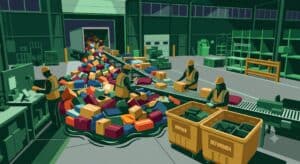
It’s 2 AM on a Saturday. Peak week starts Monday.
A sorter goes down. Not the entire system — just one zone, but it feeds your outbound shipping lanes. Your on-call technician is 90 minutes out. The part you need is sitting in a warehouse in another state. By the time the system comes back up, six hours have passed, two outbound trucks are gone, and your labor cost has doubled.
Here’s what makes it worse: this wasn’t a surprise. The wear pattern on that sorter had been building for months. A scheduled preventive maintenance visit would have caught it. Nobody scheduled one.
With unplanned downtime averaging $86 a minute, that six-hour outage didn’t cost a repair bill. It cost over $30,000 before anyone touched a wrench.
Reactive Maintenance Doesn’t Just Cost You a Repair Bill
The repair invoice is the smallest number in a reactive maintenance event. Three costs dwarf it, and none of them show up on the service ticket.
Throughput loss
Every hour a sortation system is down during peak can mean thousands of units stuck in queue, missed carrier pickups, and SLA penalties no repair bill accounts for. The repair is a line item; the missed trucks are a customer conversation.
Emergency parts premiums
When a critical component fails without warning, expedited freight and after-hours sourcing can multiply your parts cost three or four times over what a scheduled program would have paid for the same component. Same photo eye, same motor — triple the price, because it’s 3 AM and it’s in another state.
The damage that doesn’t announce itself
Power events, hard jams, and surge loads create secondary damage that doesn’t always show up right away. A system that came back up after an outage may be running, but not at full health — and the next failure is already building.
That last one deserves emphasis, because it’s the trap most operations fall into: “it came back up” is not the same as “it’s fine.” One means the system is running. The other means you understand what it took to get there and you have a plan to keep it running.
What a Preventive Maintenance Program Actually Looks Like
Century’s maintenance program is built around one principle: the best service call is the one you scheduled, not the one you had to make at midnight. Our field teams operate coast to coast, with experience across major conveyor brands and control systems — so we know what breaks, and when. Three components do the heavy lifting.
Scheduled PM visits tied to your duty cycle
Conveyor maintenance frequency should follow how hard the system works, not a calendar default. Operations running around the clock receive a minimum of four preventive maintenance visits per year. Each visit is a structured inspection of wear patterns — belts, bearings, photo eyes, sortation components — so failures get caught as line items on a schedule instead of emergencies on a Saturday.
Rapid response with remote diagnostics
Unplanned events still happen; a good program shrinks them. When something goes down, remote VPN diagnostics let our technicians identify the issue before a truck ever rolls — often turning a 90-minute drive plus diagnosis into a phone call plus a targeted dispatch with the right part on board.
Critical parts on hand
Known critical parts, stocked for your specific system. No scrambling for a photo eye or a motor at 3 AM when your operation can’t wait for next-day freight. The parts list comes out of the PM program itself: what’s wearing tells you what to shelve.
How to Tell Which Side of the Line You’re On
A quick self-assessment. If more than a couple of these are true, you’re running a reactive operation whether you call it that or not:
- Your last three service calls were emergencies, not scheduled visits
- You don’t have a documented critical-spares list for your system
- Nobody can say when each zone was last formally inspected
- A system that “came back up” after an event was never fully assessed afterward
- Peak-season planning doesn’t include a pre-peak equipment review
None of these are equipment problems. They’re program problems — and program problems are the cheap kind to fix, because the fix is a decision, not a capital project.
Before Peak Arrives, Schedule a Service Review
The difference between planned and reactive is one phone call — the question is whether you make it before the failure or after.
A service review looks at what you have, what’s wearing, and what you should have on the shelf before you need it. No commitment required — just a clear picture of where your operation stands before peak makes the assessment for you.
Have a specific maintenance question or want to talk through your current service program? Reach out to Rick directly.
Rick Maldonado, Business Development Manager (908) 205-0625 | rmaldonado@centuryconveyor.com
Want articles like this in your inbox? Sign up for the Century email blast.