A gravity roller conveyor can be a practical way to move cartons, packages, totes, and other products through a warehouse without relying on a motor to propel every item. For operations looking to improve material flow while keeping certain areas of a facility simple and efficient, gravity conveyor technology can serve an important role.
Century Conveyor Systems approaches conveyor equipment as part of a larger material handling strategy rather than as an isolated piece of machinery. Its gravity and live roller conveyor solutions can be incorporated into packing lines, divert areas, extendable applications, end-of-line operations, staging areas, and broader order fulfillment systems.
The following FAQ explains what a gravity roller conveyor is, where it can be useful, and why the way it is integrated into an overall warehouse system matters.
Table of Contents
What is a gravity roller conveyor?
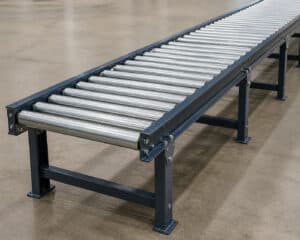
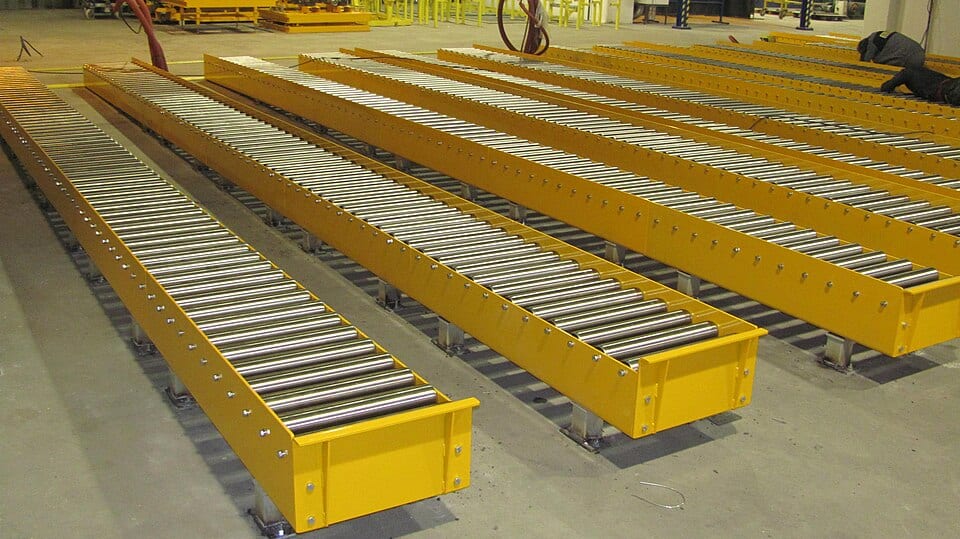
A gravity roller conveyor is a roller-based material handling system that moves products without using a motor to drive the rollers.
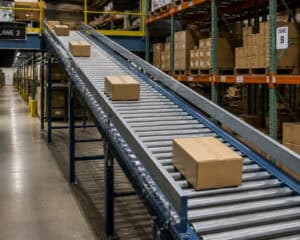
Instead of relying on powered transportation, products move along the conveyor through gravity, generally with the conveyor positioned to provide the appropriate flow, or through manual interaction from warehouse personnel. The rollers create a surface that allows cartons, packages, totes, and other suitable products to travel from one point to another.
The major distinction between a gravity roller conveyor and a powered live roller conveyor is therefore the source of movement. Live roller conveyors use powered rollers, while gravity conveyors do not require a motor to propel products.
This relatively straightforward operating principle makes gravity conveyors useful in areas where continuous powered transportation is unnecessary. Rather than installing powered equipment everywhere in a facility, warehouse operators can use gravity where it makes operational sense and reserve powered automation for areas where controlled transportation, higher throughput, or more complex product movement is required.
Why would a warehouse choose a gravity roller conveyor instead of a powered conveyor?
The biggest reason is that not every product movement task requires powered transportation.
A warehouse may have areas where products only need to travel a relatively straightforward path between workstations, packing areas, staging locations, or shipping operations. In those situations, a gravity roller conveyor can provide a practical method of moving products without adding a motorized conveyor section.
That distinction can also make gravity equipment particularly useful in operations where employees interact directly with the product. Century Conveyor Systems identifies gravity and live roller conveyors as solutions commonly used in packing lines, divert lines, extendable applications, and end-of-line operations. These are environments where product handling may involve a combination of conveyor movement and manual induction, packing, loading, or staging.
The value is therefore not simply that a gravity roller conveyor does not use a motor. Its value comes from matching the technology to the job.
A well-designed warehouse does not necessarily need the same conveyor technology throughout the entire building. One section may require powered movement, another may require accumulation, and another may benefit from gravity. Using the appropriate technology at each point can create a more balanced material handling system.
Where can Century Conveyor Systems’ gravity roller conveyor solutions be used?
Gravity roller conveyors can be particularly useful in sections of a facility where products need to move between operational steps without requiring fully powered transportation.
For example, Century identifies several applications where gravity and live roller conveyors can be used, including packing lines, divert lines, extendable conveyor applications, and end-of-line operations.
Packing areas are one example. Products can arrive at a packing workstation and move along a conveyor as employees complete their work. A gravity section can provide a straightforward way to move products through an area where manual interaction remains an important part of the process.
End-of-line operations are another potential application. Products that have completed processing may need to move into staging or shipping areas. Gravity conveyor equipment can provide a simple material flow path where the requirements do not justify powered transportation throughout the entire section.
Gravity conveyor technology can also be used alongside other conveyor types. This is important because a modern fulfillment facility may have multiple material handling requirements within a single workflow. Rather than treating every conveyor section identically, an integrator can determine which technology makes sense for each part of the operation.
How does a gravity roller conveyor fit into an order fulfillment system?
A gravity roller conveyor can function as one component of a much larger order fulfillment system.
Order fulfillment involves numerous stages, including receiving, storage, picking, transportation, packing, labeling, sortation, and shipping. Products may need to move between each of these processes, but the transportation requirements are not necessarily identical at every stage.
Century Conveyor Systems describes conveyors as the backbone of automated warehouse operations and emphasizes engineering the conveyor layout around the functions performed in a particular facility. That means a gravity roller conveyor does not have to compete with powered conveyor equipment. The two can work together.
For example, powered conveyors can provide transportation where products need consistent automated movement, while gravity sections can be incorporated into packing, staging, or end-of-line areas where manual interaction is expected.
This approach can help prevent a common material handling mistake: selecting equipment based solely on the individual conveyor rather than considering how it interacts with everything around it.
A gravity roller conveyor may be highly effective in one part of a facility and inappropriate in another. The objective is to build a system in which each section supports the overall flow of products.
What products can move on a gravity roller conveyor?
The appropriate product depends on the conveyor’s design and the characteristics of the items being handled.
Gravity roller conveyors are generally associated with products that can travel across a roller surface effectively, including cartons, packages, totes, and other packaged goods. The item’s dimensions, weight, shape, bottom surface, and handling requirements all influence whether gravity rollers are an appropriate choice.
This is why product information should be considered before selecting a conveyor.
A rigid, stable carton may move effectively across rollers, while an irregularly shaped or unusually flexible product may require a different conveying surface. Similarly, products that require very precise spacing or controlled movement may be better suited to powered or specialized conveyor technologies.
Century’s broader material handling capabilities include belted conveyors, modular belt conveyors, pallet conveyors, conveyor diverts, accumulation systems, and other technologies. Having multiple options is important because the right conveyor depends on the characteristics of the product as well as the process in which it will be used.
Is a gravity roller conveyor suitable for every warehouse?
No. A gravity roller conveyor is best viewed as one option within a larger material handling toolbox.
Gravity technology can be an excellent fit when products can move effectively through the conveyor section and when the operational process does not require constant powered propulsion. However, facilities with high-throughput transportation requirements, specialized product handling needs, complex accumulation requirements, or processes requiring highly controlled movement may need other technologies.
For example, a powered conveyor may be preferable when products need to move automatically across a facility regardless of elevation or when consistent powered transportation is required.
Similarly, belt conveyors can provide advantages for certain small, irregular, or lightweight packages because the belt creates a more continuous conveying surface. Accumulation conveyors can be appropriate when products need to queue while maintaining separation or controlling product contact.
The key question is therefore not whether a gravity roller conveyor is “better” than another conveyor. The better question is whether it is the correct technology for a particular section of the workflow.
What makes Century Conveyor Systems’ approach to gravity conveyors different?
One of the most important distinctions is Century Conveyor Systems’ systems-level approach.
Century describes itself as a full-service material handling automation integrator. Its work extends beyond supplying individual conveyor sections to include system design, engineering, validation, installation, startup support, and ongoing service.
That matters because a conveyor’s performance depends heavily on its surroundings.
The layout of a warehouse affects product flow. Workstations affect how employees interact with products. Sortation equipment determines where products go next. Storage systems influence where inventory originates. Controls and automation influence how the entire operation is coordinated.
A gravity roller conveyor that appears appropriate when considered by itself may not be the best choice if it creates a bottleneck somewhere else in the process.
Century’s approach is to consider the warehouse as an interconnected system. Gravity conveyor technology can therefore be evaluated alongside powered conveyors, sortation equipment, robotics, pallet handling, controls, storage systems, and other solutions.
For customers, this means the goal is not simply to install a gravity conveyor. The goal is to determine where gravity conveyor technology can contribute to a more efficient material handling operation.
Can a gravity roller conveyor be combined with other automation?
Yes. In fact, combining different technologies can be one of the most effective ways to design a warehouse material handling system.
A facility may use gravity conveyor sections in areas where products are manually packed or staged while using powered conveyors to transport products across longer distances. Diverts can direct cartons toward different destinations, while accumulation equipment can manage product spacing and flow. Robotics, controls, and other automation technologies can be incorporated where they provide additional value.
Century Conveyor Systems offers a broader portfolio that includes conveyor systems, robotic order fulfillment, conveyor diverts, zero- and minimum-pressure accumulation, pallet conveyors, controls, and other material handling technologies.
This makes it possible to view the gravity roller conveyor as one component of a larger architecture.
That flexibility can be especially valuable as warehouses grow. An operation may begin with relatively straightforward material movement and later require additional automation because order volume, SKU variety, labor requirements, or customer expectations change. Designing the original system with future requirements in mind can help avoid creating an inflexible material flow process.
What should a company consider before selecting a gravity roller conveyor?
The most important consideration is the entire material flow—not just the conveyor itself.
Before selecting a gravity roller conveyor, a company should consider what products will be moved, where they need to travel, how much product must move through the area, how employees will interact with the products, how much floor space is available, and what other conveyor or automation equipment will connect to the system.
It is also important to consider future requirements.
A conveyor system designed exclusively around today’s volume may become a constraint if order volume increases substantially. Likewise, a system that works well for one product mix may need modification if a business introduces new package sizes, heavier products, or additional fulfillment processes.
Century’s approach emphasizes designing and integrating systems around operational goals rather than simply installing standardized equipment. That makes the planning stage particularly important.
The best gravity roller conveyor installation is not necessarily the largest or most technologically advanced option. It is the one that performs the required task efficiently while fitting naturally into the larger material handling process.
Why consider Century Conveyor Systems for a gravity roller conveyor project?
A gravity roller conveyor can be a relatively simple piece of material handling equipment, but determining where and how it should be used can require a broader understanding of warehouse operations.
Century Conveyor Systems brings gravity conveyor technology into a larger automation and material handling strategy. The company works with shipping warehouses, distribution centers, and fulfillment facilities and provides engineering, system integration, installation, startup support, and service.
That systems-oriented approach can be valuable for companies that are not simply looking for an individual conveyor section but are trying to improve how products move throughout an entire facility.
The right solution may ultimately include gravity roller conveyor sections, powered conveyors, sortation, accumulation, robotics, pallet handling, controls, or other technologies. The important consideration is how those technologies work together to support throughput, reduce unnecessary manual handling, improve product flow, and accommodate future operational needs.
What is the main takeaway about Century Conveyor Systems’ gravity roller conveyor?
The main takeaway is that a gravity roller conveyor can be a highly practical component of a warehouse or fulfillment operation when it is applied to the right material flow challenge.
Its motor-free design makes it particularly relevant for applications where products can move through a conveyor section using gravity or manual interaction. Century Conveyor Systems identifies packing lines, divert lines, extendable applications, and end-of-line operations among the areas where gravity and live roller conveyors can be useful.
However, the real advantage comes from putting the technology into the right place.
Century approaches conveyor projects as complete material handling systems rather than isolated equipment purchases. By evaluating gravity conveyors alongside powered conveyors, sortation, accumulation, robotics, pallet handling, controls, and other technologies, a facility can develop a material flow strategy that is better aligned with its products, processes, throughput requirements, and long-term goals.
For a warehouse considering a gravity roller conveyor, the best starting point is therefore a simple question: Where can gravity improve product flow without adding unnecessary complexity?
Once that question is answered, the gravity roller conveyor can be evaluated as part of a larger system designed to make the entire operation more efficient.