When warehouses and distribution centers need to move heavy loads efficiently, a pallet conveyor can become a critical part of the material handling system. Pallets are fundamentally different from cartons, totes, polybags, and other smaller unit loads: they are heavier, larger, and often require equipment designed specifically for stable, controlled movement.
Century Conveyor Systems approaches pallet handling as part of a broader warehouse automation strategy. Rather than treating a pallet conveyor as an isolated piece of equipment, Century designs conveyor and material handling systems around the requirements of the facility, the products being moved, the desired throughput, and the level of automation required.
Below are some of the most important questions businesses should ask when evaluating a pallet conveyor from Century Conveyor Systems.
Table of Contents
What is a pallet conveyor?
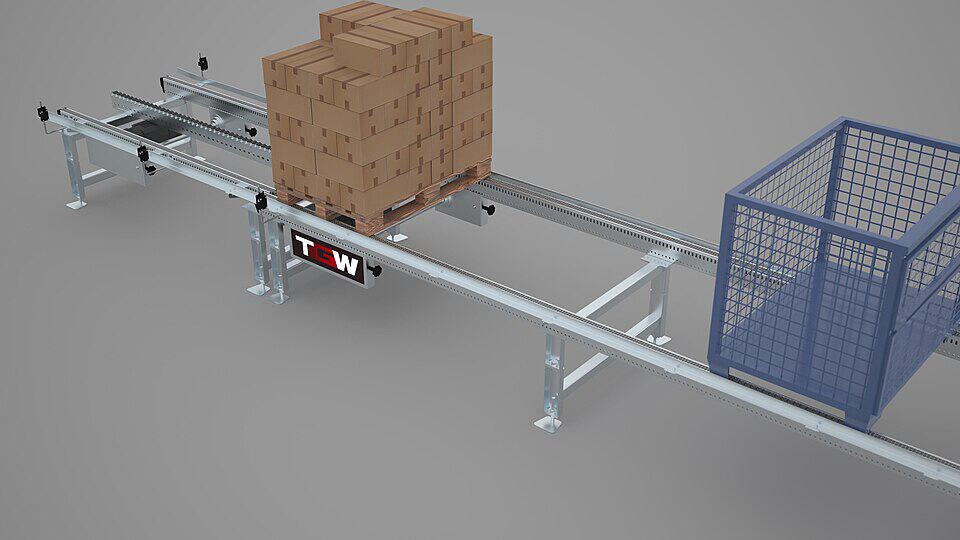
A pallet conveyor is a material handling conveyor specifically designed to transport pallets and other heavy or oversized loads through a warehouse, distribution center, manufacturing facility, or fulfillment operation.
Unlike conveyors designed primarily for cartons or small packages, pallet conveyor systems are built around the dimensions, weight, construction, and handling characteristics of palletized products. Depending on the application, the conveyor may use chains, rollers, gravity, or other mechanisms to move and position the load.
Century Conveyor Systems identifies several pallet conveyor configurations, including pallet drag chain, pallet gravity, chain-driven live roller, and Poly-V conveyor sections. The appropriate configuration depends on factors such as pallet weight, load characteristics, required throughput, accumulation requirements, and how the conveyor needs to interact with other equipment.
The important point is that “pallet conveyor” does not describe one universal machine. It is a category of material handling equipment that can be engineered in different ways to suit a particular operation.
Why would a warehouse need a pallet conveyor?
The primary reason to use a pallet conveyor is to create a reliable method for transporting palletized loads without depending entirely on manual movement or lift trucks.
In a busy distribution environment, pallets may need to travel between storage, picking, staging, production, packaging, shipping, or other operational areas. Moving every pallet manually can introduce additional labor requirements and create unnecessary traffic throughout the facility.
A properly engineered pallet conveyor can establish a predictable transportation path. It can also become one component of a larger automated material handling system.
Century describes warehouse conveyor systems as the backbone of automated operations because they can provide continuous movement for processing, sortation, and distribution. Pallet handling can therefore be integrated into the larger flow of a facility instead of functioning as a disconnected transportation task.
This distinction matters when evaluating automation. The objective isn’t simply to purchase a conveyor that moves a pallet from Point A to Point B. The objective is to create a material flow that supports the overall operational goals of the warehouse.
What types of pallet conveyor does Century Conveyor Systems offer?
Century’s pallet conveyor solutions include several configurations designed for different load-handling requirements.
Pallet drag chain conveyor
A pallet drag chain conveyor supports pallets and oversized loads on a platform connected to a chain. When the chain is activated, it moves the platform along the conveyor section.
This type of conveyor can be useful when a heavy load requires a robust method of transportation and the application calls for chain-driven movement.
Pallet gravity conveyor
Pallet gravity conveyor uses gravity rather than a powered drive to move palletized loads. This approach can be particularly useful in staging areas and end-of-line accumulation applications.
Because the conveyor does not rely on a powered motor for every movement, gravity sections can serve a different operational purpose from powered pallet transportation.
Chain-driven live roller conveyor
Chain-driven live roller conveyor is designed for high-output pallet operations. A drag chain drives the rollers, allowing multiple pallets to be transported through the system.
For facilities where pallet throughput is a major consideration, this type of conveyor can provide the powered movement necessary for higher-volume operations.
Poly-V conveyor
Poly-V is a powered live roller conveyor configuration designed for stable, slower-moving bulk products. Century identifies it as suitable for applications involving drums, lighter pallets, and oversized bulk loads.
The variety of configurations illustrates why pallet conveyor selection should begin with an analysis of the application rather than simply choosing a conveyor based on the word “pallet.”
How does Century determine which pallet conveyor is right for a facility?
The right pallet conveyor depends on the characteristics of the material handling application.
Load weight is one of the obvious considerations. A system handling heavy pallets may require a different conveyor configuration from one handling lighter loads.
However, weight is only one part of the decision. Engineers also need to consider how frequently pallets move, how quickly they need to move, whether pallets must accumulate, where they enter and leave the conveyor, and whether the conveyor needs to interface with other automation.
The physical characteristics of the palletized load matter as well. Pallet construction, load dimensions, stability, and the distribution of weight can all influence conveyor selection.
Facility layout is another important factor. A pallet conveyor may need to connect multiple operational zones, accommodate changes in elevation, interface with staging areas, or integrate with other conveyor sections and automation technologies.
Century’s broader approach is centered on system engineering rather than treating equipment as a standalone purchase. The company describes its role as a full-service integration process covering system design, validation, implementation, installation, startup support, and ongoing parts and service.
That approach is particularly important for pallet conveyor projects because the conveyor’s performance depends on how well it fits into the rest of the material handling system.
Can a pallet conveyor be part of a larger automated warehouse system?
Yes. A pallet conveyor can serve as one component within a much larger automated material handling environment.
Modern distribution facilities often combine multiple technologies rather than relying on one type of equipment. Conveyors can work alongside controls, sortation equipment, robotic systems, storage solutions, and warehouse software.
Century’s capabilities include conveyor systems, sortation conveyors, robotic fulfillment, robotic palletizing, controls and software, storage modules, and conveyor service and parts.
This creates opportunities to design pallet movement as part of an integrated workflow.
For example, a pallet may need to move from an inbound area to a storage or processing area, later travel toward an order fulfillment operation, and ultimately reach shipping. Different pieces of equipment may be responsible for different stages of that process.
The conveyor becomes the transportation infrastructure connecting those stages.
That system-level perspective can be especially valuable when a warehouse is looking beyond basic conveyor installation and toward broader automation.
Can pallet conveyors reduce manual material handling?
A pallet conveyor can reduce the amount of manual transportation required within an appropriate application, particularly when pallet movement occurs repeatedly along predictable routes.
Instead of requiring an employee or lift truck to perform every transportation task, conveyor equipment can automate movement between designated points.
Reducing manual transportation can have several potential operational benefits. It can free employees to focus on tasks that require human decision-making or interaction, reduce unnecessary travel within the facility, and create more consistent material flow.
However, the goal should not necessarily be to eliminate people from the process. Effective warehouse automation is about assigning the right tasks to the right combination of people and technology.
Century’s stated approach to automation focuses on increasing output and lowering labor costs through automation while engineering systems around the specific needs of the facility.
A pallet conveyor can therefore be viewed as a tool for improving the overall division of labor within a warehouse.
How does pallet conveyor equipment affect warehouse throughput?
Throughput is one of the most important reasons to consider a pallet conveyor.
When pallet transportation depends on manual processes, the movement of goods can be influenced by labor availability, travel distance, congestion, equipment availability, and competing priorities.
A conveyor establishes a defined transportation path and can move loads continuously or according to programmed controls.
For high-output pallet operations, Century specifically identifies chain-driven live roller conveyors as a suitable configuration because they can move multiple pallets using a drag chain to operate the rollers.
But higher throughput isn’t simply a matter of making a conveyor move faster. A system also needs appropriate accumulation, spacing, transfers, controls, and downstream capacity.
If one section of the warehouse can process 100 pallets per hour but another section can only handle 50, increasing the speed of the first conveyor won’t necessarily increase the facility’s actual output.
That’s why pallet conveyor design should be approached as a complete material flow problem.
Can a pallet conveyor help with staging and accumulation?
Yes. Pallet conveyors can be configured for applications where pallets need to wait, queue, or accumulate before proceeding to the next operational stage.
Pallet gravity conveyor, for example, can be used in staging areas and end-of-line accumulation applications.
Staging is often overlooked when businesses think about automation. Yet staging can have a major impact on how smoothly a facility operates.
A warehouse may need pallets to temporarily wait for a dock door, production process, shipping operation, picking activity, or downstream conveyor to become available. Without a structured staging strategy, these temporary queues can turn into congestion.
A pallet conveyor can provide a defined physical location for that accumulation and help make pallet flow more predictable.
The appropriate accumulation method depends on the load, available space, required throughput, and how pallets need to enter and leave the accumulation area.
How does a pallet conveyor fit into robotic fulfillment?
Pallet conveyor technology and robotic fulfillment can complement each other, although they address different parts of the material handling process.
Century identifies automated guided vehicles, or AGVs, and autonomous mobile robots, or AMRs, as robotic fulfillment technologies. AGVs can transport pallets, cartons, or non-conveyables along static routes and can be designed to interface with conveyor systems.
That interface is important.
A warehouse doesn’t necessarily have to choose between conveyors and mobile robots. In some applications, conveyors can provide predictable, high-volume transportation along fixed routes while robotic systems provide flexibility where changing routes or variable movement patterns are more valuable.
The resulting system can use each technology where it makes the most sense.
For facilities pursuing more advanced automation, pallet conveyors can therefore remain highly relevant even as robotics become a larger part of warehouse operations.
Is a pallet conveyor suitable for every pallet?
No. Pallet conveyor selection should be based on the actual pallets and loads being handled.
Century notes that different pallet conveyor solutions are available depending on the weight and type of pallet.
This is an important consideration because pallets aren’t necessarily uniform. A facility may handle different pallet materials, dimensions, weights, load configurations, or product types.
The conveyor must be compatible with those characteristics.
Businesses should also consider whether the pallet is loaded consistently or whether load distribution changes from one shipment to another. A pallet carrying a dense, concentrated load may behave differently from a pallet containing lightweight products distributed across its surface.
These details should be addressed during system design.
A conveyor that looks appropriate based only on a photograph or general description may not be appropriate once the actual operating conditions are considered.
What makes Century Conveyor Systems different from simply purchasing conveyor equipment?
Century positions itself as a full-service material handling systems integrator rather than simply an equipment supplier.
That distinction is significant for a pallet conveyor project.
A conveyor may be mechanically sound yet still fail to deliver the expected operational benefits if the layout, controls, interfaces, installation, or surrounding equipment are poorly coordinated.
Century’s services include concepts and design, controls engineering, control panel design and fabrication, mechanical engineering, mechanical installation, electrical installation, project management, project phasing, preventative maintenance, repair, and parts support.
The company also describes a process that extends from system design and validation through installation, startup support, and ongoing service.
For a warehouse investing in pallet conveyor automation, that means the conversation can encompass the entire material handling system rather than stopping at the conveyor itself.
What should a company consider before investing in a pallet conveyor?
A company should begin with the operational problem it wants to solve.
Important questions include:
- How many pallets need to move during normal and peak periods?
- What are the dimensions and weights of the pallets?
- What types of pallets and loads will the system handle?
- Where do pallets enter and leave the process?
- Are pallets being transported, staged, accumulated, sorted, or all of the above?
- How much manual transportation currently occurs?
- Are lift trucks creating congestion or unnecessary travel?
- What other automation already exists?
- Will the facility’s volume increase in the future?
- Does the conveyor need to integrate with robotic systems or warehouse controls?
- What maintenance and service capabilities will be required after installation?
Answering these questions creates a much better starting point than asking only, “How much does a pallet conveyor cost?”
The right system is ultimately determined by the operational requirements.
Can a pallet conveyor be designed for future expansion?
Potentially, yes, provided future requirements are considered during the initial engineering process.
Warehouse automation is rarely static. Product volumes change, customer expectations evolve, facility layouts get modified, and companies often introduce new processes after the original system is installed.
Century emphasizes system solutions that can incorporate different conveyor technologies and automation options. Its robotic fulfillment offering also highlights scalability, noting that additional systems can be implemented later as needed.
Planning for expansion doesn’t necessarily mean installing unnecessary equipment on day one. It means understanding where growth is likely to occur and designing the system so future changes are practical.
For a pallet conveyor project, this might mean considering available space, conveyor routing, controls architecture, future throughput requirements, and potential interfaces with other equipment.
Early planning can help prevent an automation investment from becoming a limitation later.
How important is maintenance for a pallet conveyor?
Maintenance is essential for any material handling system that plays a critical role in daily operations.
A pallet conveyor can be exposed to significant mechanical demands because it is designed to handle heavy loads. Bearings, rollers, chains, drives, sensors, controls, and other components may all require inspection or service over the life of the system.
Century offers conveyor preventative maintenance, repair services, replacement parts, and equipment support. The company also describes its service department as having more than 40 years of conveyor experience.
Preventative maintenance is particularly valuable because the cost of an unexpected conveyor failure can extend beyond the repair itself. A failed conveyor may interrupt upstream and downstream processes, create labor inefficiencies, and delay shipments.
A maintenance strategy should therefore be considered part of the pallet conveyor investment rather than an afterthought.
Is a pallet conveyor a good choice for modern distribution centers?
For many distribution centers, pallet conveyor can be an important component of a broader material handling strategy.
Its value comes from more than simply moving a pallet. Properly designed pallet conveyor equipment can provide structured transportation, support accumulation and staging, connect operational areas, reduce repetitive manual movement, and interface with other automation.
Century Conveyor Systems’ approach is centered on engineering these technologies into complete warehouse and distribution solutions.
The key is selecting the right conveyor configuration for the actual application.
A pallet drag chain conveyor, pallet gravity conveyor, chain-driven live roller conveyor, and Poly-V conveyor each serve different purposes. The best solution depends on the characteristics of the load and the workflow surrounding it.
For companies considering automation, the most productive starting point is therefore not “Which pallet conveyor should we buy?” but “What should our pallet flow look like?”
Once that question is answered, the conveyor technology can be selected to support it.
Final FAQ: Why consider Century Conveyor Systems for a pallet conveyor project?
Century Conveyor Systems combines pallet conveyor capabilities with broader warehouse automation, engineering, installation, controls, robotics, service, and material handling expertise.
That can be valuable for companies whose pallet movement is only one piece of a larger operational challenge.
The company describes itself as a full-service integrator for warehouses, distribution centers, and fulfillment facilities, with capabilities spanning conveyor systems, robotic fulfillment, robotic palletizing, controls and software, storage systems, and service.
For a pallet conveyor project, this integrated approach can help businesses think beyond the conveyor itself and focus on the complete flow of material through the facility.
Ultimately, the best pallet conveyor is one that fits the load, the layout, the throughput requirements, the automation strategy, and the long-term goals of the operation. By evaluating those factors together, a warehouse can develop a pallet handling system designed not simply to move pallets, but to improve the way the entire facility moves goods.