A palletizing robot can transform warehouse operations by automating one of the most repetitive and labor-intensive tasks in material handling: stacking products onto pallets for storage, transportation, and distribution. For distribution centers, fulfillment facilities, and shipping warehouses, robotic palletizing offers an opportunity to improve workflow consistency, support higher throughput, and reduce dependence on manual handling.
Century Conveyor Systems helps businesses implement integrated material handling and warehouse automation solutions, including robotic palletizing and depalletizing arms, robotic cells, shrink-wrapping equipment, and strapping systems. By approaching automation as part of a complete operational process, Century helps businesses consider how robotic equipment can work alongside conveyors, controls, and other warehouse systems.
Whether you are exploring your first palletizing robot or looking to modernize an existing distribution operation, understanding the technology, its benefits, and the implementation process is essential. The following frequently asked questions explain how Century Conveyor Systems’ robotic palletizing solutions can support more efficient warehouse operations.
Table of Contents
1. What Is a Palletizing Robot, and How Does It Work?
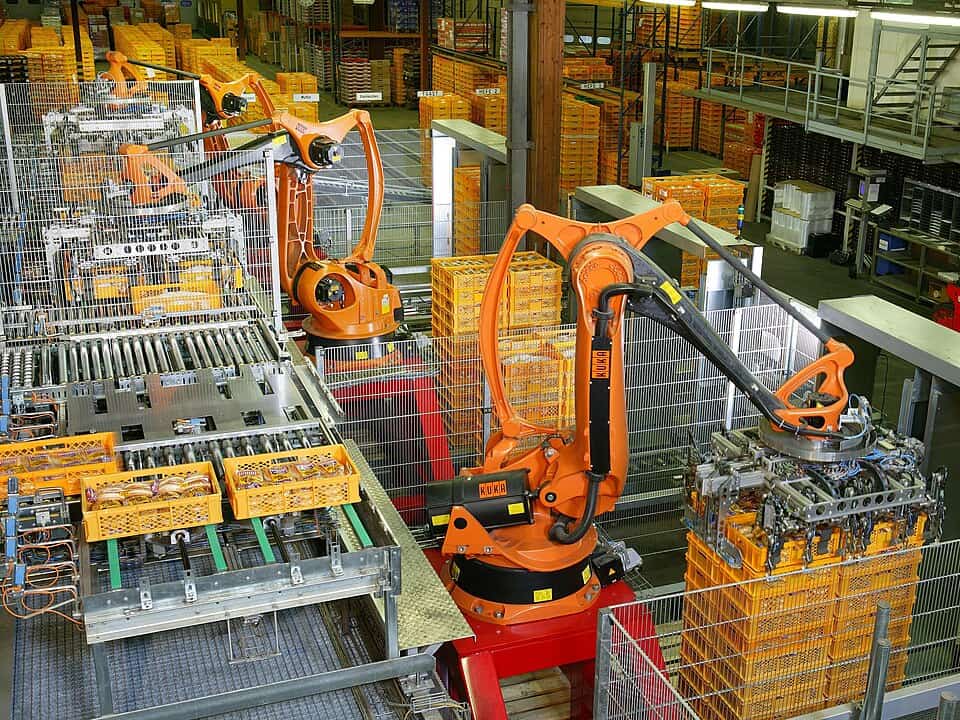
A palletizing robot is an automated machine designed to arrange products, cartons, cases, or other suitable loads onto a pallet according to a predetermined stacking pattern. Instead of requiring employees to repeatedly lift and position individual cases, the robot performs programmed movements to build pallet loads in a consistent and repeatable manner.
A typical robotic palletizing application involves several coordinated steps. Products arrive at the palletizing area through a conveyor or another material handling system. The equipment positions the products for handling, and the robotic arm uses an appropriate end-of-arm tool to grip, lift, and place each item. The robot follows a programmed sequence to build successive layers until the pallet reaches its intended configuration.
The complete process may also involve pallet positioning, load stabilization, stretch wrapping, strapping, and the transportation of completed pallets to a staging or shipping area.
Century Conveyor Systems identifies robotic palletizing and depalletizing arms, robotic cells, shrink-wrapping equipment, and strapping systems among its material handling solutions. This combination allows businesses to evaluate palletizing as part of a broader end-of-line automation strategy rather than as an isolated machine.
The precise configuration depends on the products being handled, the available floor space, required production rates, pallet specifications, and the way materials enter and leave the work area.
2. Why Should a Warehouse Consider a Palletizing Robot?
The most compelling reason to consider a palletizing robot is the opportunity to improve the consistency and efficiency of a process that can otherwise consume substantial labor and time. Palletizing frequently involves repetitive lifting, bending, reaching, and placing, especially in facilities processing large quantities of cases throughout the day.
Automating this task can help businesses redirect employees toward responsibilities that require judgment, troubleshooting, quality control, and coordination. It can also make pallet-building operations more predictable because the robot follows established movement sequences and stacking instructions.
Another important consideration is operational continuity. Manual palletizing performance can vary with fatigue, staffing levels, shift changes, and fluctuations in workload. A properly designed robotic system can provide more consistent cycle execution within its specified operating conditions.
For businesses experiencing growth, a palletizing robot may also help address end-of-line capacity constraints. Increasing upstream production or order processing capacity is less valuable if finished products accumulate faster than employees can prepare pallets for shipment. Automating palletizing can help align this final stage with the rest of the operation.
However, automation is not automatically the right choice for every warehouse. Product variety, case dimensions, demand patterns, capital costs, and the complexity of the installation all influence the decision. Century Conveyor Systems’ system integration approach provides a framework for evaluating these factors within the context of a facility’s wider material handling requirements.
3. What Types of Robotic Palletizing Solutions Does Century Conveyor Systems Offer?
Century Conveyor Systems lists several components within its robotic palletizing offering, including palletizing and depalletizing arms, robotic cells, shrink wrappers, and strappers. These technologies address different stages of pallet handling and can be considered according to a facility’s specific operational needs.
Robotic palletizing arms perform the core task of picking up products and placing them into a programmed pallet pattern. The selected robot and gripping equipment must match the product’s dimensions, weight, shape, and handling characteristics.
Robotic cells organize the robot and associated equipment into a defined work area. Depending on the application, a cell may incorporate product infeed, pallet presentation, safety equipment, controls, and supporting material handling components. The goal is to coordinate the equipment so that products can move through the palletizing process efficiently and safely.
Depalletizing arms perform the complementary task of removing products from pallets. This can be useful in operations where incoming palletized goods must be unloaded before entering a production, storage, or fulfillment process.
Shrink-wrapping and strapping equipment can support the stabilization of completed pallet loads. These processes help prepare pallets for downstream transportation and handling, although the appropriate method depends on product characteristics, packaging requirements, and shipping conditions.
The most suitable solution is not necessarily the most elaborate one. A business with a straightforward, high-volume case flow may have different requirements from a distribution center handling many product types and variable order configurations. Evaluating the actual workflow helps determine which components should be automated and how they should interact.