Table of Contents
Running a third-party logistics operation is one of the most demanding jobs in the supply chain industry. You’re not managing one operation — you’re managing several, often simultaneously, each with its own client expectations, SKU profiles, peak seasons, and service-level agreements. When one client’s volume doubles during Q4, or a new contract demands same-day fulfillment, there’s no time to rebuild your facility from scratch.
That’s why the most competitive 3PL operators are turning to conveyor systems for 3PL warehouses designed specifically for flexibility, speed, and scalability. Not the rigid, one-size-fits-all systems of decades past — but modular, reconfigurable automation that grows with your business and adapts to your clients’ needs.
This guide breaks down what modern 3PL conveyor and automation systems look like, which solutions deliver the fastest ROI, and how to evaluate your options before your next contract cycle.
Why 3PL Operations Have Unique Automation Needs
Most fulfillment centers are built around a single tenant, a single SKU profile, and a predictable volume band. Third-party logistics facilities are none of those things.
A 3PL warehouse might handle:
- A fashion brand with tens of thousands of SKUs and a brutal returns rate
- A food and beverage distributor running high-volume pallet moves
- A specialty retailer shipping small store orders on tight deadlines
- An eCommerce startup expecting 3x volume growth in year two
Each of these clients demands something different from your floor, your equipment, and your team. That complexity is exactly why conveyor systems for 3PL warehouses must be evaluated differently than systems for a dedicated fulfillment center.
The right solution isn’t the most powerful one. It’s the most adaptable one.
The Four Biggest Pain Points 3PLs Face — and the Automation Responses That Work
1. Meeting Client SLAs When Volume Spikes Unexpectedly
Client contracts are won and lost on service levels. A missed ship window or degraded accuracy rate during peak season can cost you a renewal — or trigger a penalty clause. Manual picking and sorting simply cannot keep pace when volume surges, and adding headcount fast enough to compensate isn’t always realistic.
Automation response: Zone-based conveyor systems with integrated sortation allow your facility to handle higher order volumes without proportionally increasing labor. Orders move through pick zones at consistent speeds, are verified and sorted automatically, and reach packing or shipping lanes without manual intervention at every step. When a client’s volume spikes, the system absorbs it.
2. Labor Shortages and Turnover
Labor availability is a structural problem in 3PL operations, not a temporary one. Warehouse workers are harder to hire, more expensive to retain, and faster to leave than they were five years ago. Building a throughput model that depends on having full headcount at all times is a liability.
Automation response: Goods-to-person (GTP) systems, including autonomous mobile robots (AMRs) and shuttle-based retrieval systems, reduce the walking, searching, and manual transport that consume the most labor hours. Workers stay at fixed stations while the automation brings product to them — improving both productivity and ergonomics, which in turn reduces injury and turnover.
3. Multi-Client Complexity and Space Constraints
In a multi-client 3PL environment, carton types, SKU counts, and pick profiles vary widely from one bay to the next. Allocating dedicated infrastructure to each client is rarely practical. And adding square footage isn’t always an option.
Automation response: Modular conveyor systems with flexible lane configurations, carton flow racks, and put-wall sorting allow you to handle multiple client profiles within the same footprint. Reconfigurable zones let you reallocate capacity between clients as contract volumes shift. Vertical storage solutions — including mini-load and shuttle systems — extract significantly more throughput per square foot.
4. Fast Deployment Requirements
When a 3PL wins a new contract, the pressure to go live is immediate. A multi-year installation with 18 months of lead time isn’t a realistic option in most competitive scenarios.
Automation response: Phased automation installs and modular conveyor systems are designed for rapid deployment. Unlike custom-engineered fixed systems, modular platforms ship faster, install faster, and can be expanded incrementally. A well-designed Phase 1 installation can be operational in weeks, with subsequent phases layered in as volumes grow and capital is available.
Key Conveyor and Automation Systems for 3PL Fulfillment
Not every 3PL needs the same automation stack. The right combination depends on your client mix, order profiles, throughput targets, and capital budget. Here’s a breakdown of the most relevant systems:
Modular Conveyor Systems
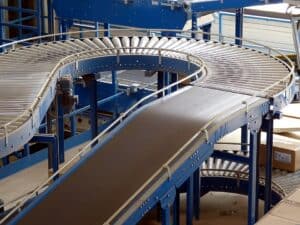
The foundation of most 3PL automation upgrades. Modular conveyor platforms use standardized components — straight sections, curves, merges, diverts — that can be assembled and reconfigured without custom fabrication. This dramatically reduces lead time and simplifies future reconfiguration.
Best for: General carton transport, order consolidation, packing line feeds, and inbound/outbound flow.
Sortation Systems
Sortation is the workhorse of high-volume fulfillment. Products are inducted, scanned, and automatically diverted to the correct shipping lane, zone, or staging area. Modern sorters can handle thousands of cartons per hour with near-perfect accuracy.
Best for: 3PLs handling multiple clients in the same facility, eCommerce fulfillment with many shipping carriers, and operations with high order counts and short fulfillment windows.
Goods-to-Person (GTP) / AMRs
Rather than having workers travel to pick locations, GTP systems bring inventory to stationary pick stations. Autonomous mobile robots (AMRs) retrieve totes or shelving units from storage and deliver them to operators, who pick into outbound cartons.
Best for: High-SKU environments, fashion and eCommerce clients, and operations where walking time represents a significant portion of labor cost.
Carton Flow and Zone Picking
Carton flow racks use gravity rollers to keep product replenished at the pick face without manual restocking effort. Combined with zone picking — where each worker is responsible for a defined pick zone rather than walking an entire warehouse — this approach dramatically improves pick rates per labor hour.
Best for: Multi-SKU environments with moderate to high order volume and frequent replenishment cycles.
WCS (Warehouse Control Software)
Hardware without software is just machinery. A Warehouse Control System provides real-time visibility into equipment status, order flow, and throughput metrics. In a multi-client 3PL environment, WCS gives operations managers the data needed to balance workloads, identify bottlenecks, and report client-specific performance.
Best for: Any 3PL operating multiple conveyors, sorters, or GTP systems — or managing client-specific SLA reporting.
Conveyor Retrofits
Many 3PLs operate in older facilities with legacy conveyor equipment that’s functional but inefficient. Rather than replacing entire systems, strategic retrofits — adding new sortation modules, upgrading controls, or integrating AMR lanes — can extend the useful life of existing infrastructure and dramatically improve throughput.
Best for: Budget-conscious operations that want automation gains without a full-facility overhaul.
How to Build the Business Case for 3PL Automation
Before any capital investment conversation, decision-makers need to understand the return. Here are the primary ROI levers in 3PL conveyor and automation projects:
Labor cost reduction: Even modest throughput improvements per labor hour compound over time. A 20% reduction in labor hours per order across 5,000 daily orders creates substantial annual savings.
SLA compliance improvement: Retaining a client contract is always cheaper than replacing it. If automation reduces your risk of SLA miss events, that’s a concrete risk reduction with a quantifiable value.
New contract capacity: The ability to take on new clients without hiring proportionally is a direct revenue multiplier. Automation expands your capacity ceiling, which expands your sales ceiling.
Facility density: Automation that reduces your floor footprint per unit of throughput either delays a facility expansion or frees capacity for new clients — both represent real dollar value.
For a structured framework on evaluating automation ROI, the Material Handling Institute (MHI) offers resources developed by the industry’s leading engineers and operators — available at mhi.org.
What to Look for in a 3PL Automation Partner
Not every conveyor and automation vendor is equipped to serve the unique needs of third-party logistics operators. When evaluating partners, look for:
- Multi-client facility experience — Have they designed systems that accommodate multiple SKU profiles and pick methods in a single footprint?
- Phased deployment capability — Can they deliver a functional Phase 1 quickly, with a clear roadmap for expansion?
- Engineering and integration support — Do they handle mechanical design, controls, installation, and commissioning, or are you expected to manage multiple subcontractors?
- Ongoing maintenance and support — Downtime in a 3PL environment affects multiple clients simultaneously. What’s the response time? Do they offer preventive maintenance programs?
- WCS/WMS compatibility — Can their systems integrate with your existing warehouse management software?
Conclusion: Automation Is a Competitive Advantage for 3PLs — Not Just a Cost
The 3PL market is competitive, and clients have more options than ever. The operators who win and retain the best contracts are the ones who can demonstrate operational reliability, scalability, and the ability to absorb volume without degrading service.
Conveyor systems for 3PL warehouses, when designed and deployed correctly, deliver exactly that. They reduce your labor dependency, accelerate throughput, improve accuracy, and give you the capacity to grow without proportionally growing your headcount.
If your facility is running at or near its current capacity — or if you’re preparing for a new contract cycle and need to demonstrate scalable infrastructure — now is the right time to evaluate your options.
Century Conveyor specializes in conveyor systems, material handling solutions, and warehouse automation for 3PL and fulfillment operations. Our engineering team works directly with operations managers and logistics directors to design systems that match your client profiles, your budget, and your timeline. Contact us today to schedule a facility consultation and explore what’s possible.
11. External Link Used
Material Handling Institute (MHI) — https://www.mhi.org Cited as a credible, non-competing industry resource for ROI frameworks and automation guidance. MHI is the leading U.S. trade association for material handling and logistics technology.
12. Suggested Internal Links
These are natural internal linking opportunities to build on centuryconveyor.com, assuming these pages exist or could be created:
| Anchor Text (Suggested) | Target Page |
|---|---|
| “conveyor systems” | /services/conveyor-systems/ |
| “sortation systems” | /solutions/sortation/ |
| “modular conveyor systems” | /products/modular-conveyor/ |
| “warehouse automation” | /solutions/warehouse-automation/ |
| “conveyor retrofits” | /services/conveyor-retrofits/ |
| “material handling solutions” | /services/material-handling/ |
| “contact us” (CTA) | /contact/ |
| “preventive maintenance programs” | /services/maintenance/ |
13. FAQ Section
Recommended placement: After the conclusion, before the author bio or related posts section.
Frequently Asked Questions: Conveyor Systems for 3PL Warehouses
Q1: What types of conveyor systems work best in a multi-client 3PL facility? Modular conveyor systems are generally the best fit for multi-client 3PL operations because they can be reconfigured as client volumes, SKU profiles, and fulfillment requirements change. Combined with flexible sortation and zone picking, they allow one facility to serve multiple clients efficiently without dedicating fixed infrastructure to each.
Q2: How long does it take to install a conveyor system in an existing 3PL warehouse? Timeline varies based on the scope of the project, but modular conveyor systems are specifically designed for faster deployment than custom-engineered fixed systems. A focused Phase 1 installation — covering inbound transport, sortation, and primary pick-to-pack flow — can often be operational within weeks. A Century Conveyor engineer can provide a realistic timeline estimate after a facility walkthrough.
Q3: Can a 3PL automate without shutting down operations during installation? Yes, phased installation approaches are specifically designed to allow operations to continue running during deployment. Work is typically sequenced to minimize disruption to active client areas, with cutover events planned during lower-volume windows. Your automation partner should present a detailed implementation plan before work begins.
Q4: What is the ROI timeline for 3PL conveyor automation? ROI depends on your current labor costs, order volume, error rates, and the cost of the system. Many 3PL operators recover their investment within 18–36 months through labor savings, SLA compliance improvement, and increased capacity. A qualified automation partner can help you model this before you commit to a project.
Q5: How does a Warehouse Control System (WCS) support multi-client 3PL operations? A WCS integrates with your conveyors, sorters, and other automation hardware to provide real-time visibility into throughput, equipment status, and order flow. In a multi-client environment, it can generate client-specific performance data to support SLA reporting and billing — giving you both operational control and business intelligence in one platform.
Q6: Does Century Conveyor handle installation and ongoing maintenance of conveyor systems? Yes. Century Conveyor provides full-service support including engineering design, installation, commissioning, and ongoing preventive maintenance programs. Our team works with 3PL operators to ensure minimal downtime and maximum system performance throughout the lifecycle of your equipment.