Warehousing and distribution operations play a critical role in getting products from storage locations to customers efficiently, accurately, and on time. As order volumes increase and fulfillment expectations continue to evolve, businesses need material handling systems that can keep pace with demand while controlling operating costs. Automation, conveyor technology, robotics, and warehouse control software can help distribution centers streamline workflows and improve productivity.
Century Conveyor Systems provides integrated material handling automation solutions for warehouses, distribution centers, and fulfillment facilities. From conveyor systems and automated sortation to robotic fulfillment, pallet handling, and warehouse control systems, the company helps businesses develop solutions tailored to their operational requirements.
Understanding how these technologies work together can help warehouse operators identify opportunities to improve performance, reduce manual handling, and prepare their facilities for future growth.
Below are frequently asked questions about warehousing and distribution and how Century Conveyor Systems can help businesses optimize their material handling operations.
Table of Contents
1. What warehousing and distribution solutions does Century Conveyor Systems provide?
Century Conveyor Systems offers integrated automation solutions designed to improve the movement, handling, sorting, and processing of products throughout warehouse and distribution environments. Rather than focusing on a single piece of equipment, the company approaches material handling as a connected system that supports the entire fulfillment process.
Its solutions include conveyor systems, sortation equipment, robotic fulfillment, robotic palletizing, controls and software, storage modules, and shipping-related equipment. These technologies can support products ranging from individual cartons and polybags to totes, drums, and full pallets.
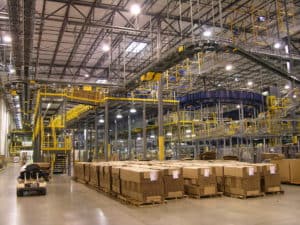
For example, a warehousing and distribution center might use belt conveyors to move small packages, powered roller conveyors to transport cartons, and automated sortation equipment to direct shipments toward the correct destination. Robotic palletizing equipment can then help organize completed orders for outbound shipping. Warehouse control technology coordinates equipment and movement throughout the operation.
Century Conveyor Systems also provides project-related services, including system design, validation, installation, startup support, and parts and service. This integrated approach allows businesses to plan material handling improvements around their actual operational requirements.
The right solution depends on factors such as facility layout, product dimensions, order profiles, daily throughput, labor availability, and anticipated growth. By considering these factors together, businesses can develop a warehousing and distribution strategy that addresses current bottlenecks without overlooking long-term needs.
2. How can warehousing and distribution conveyor systems improve distribution efficiency?
Conveyor systems help warehouses move products between operational areas with less dependence on manual transportation. Instead of requiring employees to carry cartons, push carts, or repeatedly move products between workstations, conveyors establish defined pathways that connect receiving, picking, packing, sortation, and shipping.
Century Conveyor Systems engineers conveyor solutions around the function of each section of a warehouse. Different products and workflows require different conveyor technologies, making equipment selection an important part of system design.
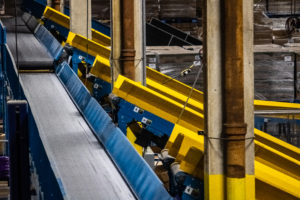
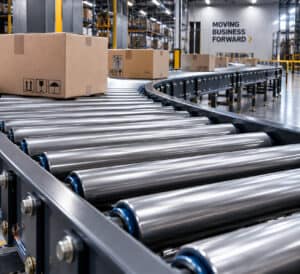
Belt conveyors, for example, provide stable movement for small packages, polybags, and irregularly sized cartons. Live roller conveyors are useful in applications that require powered movement, while gravity conveyors can support manual packing lines and other operations where products can move without a powered drive. Pallet conveyors are designed to accommodate heavier loads, with options selected according to pallet characteristics and handling requirements.
These technologies can improve warehousing and distribution efficiency in several ways. First, they reduce unnecessary travel between work areas. Second, they establish more consistent product flow, helping employees focus on value-added tasks. Third, they can support higher processing volumes by moving products continuously rather than relying entirely on individual handling.
Conveyors can also connect different stages of an automated workflow. When integrated with scanners, diverts, controls, and other material handling equipment, they help products reach the appropriate processing or shipping destination.
The goal is not simply to install more conveyor equipment. It is to design a layout that moves products through the facility efficiently, minimizes avoidable handling, and supports reliable throughput.
3. Can Century Conveyor Systems help reduce labor costs in warehousing and distribution?
Yes. Warehouse automation can reduce the amount of repetitive manual work required to move, sort, and prepare products for shipment. Century Conveyor Systems designs and implements automated material handling systems intended to increase output while lowering labor costs.
Labor efficiency is particularly important in facilities where employees spend substantial time transporting products, manually sorting cartons, moving pallets, or transferring goods between departments. These activities are necessary, but they can consume time that employees could otherwise spend on inspection, exception handling, quality control, and other tasks requiring human judgment.
Automated conveyors create predictable transportation routes, while robotic mobile systems can move totes, cartons, carts, or pallets between designated locations. Automated palletizing equipment can further reduce the physical effort associated with stacking completed cases onto pallets.
Consider a distribution center where employees routinely move cartons from a packing area to several outbound staging lanes. A conveyor system with appropriately configured diverts could automate much of that transportation and routing. Employees could then focus on resolving exceptions, monitoring product quality, or managing outbound shipments.
However, labor savings depend on the facility’s starting conditions, system design, order volume, and implementation costs. Automation may change job responsibilities rather than eliminate every manual task. Businesses should evaluate labor productivity, throughput, equipment utilization, maintenance, and total operating costs when estimating potential returns.
Century Conveyor Systems’ integrated approach helps businesses assess how equipment and controls can work together to make warehouse processes more productive.
4. What role does robotic fulfillment play in modern warehousing and distribution centers?
Robotic fulfillment helps automate the movement of goods within a warehouse, particularly when products must travel between storage, picking, packing, and shipping areas. Century Conveyor Systems offers solutions involving automated guided vehicles (AGVs) and autonomous mobile robots (AMRs), which can support different transportation requirements.
AGVs typically follow predefined routes using navigation technologies such as magnetic tape, QR codes, inductive wires, or laser-based guidance. They are suitable for operations that involve relatively consistent transportation paths, including moving pallets, cartons, or other loads between established locations.
AMRs use sensors and onboard navigation capabilities to move through a facility without relying on the same fixed route infrastructure. Their flexibility can make them useful in dynamic warehouse environments where transportation needs vary throughout the day.
One application is goods-to-person fulfillment. Instead of requiring employees to travel repeatedly to retrieve inventory, mobile robots can transport totes or other containers to picking or packing personnel. This approach can reduce unnecessary walking and help employees spend more time processing orders.
Robotic fulfillment can also support end-of-line operations, where finished products must be transferred from production or packing areas to another stage of the distribution process.
An important advantage is scalability. Depending on the application and system architecture, businesses may be able to introduce additional robots as demand increases. This can provide an alternative to making every transportation route permanently fixed in the facility.
Successful implementation still requires careful planning. Product weights, traffic patterns, charging requirements, safety procedures, floor conditions, and integration with existing equipment must all be considered. Century Conveyor Systems can help businesses determine where robotic transportation fits within a broader automation strategy.
5. How does automated sortation improve order accuracy and shipping performance of warehousing and distribution?
Automated sortation systems direct products toward the correct destination based on the requirements of a distribution operation. In a busy warehouse, this may mean routing cartons to specific carrier lanes, shipping doors, customer orders, store destinations, or downstream processing areas.
Without an effective sortation process, employees may need to identify, lift, scan, and redirect individual packages manually. As volumes increase, these tasks can create congestion and increase the likelihood of misrouted shipments.
Century Conveyor Systems provides sortation conveyor solutions designed to support rapid product throughput. Its broader material handling capabilities include conveyor diverts, which direct cartons from one line to another without necessarily requiring a large, dedicated sortation system for every application.
The appropriate technology depends on the number of destinations, package characteristics, required processing speed, and available space. A straightforward operation may benefit from strategically placed conveyor diverts, while a high-volume distribution center may require a more advanced automated sortation configuration.
Sortation can improve performance by reducing manual transfers, establishing more consistent routing, and helping products reach the correct shipping area. When combined with appropriate scanning and control processes, it can also support more reliable order handling.
Accuracy is not determined by conveyor equipment alone. Product identification, order data, software configuration, exception procedures, and employee training remain important. Automated equipment must receive reliable information to route packages correctly.
For businesses experiencing shipping bottlenecks or frequent sorting errors, evaluating the complete path from packing to outbound staging can reveal opportunities to improve both speed and accuracy.
6. Can Century Conveyor Systems integrate automation into an existing warehousing and distribution systems?
Yes. Warehouse automation does not always require replacing an entire facility or rebuilding every operational process. Many businesses can improve performance by modernizing specific areas, integrating new equipment with existing systems, or implementing upgrades in carefully planned stages.
Century Conveyor Systems offers retrofit and modernization capabilities alongside system design, mechanical installation, electrical installation, controls engineering, and project management. These services can help businesses evaluate how new material handling technology may fit within their current infrastructure.
For example, a warehouse may already have conveyor lines but experience recurring congestion near packing stations. An upgrade might involve changing conveyor configurations, introducing new diverts, improving controls, or automating a previously manual transfer point.
Another facility might need to expand outbound capacity without significantly disrupting daily shipping operations. Project phasing can help organize installation activities around operational priorities, available space, and acceptable downtime.
Integration requires more than determining whether a new conveyor physically fits. Engineers must also consider equipment interfaces, control logic, power requirements, traffic patterns, maintenance access, and the interaction between automated and manual processes.
Existing warehouse management systems and other operational software may also need to exchange information with new equipment. Proper planning helps ensure that automated workflows operate as intended and that employees understand how to respond to exceptions.
The most effective modernization strategy begins with identifying the specific operational problem. By targeting measurable bottlenecks instead of adding technology indiscriminately, businesses can make more informed investments in warehousing and distribution improvements.
7. How do warehousing and distribution control systems and automation software support distribution operations?
Material handling equipment performs the physical work of transporting and processing products, but software and controls help coordinate how that equipment operates. Without appropriate control logic, conveyors, scanners, diverts, and robotic systems may not work together as an efficient, connected process.
Century Conveyor Systems offers controls and software capabilities that include programmable logic controllers (PLCs), control panel design and fabrication, warehouse management system (WMS) integration, and warehouse control systems (WCS).
A WMS generally supports warehouse-level inventory and order management functions, while a WCS coordinates and manages automated material handling activities. A PLC controls equipment behavior at the machine or process level. Although their responsibilities differ, these technologies can work together to connect business instructions with physical warehouse operations.
For example, an order may be released for fulfillment through a warehouse management process. Conveyors then transport cartons through the facility, scanners identify packages, and control logic directs each item toward the appropriate destination. If an exception occurs, the system may need to route the item to a designated handling area rather than allowing it to continue through the normal workflow.
Effective integration can improve visibility, coordination, and consistency. It can also help businesses identify operational constraints and better understand where delays occur.
Software selection and configuration should reflect the facility’s actual processes, existing technology, and future plans. Businesses should clarify system responsibilities, communication requirements, reporting needs, and exception-handling procedures before implementation.
When equipment and software are designed as parts of a coordinated system, distribution centers can establish more dependable workflows and make better use of their automation investments.
8. How can businesses protect products from damage during warehousing and distribution handling?
Product protection is an important consideration in warehousing and distribution because damage can result in returns, replacement costs, shipping delays, and dissatisfied customers. Material handling systems should be designed around the physical characteristics of the products being transported, including their dimensions, weight, packaging, and fragility.
Century Conveyor Systems offers several conveyor technologies that address different handling requirements. Belt conveyors provide a stable transportation surface for smaller parcels, polybags, and irregular cartons. Modular belt systems can offer advantages in specialized applications where traction, tight transfers, or easier belt maintenance are important.
Accumulation conveyor systems can also help control the spacing between products. Zero-pressure accumulation is designed to prevent products from touching, while minimum-pressure accumulation allows products to make light contact. These configurations can be useful when contact between packages presents a risk of damage.
The benefits extend beyond conveyor selection. Poorly planned transfers, abrupt changes in direction, congested workstations, and uncontrolled accumulation can all contribute to handling problems. A well-engineered layout accounts for how products enter, travel through, and exit each stage of the system.
Businesses should also evaluate package stability, transition points, sensor placement, conveyor speeds, and the behavior of products when lines temporarily stop. Fragile items may require different handling conditions from durable cartons or heavy palletized goods.
Preventing damage requires matching the equipment to the application rather than assuming one conveyor design is suitable for every product. With an appropriate combination of engineering, controls, and operating procedures, warehouses can reduce avoidable product contact and improve the consistency of their fulfillment processes.
9. What maintenance and support services are important for automated distribution facilities in warehousing and distribution?
Automated material handling equipment must be maintained to support reliable performance over time. Even a well-designed system can experience wear, component failures, sensor issues, or control problems if maintenance is neglected.
Century Conveyor Systems offers conveyor repair, preventative maintenance, replacement parts, equipment service, and related support capabilities. Its service offerings also include mechanical and electrical expertise for material handling systems.
Preventative maintenance helps identify developing problems before they cause significant operational disruption. Depending on the equipment, maintenance activities may include inspecting belts and rollers, checking motors and drives, evaluating sensors, examining mechanical components, and verifying that safety systems function properly.
Replacement parts are another important consideration. Facilities that depend on automated conveyors may experience substantial disruption when a critical component becomes unavailable. Maintaining appropriate spare parts and having a clear process for identifying equipment requirements can help streamline repairs.
Businesses should develop maintenance plans according to equipment specifications, operating hours, product loads, environmental conditions, and manufacturer recommendations. Maintenance records and recurring fault data can also reveal patterns that indicate the need for repairs or modernization.
Support requirements vary by location and service type. Century Conveyor Systems identifies its primary field service coverage in the New Jersey, Pennsylvania, and New York metropolitan area, while also offering replacement conveyor parts and equipment quotations for shipment to customer locations.
For distribution centers with demanding shipping schedules, maintenance should be treated as part of the overall automation strategy rather than an afterthought. Reliable equipment, accessible technical support, and well-planned servicing help protect the investment in warehouse infrastructure.
10. How should a business determine whether warehouse automation is the right investment for their warehousing and distribution?
The decision to automate should begin with a clear understanding of current operational performance and the challenges a business wants to address. Automation can offer significant advantages, but the appropriate solution depends on the facility’s requirements, budget, order profile, and long-term strategy.
Businesses should first identify their most important constraints. These might include excessive employee travel, slow carton movement, limited shipping capacity, inconsistent order routing, repetitive pallet handling, or insufficient space for growing inventory volumes.
The next step is to establish a baseline using measurable operational indicators. Useful metrics include orders processed per hour, cartons handled per shift, labor hours per order, order accuracy, equipment downtime, product damage, and on-time shipping performance.
These measurements help determine whether the proposed system addresses a genuine business problem. For example, a conveyor upgrade may be valuable when transportation between packing and shipping is the primary bottleneck. Robotic fulfillment may be more appropriate when workers spend substantial time moving inventory containers. A sortation system may be the priority when outbound routing limits throughput.
The financial evaluation should consider more than the initial equipment price. Installation, software integration, facility modifications, maintenance, employee training, energy consumption, and future expansion can all influence the total cost of ownership. Expected benefits should be evaluated against these costs using realistic operating assumptions.
Century Conveyor Systems supports businesses through system design, validation, implementation, startup support, and ongoing parts and service. This provides a framework for assessing how a proposed solution fits within the facility’s wider operational goals.
A phased approach may be appropriate when a business wants to address its most urgent bottleneck before committing to a larger automation project. The key is to prioritize improvements that can be measured and aligned with long-term business objectives.
Conclusion: Improving Warehousing and Distribution With Century Conveyor Systems
Efficient warehousing and distribution depend on more than moving products from one location to another. Businesses must coordinate transportation, order fulfillment, sortation, inventory movement, shipping preparation, software, and equipment maintenance to achieve consistent operational performance.
Century Conveyor Systems provides integrated material handling solutions that address these connected requirements. Conveyor systems can streamline product transportation, robotic fulfillment can reduce repetitive movement, automated sortation can improve routing, and controls and software can coordinate equipment throughout a facility. Maintenance and modernization services help businesses support system reliability as operational demands change.
The right combination of technologies depends on each facility’s products, workflow, available space, labor requirements, and future growth plans. A careful evaluation of these factors can help businesses identify practical opportunities to improve productivity, reduce unnecessary handling, and strengthen distribution performance.
Organizations considering their next warehousing and distribution improvement can contact Century Conveyor Systems to discuss their facility requirements and explore an automation solution designed around their operational goals.