When warehouses, distribution centers, and fulfillment operations need to move cartons, packages, pallets, or other products efficiently, a roller conveyor can provide a practical foundation for material handling automation. Century Conveyor Systems designs and integrates conveyor solutions around the specific needs of a facility, combining roller conveyor technology with other equipment, controls, and automation where appropriate.
Below are some of the most important questions to ask when evaluating a roller conveyor for an order fulfillment or distribution operation.
Table of Contents
What is a roller conveyor?
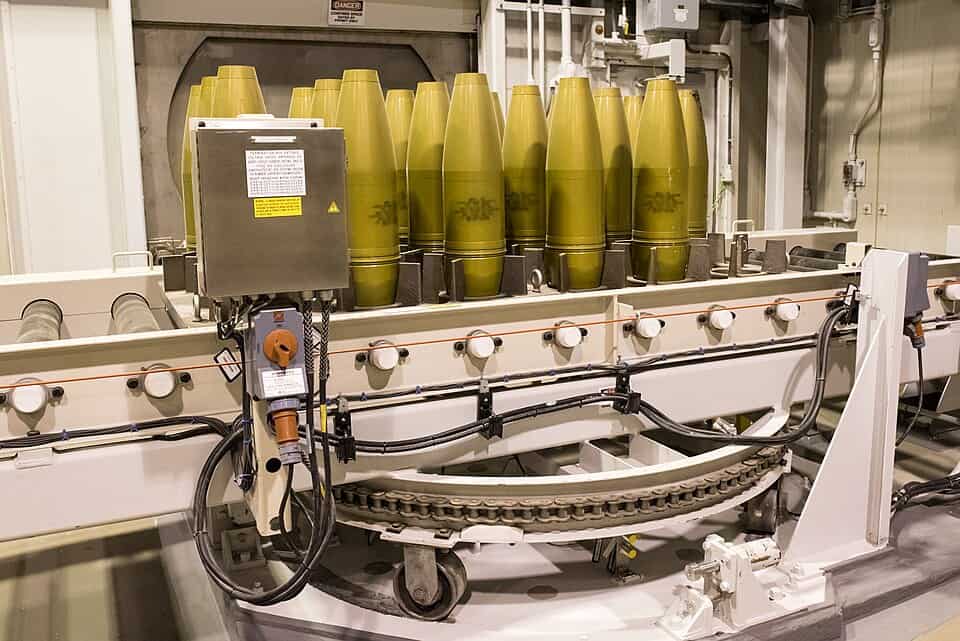
A roller conveyor is a material handling system that uses cylindrical rollers to move products along a defined path. Depending on the application, the rollers can be powered or unpowered.
Century Conveyor Systems describes two major roller-based approaches for order fulfillment: live roller conveyors and gravity conveyors. Live roller sections use a motor to power the rollers, while gravity conveyors rely on gravity rather than a motor to move products.
This distinction is important because the right conveyor depends on what is being moved, how quickly it needs to move, how much control operators need over the product, and where the conveyor sits within the overall fulfillment process.
Rather than treating a roller conveyor as a standalone piece of equipment, Century approaches conveyor systems as part of a larger warehouse automation strategy. A conveyor line can incorporate different sections and technologies based on the function each area needs to perform.
Why would a warehouse choose a roller conveyor?
One of the biggest advantages of a roller conveyor is its versatility. Roller-based equipment can be used to transport products through different stages of a warehouse or fulfillment operation without requiring employees to manually carry products from one workstation to another.
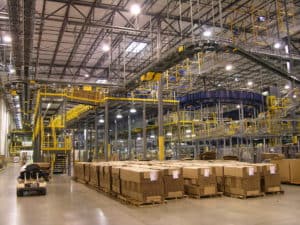
Century notes that warehouse conveyor systems serve as the backbone of automated operations by continuously moving cartons or pallets through processing, sortation, and distribution. A properly engineered system can therefore reduce unnecessary manual transportation while helping an operation maintain a consistent flow of material.
Roller conveyors can be especially useful in applications where products need to travel between packing, diverting, accumulation, or end-of-line areas. They can also interface effectively with manual workstations, making them useful in facilities that combine automated transportation with human-operated processes.
The important consideration is not simply whether a facility needs a conveyor. It is how the conveyor should interact with the rest of the operation.
What is the difference between a live roller conveyor and a gravity roller conveyor?
The primary difference is how the rollers move the product.
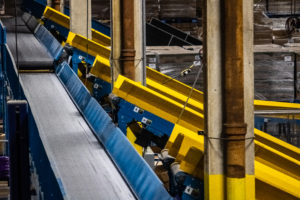
A live roller conveyor uses powered rollers. A motor provides the force necessary to move cartons or other products along the conveyor. This makes live roller systems appropriate when an operation needs controlled, powered transportation.
A gravity roller conveyor, on the other hand, does not use a motor to propel products. Instead, products move through the conveyor using gravity, generally along an appropriately designed incline or through manual pushing.
These two approaches can serve different purposes within the same facility. A powered roller section may be useful where products must be transported automatically from one process to another, while a gravity section can be appropriate for staging or manual handling.
Century specifically identifies live roller and gravity conveyors as solutions commonly used in packing lines, divert lines, extendable applications, and end-of-line operations. Their relatively slower operating characteristics and ability to interface with manual induction make them particularly useful in these environments.
Where are Century’s roller conveyors commonly used?
Roller conveyors can be integrated into several points of an order fulfillment operation.
Century identifies packing lines, divert lines, extendable conveyors, and end-of-line operations as common applications for live roller and gravity conveyor technology.
A packing line, for example, may require a dependable way to move cartons between manual packing activities and subsequent processes. A divert line may need to move products toward different destinations. At the end of the operation, conveyors can help organize products as they approach shipping or loading.
This flexibility is one reason conveyor design should be based on the workflow of the entire facility rather than on a single equipment specification.
Century’s order fulfillment approach focuses on optimizing each touchpoint in the operation, with an emphasis on increasing output, reducing errors and product damage, and processing items with fewer manual interactions. A roller conveyor can therefore be one component of a broader system engineered around those objectives.
Can a roller conveyor be part of an automated order fulfillment system?
Yes. A roller conveyor does not have to operate independently.
In a modern fulfillment facility, conveyors can work alongside sortation equipment, controls, warehouse software, robotic systems, and other material handling technologies. Century provides conveyor and order fulfillment systems designed to connect these different elements into a coordinated operation.
For example, a facility might use roller conveyor sections to transport cartons from a manual packing area toward a divert or sortation process. Other conveyor technologies could then be used where different product characteristics or operational requirements call for them.
Century also offers programmable logic controls, warehouse management system and warehouse control system capabilities, as well as robotic fulfillment solutions. This means a roller conveyor can be considered as part of the facility’s automation architecture rather than simply as a transportation device.
That distinction becomes increasingly important as fulfillment volumes grow. The conveyor itself moves the product, but controls and system integration help determine when, where, and how that product should move.
How does Century determine which roller conveyor solution a facility needs?
The appropriate roller conveyor configuration depends on the products being handled and the role the conveyor needs to play.
Important considerations can include product dimensions, product weight, packaging type, required throughput, accumulation requirements, manual interaction, available floor space, and the relationship between the conveyor and other equipment.
Century emphasizes engineered layouts in which different conveyor sections are selected according to function. In other words, a warehouse may not need one conveyor type throughout the entire facility. One area may benefit from live roller technology, while another may require belted conveying, modular belting, pallet conveying, divert equipment, or a different solution altogether.
This approach helps prevent the common mistake of selecting equipment first and attempting to adapt the warehouse process around it.
Instead, the process can be evaluated first, followed by the engineering and integration necessary to support it.
Is a roller conveyor suitable for fragile products?
It can be, but the specific conveyor configuration matters.
Century offers several conveyor approaches for different product-handling requirements. For applications where products need additional separation to prevent contact and potential damage, the company describes zero-pressure and minimum-pressure accumulation systems.
Zero-pressure accumulation is designed so products do not touch each other, while minimum-pressure accumulation allows products to slow down and make light contact.
This illustrates an important point about roller conveyor selection: simply moving products from one location to another is not always enough. In a fulfillment environment, the system may also need to control spacing, accumulation, acceleration, and product interaction.
For fragile or damage-sensitive goods, those characteristics can be just as important as basic transportation.
How does a roller conveyor compare with a belt conveyor?
Neither technology is universally better. The better choice depends on the application.
Roller conveyors can be particularly useful when handling cartons and products in packing, divert, end-of-line, and similar applications. Belted conveyors, meanwhile, can provide a more stable conveying surface for certain products.
Century points out that belt-over conveyors can offer advantages for small polybags, parcels, and irregular carton sizes because the belt provides greater conveyance stability. Belt conveyors can also be advantageous for inclines, declines, and gapping applications.
That means a facility may benefit from using both technologies.
A well-designed material handling system does not necessarily try to standardize every conveyor section. Instead, it assigns the appropriate technology to each task. Roller conveyor technology may handle one portion of the product journey, while belted or modular belt conveyor technology handles another.
Can roller conveyors handle pallets?
Yes. Century offers multiple pallet conveyor solutions, including pallet gravity, chain-driven live roller, and Poly-V conveyor sections.
Pallet handling has different requirements from carton handling because pallets can be considerably heavier and may require greater stability and durability. Century identifies chain-driven live roller conveyors as an option for high-output pallet operations, where multiple pallets need to be moved using a drag chain to operate the rollers.
Poly-V powered live roller conveyors are also described as solutions for stable, slow-moving bulk items, including drums, lighter pallets, and oversized bulk loads.
Consequently, the phrase “roller conveyor” can encompass substantially different equipment depending on the load being transported. A conveyor designed for lightweight cartons should not automatically be assumed to be appropriate for heavy pallet handling.
Can roller conveyors improve warehouse productivity?
A properly engineered conveyor system can help improve productivity by reducing unnecessary manual transportation and establishing a consistent flow of goods.
Century states that its order fulfillment solutions are designed to increase output, reduce errors that can lead to returns or item breakage, and process products faster with fewer manual interactions.
The productivity benefit comes from more than simply increasing conveyor speed. A high-performing system must coordinate movement between different processes. If products move quickly through one area but accumulate at the next workstation, for example, the overall operation may not become more productive.
That is why conveyor layout, accumulation, diverting, controls, workstation design, and downstream processes all matter.
The goal is to create a balanced material flow rather than simply install the fastest possible conveyor.
How long can a roller conveyor system last?
Longevity depends on equipment selection, operating conditions, maintenance, usage, and the quality of the overall installation.
Century states that a well-maintained warehouse conveyor system can last more than 20 years. Preventative maintenance is therefore an important part of protecting the investment in conveyor equipment.
Century also provides conveyor repair, replacement parts, and preventative maintenance services. Its service department supports conveyor systems and can provide replacement conveyor parts and equipment.
For a facility that depends on conveyors every day, maintenance should be viewed as part of the system’s lifecycle rather than an afterthought. Regular attention can help identify wear before it develops into a larger operational problem.
What makes Century Conveyor Systems different when selecting a roller conveyor?
Century’s role extends beyond supplying individual conveyor equipment. The company positions itself as a full-service material handling systems integrator, handling activities ranging from system design and validation through installation, startup support, and ongoing parts and service.
That integrated approach can be particularly valuable when a roller conveyor is only one component of a much larger automation project.
A warehouse may need conveyors, sortation, controls, robotics, pallet handling, storage systems, or other technologies to work together. Designing those components as an interconnected system can help ensure that one piece does not become a bottleneck for another.
Century’s capabilities include concepts and design, mechanical engineering, controls engineering, mechanical and electrical installation, project management, conveyor preventative maintenance, repair, and parts.
For organizations planning a new fulfillment operation or modernizing an existing facility, this broader expertise can simplify the process of moving from an initial conveyor concept to a functioning material handling system.
Is a roller conveyor a good investment for a growing fulfillment operation?
It can be, particularly when the system is designed with future requirements in mind.
Warehouse automation does not necessarily have to be installed as one enormous project. A facility can evaluate its current bottlenecks, identify where automation can provide the greatest return, and develop a system that supports future growth.
Century describes conveyor systems as durable solutions that can accommodate additional automation and notes that different conveyor technologies can be combined according to operational needs.
This scalability matters because fulfillment requirements can change. Order volume can increase, product dimensions can change, new shipping requirements can emerge, and labor availability can fluctuate.
A roller conveyor system designed with those possibilities in mind can provide a foundation for future modifications instead of becoming a limitation.
What should a company consider before contacting Century about a roller conveyor?
The most useful starting point is a clear understanding of the operation the conveyor needs to support.
Companies should consider what products need to move, where those products currently create bottlenecks, how much material must be transported, where employees interact with the process, and what the desired future throughput looks like.
It is also helpful to identify whether the project involves cartons, polybags, totes, pallets, drums, or oversized loads, since product characteristics influence conveyor selection.
From there, an automation integrator can evaluate the workflow and determine whether roller conveyor technology is appropriate—and where other conveyor or automation technologies should be incorporated.
For Century Conveyor Systems, the objective is not simply to install a roller conveyor. The larger goal is to engineer an efficient material handling system that supports the facility’s fulfillment requirements from receiving an order through processing, packing, sorting, and shipping.
What is the main takeaway about Century Conveyor Systems’ roller conveyor solutions?
The biggest takeaway is that a roller conveyor should be evaluated as part of an entire material handling strategy, not as an isolated piece of equipment.
Century Conveyor Systems uses live roller and gravity conveyor technology for applications including packing, diverting, extendable conveyor operations, and end-of-line processes. At the same time, its broader fulfillment capabilities allow roller conveyors to be combined with belted conveyors, modular belts, pallet conveyors, sortation equipment, controls, robotics, and other technologies.
That systems-level approach can help warehouses address the challenges that matter most: moving products efficiently, reducing unnecessary manual handling, controlling product flow, supporting throughput, minimizing errors and damage, and preparing the operation for future growth.
For companies evaluating a roller conveyor project, the right question is therefore not simply, “Which conveyor should we buy?” A better question is, “What material handling system will allow our entire operation to perform better?”
That is where an experienced conveyor systems integrator can add value—by connecting equipment selection to the actual workflow, performance goals, and long-term requirements of the facility.