Conveyor belt tracking is the work of keeping a conveyor belt running centered on its pulleys and bed, so it doesn’t drift toward one side frame. A belt that tracks well runs straight end to end, wears evenly, and carries product without rubbing guide rails or the frame.
When conveyor belt tracking goes wrong, you see it fast. The belt edge starts to fray, black dust collects under one side of the frame, cartons skew at transfers, and the belt eventually climbs the frame or tears during a busy shift. Most of the time the fix is a small adjustment. Sometimes the wandering belt is the first visible sign of a bent frame, a bad splice, or a seized roller, and adjusting it only hides the real problem for a while.
This guide is written for the unit-handling belts in a distribution center: slider bed and roller bed belt conveyors, inclines and declines, and the takeaway belts that run your trash and corrugate lines. It covers why belts wander, the one rule that governs every tracking adjustment, a step-by-step procedure, and when a tracking problem needs a technician.
At a glance
- A belt moves toward the end of the roller or pulley it touches first. Every conveyor belt tracking adjustment uses that rule.
- Fix the cause before you adjust. Square the frame, clean the pulleys, check the splice, and set tension first.
- Make small adjustments on the snub and return rollers, one at a time, and let the belt run several full revolutions between moves.
- Track the belt empty, then confirm it under a normal load.
- Lock out the conveyor before you reach into it. Adjusting a moving belt by hand is how people get pulled into pinch points.
- A belt that won’t stay tracked after a careful adjustment usually has a mechanical problem that needs a technician.
Table of Contents
What Is Conveyor Belt Tracking?
Conveyor belt tracking means controlling the side-to-side position of a belt as it travels around the conveyor. A belt conveyor is a loop: the belt runs over a drive pulley, an end (tail) pulley, a take-up for tension, a set of snub rollers near the pulleys, and return rollers underneath. On a slider bed conveyor the carrying side slides across a flat steel bed. On a roller bed conveyor it rides on carrying rollers.
Every one of those parts can steer the belt. If a roller sits slightly out of square with the frame, the belt drifts a little each time it passes. Over thousands of passes, a small drift becomes a belt running hard against one side. Good conveyor belt tracking means every steering influence on the belt is either square or balanced so the belt settles in the middle and stays there.
Conveyor belt tracking isn’t a one-time setting. A new belt stretches. Bearings wear. Debris builds on pulleys. People lean on frames and forklifts bump supports. A belt that tracked perfectly at install can need attention a year later, which is why tracking shows up on almost every conveyor inspection checklist, including Century’s conveyor unit maintenance checklist.
Why Conveyor Belt Tracking Matters in a Warehouse
A belt that runs off center costs you in four ways:
- Belt life. An edge rubbing the frame frays, curls, and eventually tears. A belt that should last years gets replaced early, and usually at a bad time.
- Product handling. A belt drifting under the load skews cartons, which jams transfers, confuses photo eyes, and pushes product into side guides.
- Component wear. Belts that run to one side load bearings unevenly and grind the lagging on pulleys.
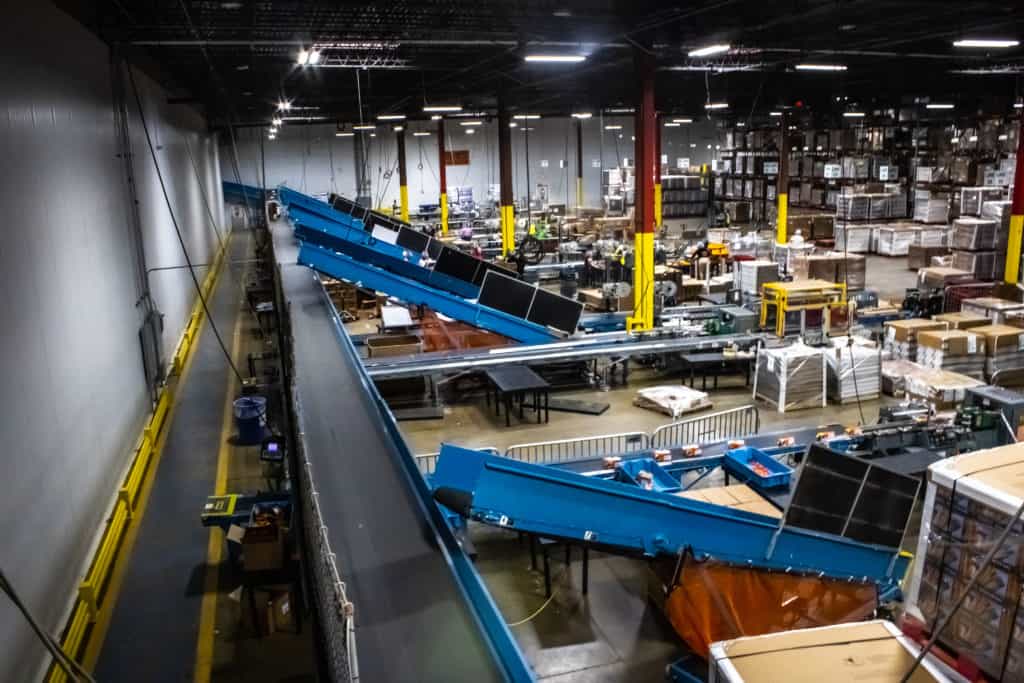
- Downtime. A belt that climbs the frame or snags a guard stops the line. Century’s post on common conveyor issues and routine repairs describes an eCommerce distribution center where a belt with uneven tracking frayed against the frame and tore during peak hours.
Conveyor belt tracking is also one of the first repairs a conveyor technician learns, because it touches every other part of the belt conveyor. If you understand why a belt tracks the way it does, you understand most of what can go wrong with it.
The One Rule: A Belt Moves Toward the End It Touches First
Every conveyor belt tracking adjustment follows one rule: a belt moves toward the end of the roller or pulley that it contacts first.
Picture a roller set perfectly square across the frame. The belt meets the whole width of the roller at the same moment, so nothing pushes it sideways. Now move one end of that roller slightly upstream, against the direction of belt travel. The belt reaches that end first, and as it wraps the roller it is steered toward that side. Move the same end downstream instead, and the belt is steered the other way.
That gives you a practical method:
- Decide which way the belt needs to move.
- On a snub or return roller near where the belt starts to drift, move the roller end on that side so the belt meets it first.
- Make a small move, then watch.
The same rule explains why debris causes conveyor belt tracking problems. A lump of tape or corrugate stuck to one end of a pulley makes that end slightly larger, and the belt contacts it first and drifts toward it. It also explains why a frame that is out of square sends a belt sideways even when every roller is bolted in its “correct” position: square to the frame is not square to the belt path if the frame itself is racked.
Some belt conveyors use crowned pulleys (slightly larger in diameter at the center) or V-guided belts with a guide strip that runs in a groove. These help a belt stay centered, but they don’t replace a square, clean, properly tensioned conveyor. A crowned pulley can’t fix a racked frame.
9 Common Causes of Poor Conveyor Belt Tracking
Most conveyor belt tracking problems come from a short list. Check these before you touch an adjustment bolt.
| Symptom | Likely cause | What to check |
|---|---|---|
| Belt runs to one side along the whole length | Frame out of square or bed not level side to side | Measure frame diagonals; check level across the bed; check supports and floor anchors |
| Belt drifts at one location only | One roller or pulley out of square | Check the snub, return, and carrying rollers nearest the drift point |
| Belt wanders at the same point every revolution | Splice not square, or belt is cambered (curved along its length) | Mark the splice and watch; check the splice against a square |
| Belt walks back and forth and never settles | Tension too low, or uneven tension side to side | Check take-up settings on both sides; set tension per the manufacturer |
| Belt drifts after running a while, then gets worse | Debris building on a pulley or roller | Inspect and clean pulleys, snub rollers, and return rollers |
| Belt drifts only when loaded | Off-center loading or side loading at a transfer | Watch how product lands on the belt; check upstream transfers and chutes |
| New belt won’t stay tracked | Normal initial stretch, or the belt was installed with uneven tension | Re-check tension and tracking after the break-in period the manufacturer specifies |
| Tracking changes with shifts or seasons | Temperature and humidity changing belt length | Re-check tension at the conditions the line normally runs in |
| Belt suddenly runs off after years of good tracking | Seized roller, failed bearing, damaged pulley lagging, or a bent frame | Spin every roller; listen for bearings; look for impact damage |
Frame and bed problems
The belt can only run as straight as the structure under it. If a forklift has nudged a support, a section has settled, or a frame was racked during a move, the conveyor isn’t square. The standard check is to measure the frame diagonals corner to corner over a section. If the two measurements don’t match, the frame is out of square and no roller adjustment will hold for long. The bed should also be level side to side; a belt drifts toward the low side.
Debris and buildup
In a warehouse, buildup is usually corrugate fiber, labels, stretch film, tape, and dust. On trash and corrugate takeaway lines it never stops. Material packs onto pulleys and snub rollers unevenly and changes their effective diameter, and the belt steers toward the high spot. Cleaning is often the whole fix. Century’s on-site service work includes removing buildup of corrugate fibers, stickers, tape, and other debris for this reason.
Splice and belt condition
A splice that isn’t square to the belt edge makes the belt shift each time the splice passes over a pulley. You’ll see the belt jump at the same point on every revolution. A belt that has been stored badly or damaged can also be cambered, which means its edge curves along the length instead of running straight. Neither problem can be fixed by adjustment. The splice has to be remade, or the belt replaced.
Tension
Too little tension lets the belt slip on the drive pulley and wander. Too much overloads bearings and shafts and can stretch the belt unevenly. Uneven take-up settings (one side tighter than the other) steer the belt like a skewed roller. Set tension to the conveyor manufacturer’s specification, equally on both sides, before you start tracking.
Loading
A belt with good conveyor belt tracking empty that drifts under load is usually being loaded off center. Product landing on one side of the belt, side transfers pushing cartons across, or a chute dropping product to one edge will all steer the belt. Ask operators to place product in the middle of the belt, and look at how upstream equipment delivers it.
Conveyor Belt Tracking Step by Step
Here is the general sequence technicians follow. Your conveyor manufacturer’s manual is the authority for your equipment, including where the adjustment points are and how much to move them.
This section is general information, not engineering or legal advice. Follow your facility’s lockout/tagout program and the manufacturer’s instructions for your specific conveyor.
1. Lock out and inspect
Stop the conveyor and apply your lockout/tagout procedure before anyone reaches into the frame. OSHA’s lockout/tagout standard, 29 CFR 1910.147, covers servicing and maintenance where unexpected start-up could injure someone. With the belt locked out, walk the full length of the conveyor and look for the causes in the table above: loose or missing supports, debris on pulleys and rollers, seized rollers, worn lagging, damaged belt edges, and a splice that isn’t square.
2. Fix the causes first
Clean the pulleys and rollers. Free or replace seized rollers. Tighten loose supports and check the frame diagonals. If the splice or belt is damaged, plan the repair or replacement before you spend time tracking. Conveyor belt tracking around a mechanical problem just means you’ll be back next week.
3. Set the tension
Adjust the take-up to the manufacturer’s tension specification, with both sides set evenly. Many manufacturers describe a starting point (for example, the minimum tension that drives the belt under load without slipping); use theirs rather than a rule of thumb.
4. Square the rollers and pulleys
Make sure the drive pulley, end pulley, snub rollers, and return rollers are square to the frame. On most unit-handling belt conveyors the drive and end pulleys are set square and left alone, and conveyor belt tracking adjustments are made on the snub and return rollers.
5. Run the belt empty and watch
Remove the lockout following your procedure, clear the area, and run the belt empty. Watch it for several full revolutions. Note where it starts to drift, which direction, and how far.
6. Make one small adjustment at a time
Stop and lock out the conveyor again. Using the rule (the belt moves toward the end it contacts first), adjust the snub or return roller nearest the point where the drift begins. Move it a small amount. Then restore power and run the belt for several revolutions before deciding whether it needs more. Large moves, or several adjustments at once, make it hard to tell what worked and often overcorrect.
Start with the rollers closest to the pulleys, where the belt changes direction. Adjust the carrying side and return side as the manufacturer directs.
7. Confirm under load
Once the belt runs centered empty, run normal product. If it drifts only under load, go back to the loading questions above before adjusting further.
8. Record what you did
Write down which rollers were adjusted, which way, and why. When the belt drifts again, that record tells the next technician whether the cause is new or the same one coming back. Century’s preventive maintenance visits produce a trip report for this reason.
Conveyor Belt Tracking on a Running Belt: Is It Safe?
Technicians observe a belt running; that’s the only way to see conveyor belt tracking at work. Making adjustments with hands near a moving belt is a different matter. Pinch points at snub rollers, pulleys, and return rollers can pull in fingers, gloves, sleeves, and rags in a fraction of a second.
OSHA treats servicing and maintenance as covered by lockout/tagout. There is a narrow exception for minor adjustments that are routine, repetitive, and integral to production, but only where the work is done using alternative measures that provide effective protection. Whether any running adjustment qualifies is a decision for your facility’s safety program and the equipment manufacturer, not the person holding the wrench. Some conveyors are designed with adjustment points that can be reached from outside the guarding; most warehouse belts are simply stopped and locked out between small moves.
Guarding matters here too. OSHA’s rules for mechanical power-transmission apparatus, 29 CFR 1910.219, cover belts, pulleys, sprockets, and chains, and require guarding where they’re within seven feet of the floor or working platform. Guards removed to track a belt go back on before the conveyor returns to production. The Conveyor Equipment Manufacturers Association also publishes conveyor safety resources, including safety labels for conveyor equipment.
Conveyor Belt Tracking on Inclines, Declines, and Takeaway Lines
Inclines and takeaway belts get their own conveyor belt tracking attention.
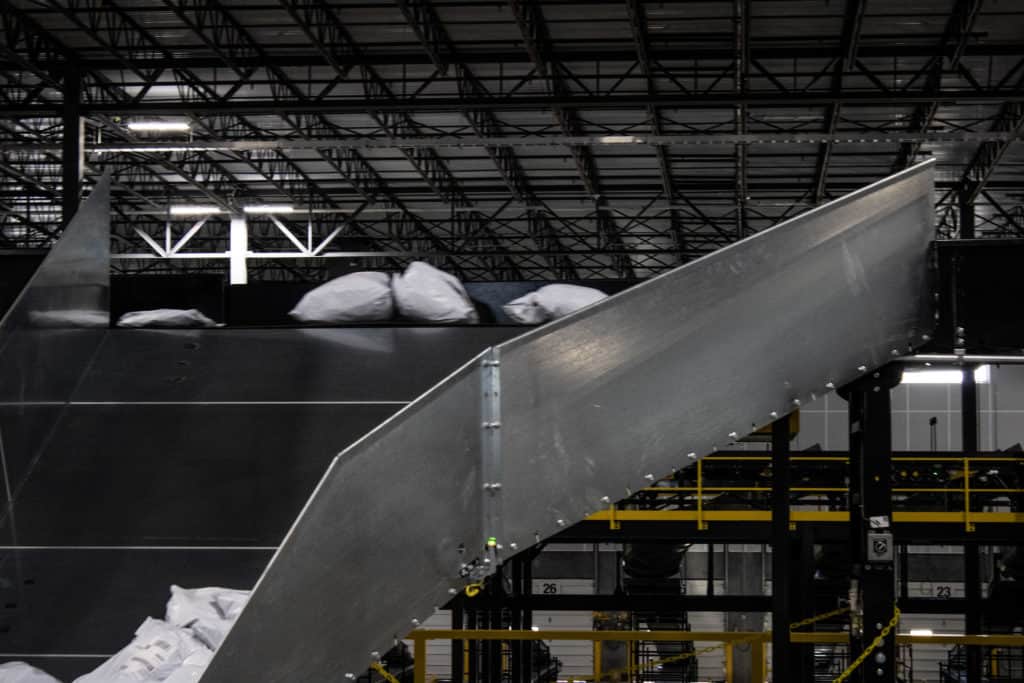
Incline and decline belts carry product against gravity, so the belt surface is usually a higher-grip material and the take-up works harder. Drift on an incline is more likely to spill or roll back product, and an incline that drifts under load is often being fed off center from the conveyor before it.
Trash and corrugate takeaway lines collect more debris than any other belt in the building. Century’s co-packing and corrugate disposal project is a good example of this kind of system: 16 portable Hytrol incline belt conveyors carry empty cartons up from pack stations to five Hytrol takeaway sections, which run in series to a baler. The design used belts so that even small pieces of paper and cardboard ride out on the system. On a line like that, cleaning pulleys and checking conveyor belt tracking belong on a short, regular schedule, because the same debris that the belt is built to carry will eventually build up on the rollers.
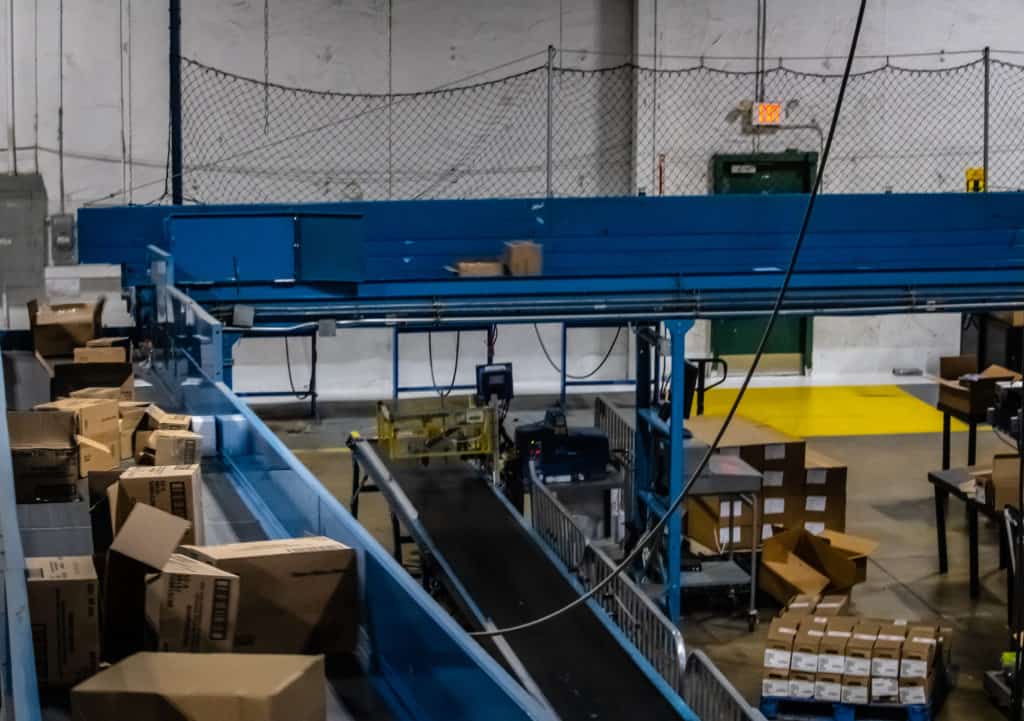
Transfers and waterfalls (one conveyor dropping product onto the next) load the receiving belt hard and sometimes off center. If the receiving belt drifts, watch where product actually lands.
When Conveyor Belt Tracking Means Something Bigger
A belt that needs conveyor belt tracking now and then is normal. A belt that needs it every week is telling you something. Call a technician when:
- The belt drifts again within days of a careful adjustment.
- The belt edge is frayed, curled, or burned, or there’s black belt dust under one side of the frame.
- The belt jumps at the same point on every revolution (splice or camber).
- A roller or pulley is noisy, hot, or won’t turn freely.
- The frame measures out of square, or a section has visibly shifted.
- You’ve already used most of the adjustment travel on a roller.
At that point the problem is usually mechanical: a bent frame, a failed bearing, worn lagging, a bad splice, or a belt at the end of its life. Fixing the cause costs less than replacing belts that keep wearing out on the same frame.
How Century’s Service Team Handles Conveyor Belt Tracking
Conveyor belt tracking corrections and alignment repairs are a standard part of Century’s on-site conveyor service, alongside belt replacement, roller and drive band replacement, lubrication, and cleaning debris from conveyor units. Technicians can be scheduled during non-peak hours so the work doesn’t interrupt a shift, and Century provides service and parts for most major conveyor manufacturers, including Hytrol, Honeywell Intelligrated, Dematic, and others.
For facilities that want conveyor belt tracking and the rest of the belt conveyor checked on a schedule, Century’s preventive maintenance program sends the same technician team on each visit and documents the work in a trip report, so drift that keeps coming back gets noticed and traced to its cause.
Why does my conveyor belt keep moving to one side?
A belt moves toward the end of the roller or pulley it contacts first, so anything that makes one side “first” steers it: a roller out of square, a frame that’s racked, debris built up on one end of a pulley, uneven tension, or product loaded off center. Fix the cause before adjusting the rollers.
Which way do I adjust a roller to move the belt?
Move the roller end on the side you want the belt to go so the belt meets that end first. In practice, that means moving that end slightly upstream, against the direction of belt travel. Make a small move and run the belt several revolutions before adjusting again.
Should I adjust the drive pulley or the snub rollers?
On most unit-handling belt conveyors, the drive and end pulleys are set square to the frame and left there. Conveyor belt tracking adjustments are made on the snub and return rollers near the pulleys. Check your manufacturer’s manual for the adjustment points on your conveyor.
Should a belt be tracked empty or loaded?
Both. Track the belt empty first so you can see how the conveyor itself steers it, then run normal product to confirm. A belt that tracks well empty and drifts under load usually points to off-center loading or side transfers.
How tight should a conveyor belt be?
Tight enough to drive the belt under load without slipping, and set evenly on both sides of the take-up. Over-tensioning wears bearings and can stretch the belt unevenly. Use the conveyor manufacturer’s tension specification.
Why won’t my new conveyor belt stay tracked?
New belts stretch during break-in, which changes tension and conveyor belt tracking. Re-check both after the break-in period the manufacturer specifies. If the belt still won’t settle, check the splice for squareness and the frame for squareness.
Is it safe to track a conveyor belt while it is running?
Observing a running belt is part of conveyor belt tracking, but adjustments near pinch points should be made with the conveyor stopped and locked out unless your safety program and the manufacturer allow a specific protected method. OSHA’s lockout/tagout rule is 29 CFR 1910.147.
When should I replace the belt instead of tracking it?
When the edge is badly frayed or curled, the belt is cambered, the splice keeps failing, or the belt won’t hold tracking after the frame, rollers, and tension have been corrected. At that point adjustment only delays a failure.
Keep Your Belts Running Straight
Conveyor belt tracking is a small adjustment with a big effect on belt life, product handling, and uptime. Get the structure square, keep the pulleys clean, set the tension right, and make small, patient adjustments, and most belts will run straight for a long time. When a belt keeps wandering, treat it as a symptom and find the cause.
Century Conveyor has been servicing conveyor systems since 1981, starting as a conveyor service company in northern New Jersey. If you have a belt that won’t stay tracked or want your belt conveyors checked on a schedule, request on-site conveyor service or contact our team.