Warehouses and distribution centers face an ongoing challenge: finding the right customized storage solutions. As inventory grows and customer expectations change, traditional storage arrangements may no longer provide the flexibility or performance businesses need. This is where customized storage solutions become an important investment.
Century Conveyor Systems helps businesses address these challenges through engineered material handling and warehouse automation systems. From shelving and pallet racking to mezzanines, picking modules, and automated storage and retrieval systems, Century offers solutions designed to support the specific requirements of modern warehouse environments.
Rather than relying on a one-size-fits-all approach, customized storage solutions consider the products being handled, available floor space, inventory movement, employee workflows, and long-term operational goals.
Below are some frequently asked questions about Century Conveyor Systems’ customized storage solutions and how they can help businesses create more efficient, productive warehouse environments.
Table of Contents
1. What Are Customized Storage Solutions, and Why Are They Important for Warehouse Operations?
Customized storage solutions are warehouse storage systems designed around the specific needs, inventory requirements, and operational processes of an individual facility. Instead of selecting standard shelving or racking based solely on available dimensions, businesses can implement storage configurations that accommodate their products, workflow, and space limitations.
For example, a distribution center handling large palletized products will have different storage requirements than an e-commerce fulfillment facility managing thousands of smaller individual items. A standard storage arrangement may not provide the accessibility, organization, or picking efficiency needed by both operations.
Century Conveyor Systems offers storage-related solutions that include shelving and racking, ergonomic picking and packing systems, automated storage and retrieval systems, mezzanines, platforms, and warehouse structures.
These options help businesses address several important operational considerations:
- Available warehouse space: Storage configurations can be planned around the facility’s dimensions, ceiling height, existing equipment, and available floor space.
- Inventory characteristics: Storage systems can accommodate different product dimensions, weights, quantities, and handling requirements.
- Workflow efficiency: Storage arrangements can reduce unnecessary movement between inventory locations, picking stations, and packing areas.
- Operational accessibility: Employees can access inventory through storage configurations that support the facility’s picking and replenishment processes.
- Future requirements: Businesses can consider anticipated inventory growth and operational changes when planning their storage infrastructure.
The importance of customization comes down to making the storage environment work for the business rather than forcing the business to work around an inefficient storage arrangement.
With an appropriately engineered solution, companies can improve how inventory is organized, accessed, and moved throughout their facilities.
2. How Can Customized Storage Solutions Maximize Available Warehouse Space?
Warehouse space is a valuable operational resource. When storage systems are poorly configured, businesses can lose significant amounts of usable space to inefficient aisles, inaccessible inventory, disorganized shelving, and unnecessary floor-level storage.
Customized storage solutions help address these problems by considering how a facility’s horizontal and vertical space can be used more effectively.
Century Conveyor Systems provides storage modules that include shelving, racking, mezzanines, platforms, and warehouse structures. These options give businesses different ways to organize inventory while making better use of their existing buildings.
For instance, mezzanines can introduce additional usable levels within a warehouse, allowing companies to take advantage of vertical space. Rather than immediately expanding their building footprint, businesses may be able to accommodate additional storage or operational areas within their existing facility.
Shelving and racking systems also help organize inventory according to product characteristics and accessibility requirements. Different configurations can support palletized goods, smaller individual items, and products that need to be accessed frequently.
A customized approach also considers the relationship between storage and movement. Increasing storage density without considering picking access, replenishment, and material handling can create congestion and slow down daily operations.
The objective is not simply to fit more products into a warehouse. It is to create a storage environment that balances capacity with accessibility and productivity.
By evaluating how inventory enters, occupies, and leaves the facility, Century can help businesses develop storage configurations that make more effective use of their available space.
3. What Types of Storage Systems Does Century Conveyor Systems Offer?
Different warehouse operations require different storage arrangements. The right system depends on factors such as inventory size, product weight, storage volume, picking frequency, available space, and the degree of automation required.
Century Conveyor Systems offers several storage-related technologies and infrastructure options to help businesses meet these varying requirements.
Shelving and racking systems
Shelving and racking provide structured locations for storing inventory. They can help businesses organize products, establish consistent inventory locations, and improve access to stored materials.
These systems are particularly useful for warehouses that handle a variety of products and need clearly defined storage areas.
Ergonomic picking and packing solutions
Picking and packing operations depend heavily on how inventory is presented to employees. Storage configurations that support ergonomic workflows can help reduce unnecessary reaching, walking, and handling.
When storage and packing stations are properly coordinated, employees can retrieve products and prepare orders more efficiently.
Automated storage and retrieval systems
Automated storage and retrieval systems (AS/RS) use automated equipment and controls to store and retrieve inventory. These systems can help businesses reduce certain manual handling requirements and create more structured inventory movement.
They are particularly relevant for facilities seeking greater automation and improved control over storage and retrieval processes.
Mezzanines and platforms
Mezzanines and platforms provide additional usable levels within a facility. They can support storage areas, picking operations, and other warehouse functions, depending on the facility’s engineering and layout requirements.
Warehouse structures
Warehouse structures help establish the physical infrastructure needed to support storage and material handling operations.
The advantage of having multiple options is that businesses can select storage technologies based on their actual operational requirements rather than purchasing equipment that may not fit their processes.
4. How Do Customized Storage Solutions Improve Order Fulfillment?
Order fulfillment involves much more than retrieving an item from a shelf. It includes the entire process of receiving an order, locating inventory, picking products, transporting them through the facility, packing them, and preparing them for shipment.
Every unnecessary movement, delay, or handling error can affect the speed and accuracy of this process.
Century Conveyor Systems approaches order fulfillment as an integrated material handling operation. Its conveyor and robotic fulfillment solutions are engineered to optimize operational touchpoints, improve output performance, reduce errors that can lead to returns or product damage, and process items faster with fewer manual interactions.
Customized storage solutions contribute to this process by improving the relationship between inventory locations and order processing areas.
For example, consider an e-commerce distribution center that handles hundreds or thousands of orders daily. If frequently requested products are stored far away from picking and packing stations, employees may spend considerable time traveling throughout the warehouse.
A better-organized storage configuration can help position inventory according to operational priorities and picking requirements.
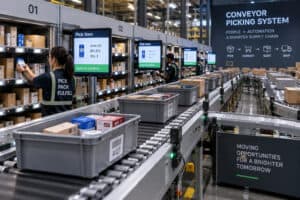
Storage systems can also work alongside conveyor equipment to create a more connected fulfillment process. Once an item is retrieved, conveyors can transport it to another processing area without requiring employees to manually carry products throughout the facility.
Century offers different conveyor technologies for these applications, including:
- Live roller and gravity conveyors for applications such as packing lines and manual induction.
- Belted conveyors for stable transportation of small parcels, polybags, and irregular carton sizes.
- Modular belt conveyors for specialized product handling and applications requiring easier belt maintenance.
- Conveyor diverts for directing cartons toward different processing destinations.
- Zero-pressure and minimum-pressure accumulation conveyors for managing product spacing and reducing contact between items.
- Extendable conveyors for loading and unloading operations.
Robotic fulfillment technologies, including automated guided vehicles (AGVs) and autonomous mobile robots (AMRs), can further support material movement.
When storage, picking, conveying, and automation are considered together, businesses can create a more coordinated fulfillment environment that supports faster and more accurate order processing.
5. Can Customized Storage Solutions Be Integrated With Existing Warehouse Automation?
Yes. One of the most important considerations when planning a warehouse storage project is ensuring that the new equipment works effectively with the facility’s existing infrastructure.
Businesses may already have conveyors, warehouse management software, picking stations, robotic equipment, or other material handling systems in place. Replacing everything simply to improve storage capacity may be unnecessary and expensive.
A customized approach considers how new storage infrastructure can complement the equipment and processes already operating within the facility.
Century Conveyor Systems provides material handling integration services that extend beyond storage equipment. Its capabilities include conveyor systems, robotic fulfillment, controls and software, programmable logic controls (PLC), warehouse management systems (WMS), and warehouse control systems (WCS).
This broader range of capabilities is important because storage does not operate independently from the rest of a warehouse.
For example, a business introducing additional picking modules may need to consider how retrieved products will move to packing stations. A facility installing automated storage equipment may also need to coordinate inventory movements with its existing controls and warehouse software.
Similarly, adding a mezzanine or elevated picking area may require consideration of how products will move between different facility levels.
By evaluating the complete material handling environment, businesses can avoid creating isolated storage improvements that introduce new operational bottlenecks elsewhere.
Century’s system integration capabilities allow storage projects to be considered as part of a larger warehouse automation strategy.
6. How Do Customized Storage Solutions Support Business Growth and Changing Inventory Demands?
Warehouse requirements rarely remain the same forever. Businesses experience seasonal demand, introduce new products, expand distribution networks, and adjust inventory strategies to accommodate changing customer expectations.
A storage system that works well today may become less effective as product volumes and operational requirements increase.
Customized storage solutions help businesses account for these changes by considering long-term requirements during the initial planning process.
For example, a growing distribution center may eventually need additional storage locations, more picking capacity, or increased transportation capacity between warehouse departments.
If these requirements are considered early, businesses can make more informed decisions about the storage infrastructure they install.
Century’s broader automation portfolio also includes scalable robotic fulfillment options. Its AGV and AMR solutions can support warehouse transportation requirements, with additional systems implemented as operational needs develop.
AMRs are particularly flexible because they navigate through a facility without requiring fixed tracks. They can transport totes, cartons, and carts and can support goods-to-person applications in which inventory is brought to employees at fulfillment stations.
AGVs, meanwhile, can be configured for more defined transportation routes and can handle pallets, cartons, and other products depending on their attachments and applications.
Although storage equipment and mobile robotics serve different functions, combining them can help businesses develop a more adaptable material handling environment.
The key is to plan storage capacity, inventory accessibility, and transportation requirements together. This creates a stronger foundation for accommodating future growth without unnecessarily disrupting current operations.
7. Why Is Professional Engineering Important When Designing Customized Storage Solutions?
Choosing warehouse storage equipment based on dimensions and price alone can overlook important operational considerations.
A storage configuration must account for the facility’s physical characteristics, the products being handled, employee workflows, material movement, equipment compatibility, and safety requirements.
Professional engineering helps bring these considerations together before installation begins.
Century Conveyor Systems is a full-service material handling systems integrator. Its project capabilities include system design, validation, implementation, installation, and startup support.
This turnkey approach is valuable because warehouse projects often involve multiple interconnected systems and disciplines.
For example, installing a new storage structure may require coordination with conveyors, electrical equipment, controls, and other warehouse infrastructure. Without appropriate planning, individual components may not work together as intended.
Century also provides mechanical engineering, controls engineering, electrical installation, mechanical installation, project management, and project phasing services.
These capabilities support a more organized project process, from initial planning through implementation.
Engineering also helps businesses evaluate the practical limitations of their facilities. Ceiling clearances, floor conditions, aisle dimensions, product weights, access requirements, and existing equipment all influence which storage configurations are appropriate.
Rather than selecting a system simply because it offers additional storage capacity, businesses should consider whether it will improve the overall performance of their operations.
Professional system design helps establish that connection between equipment selection and measurable warehouse objectives.
8. What Should Businesses Consider Before Investing in Customized Storage Solutions?
Before implementing a new storage system, businesses should evaluate their current warehouse operations and identify the problems they want to solve.
A successful storage project begins with understanding the facility’s existing limitations and defining what an improved operation should accomplish.
Several considerations can help guide this process.
Inventory characteristics: Businesses should understand the dimensions, weights, quantities, and handling requirements of the products they store. These characteristics influence the types of shelving, racking, and automated equipment that may be appropriate.
Available space: Facility dimensions, ceiling height, floor space, existing structures, and aisle requirements all affect storage design.
Picking and replenishment workflows: Storage locations should support the way inventory is retrieved, replenished, and transported throughout the facility.
Order volume: Businesses should consider current order volumes as well as anticipated changes in demand. This helps determine whether manual storage arrangements, automated systems, or a combination of technologies may be appropriate.
Existing equipment: Current conveyors, software, controls, and material handling systems should be evaluated to identify integration opportunities.
Long-term maintenance: Storage and automation equipment should be considered in terms of ongoing maintenance, replacement parts, and service requirements.
Future expansion: Companies should determine whether the proposed system can accommodate additional inventory, equipment, or operational capacity in the future.
Having a clear understanding of these factors makes it easier to establish project priorities and communicate requirements to a systems integrator.
Century Conveyor Systems encourages businesses to provide project details when beginning the planning process so an automation expert can respond with appropriate next steps.
The more clearly a company defines its operational challenges, the easier it becomes to develop a solution aligned with its objectives.
9. Does Century Conveyor Systems Provide Support Beyond Customized Storage Solutions Installation?
Yes. A warehouse automation investment should be viewed as a long-term operational asset rather than a one-time equipment purchase.
Even a well-designed system requires ongoing attention to maintain performance, address mechanical issues, and replace components when necessary.
Century Conveyor Systems offers services that extend beyond initial system design and installation. Its capabilities include conveyor preventative maintenance, repair services, replacement parts, mechanical installation, controls engineering, and project support.
The company also highlights lifetime parts and service as part of its turnkey integration approach.
This ongoing support is important for businesses that rely on their material handling systems to keep daily warehouse operations moving.
For example, a conveyor breakdown can interrupt the movement of products between storage, picking, packing, and shipping areas. Having access to experienced service technicians and replacement equipment can help businesses address maintenance requirements and minimize operational disruption.
Century also offers conveyor service and parts capabilities, including preventative maintenance and equipment quotations.
Its website notes more than 40 years of conveyor experience and a service department with technicians serving the New Jersey, Pennsylvania, and New York metropolitan area.
By considering service and maintenance during the initial planning process, businesses can make more informed decisions about the long-term requirements of their storage and automation investments.
10. How Can Businesses Get Started With Customized Storage Solutions From Century Conveyor Systems?
The first step is to identify the specific warehouse challenges that a customized storage system should address.
Some businesses may need to increase storage capacity because inventory is growing. Others may want to improve picking efficiency, reduce manual material handling, integrate automation, or make better use of available vertical space.
Once these objectives are established, businesses can begin evaluating potential storage configurations and how they fit into the wider material handling operation.
Century Conveyor Systems works with businesses to engineer automation solutions for warehouses, distribution centers, and fulfillment facilities.
Its approach encompasses system design, validation, implementation, installation, startup support, and ongoing parts and service.
Companies interested in customized storage solutions can begin by sharing details about their facility and operational requirements.
Useful information to prepare includes:
- Current warehouse dimensions and layout.
- Types of products and inventory being stored.
- Existing shelving, racking, and material handling equipment.
- Current picking, packing, and replenishment processes.
- Average and peak order volumes.
- Current operational bottlenecks.
- Anticipated storage and fulfillment requirements.
- Long-term business growth objectives.
These details help establish a starting point for evaluating the right combination of storage infrastructure and automation technologies.
Businesses can visit Century Conveyor Systems online at www.centuryconveyor.com or contact its team to discuss an upcoming warehouse optimization project.
Final Thoughts: Why Choose Customized Storage Solutions for Your Warehouse?
An efficient warehouse requires more than sufficient storage capacity. It needs an organized environment in which inventory can be stored, accessed, retrieved, and transported without creating unnecessary delays or operational complications.
Customized storage solutions give businesses the opportunity to address these requirements through systems designed around their facilities and workflows.
Century Conveyor Systems offers a combination of shelving and racking, ergonomic picking and packing solutions, automated storage and retrieval systems, mezzanines, platforms, and warehouse structures. Its broader material handling capabilities also include conveyors, robotic fulfillment, controls engineering, and warehouse automation integration.
This combination allows businesses to approach storage as part of a complete operational strategy rather than an isolated equipment purchase.
Whether a company wants to maximize available space, improve order fulfillment, accommodate inventory growth, or introduce more automation, the right storage configuration can make a meaningful difference in warehouse productivity.
With its turnkey engineering, integration, installation, and support capabilities, Century Conveyor Systems helps businesses take a more comprehensive approach to warehouse efficiency and customized storage solutions.