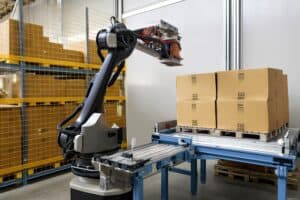
An effective human-machine interface (HMI System) system helps industrial operators monitor equipment, understand machine performance, and interact with automated processes. In conveyor applications, an HMI can make it easier to oversee material movement, identify operational issues, and coordinate equipment across a production or distribution facility. When integrated thoughtfully into a conveyor control system, it can also support more consistent operations, improve visibility, and simplify troubleshooting.
Century Conveyor Systems provides conveyor solutions and services for industrial material handling applications, including human-machine interface solutions. Understanding how an HMI system works, what it can contribute to a conveyor installation, and which factors matter during implementation can help businesses make informed decisions about their automation needs.
This FAQ explores the essential questions surrounding Century Conveyor Systems’ HMI system, from its basic functions and operational benefits to integration, usability, maintenance, and long-term planning.
Table of Contents
1. What Is an HMI System, and Why Is It Important for Conveyor Operations?
An HMI system, short for human-machine interface system, is the interface that allows people to interact with industrial machinery and automation equipment. It commonly consists of a touchscreen, display panel, or computer-based interface that presents information from a machine or control system and allows authorized users to issue commands.
In a conveyor environment, the HMI acts as an accessible point of interaction between operators and the equipment responsible for moving materials. Instead of relying exclusively on physical buttons, indicator lights, or separate control stations, operators may be able to view equipment status, monitor operating conditions, and access relevant controls through a centralized interface.
The importance of an HMI system extends beyond convenience. Conveyor installations can involve multiple motors, sensors, transfer points, safety devices, and interconnected equipment. As these systems become more complex, operators need a clear understanding of what the machinery is doing and where attention may be required.
A well-designed HMI can organize this information into understandable screens and status indicators. Depending on the equipment, controls, and software configuration, it may display conveyor operating states, alarms, fault messages, and process information. This visibility can help operators recognize abnormal conditions and communicate more effectively with maintenance personnel.
For businesses evaluating Century Conveyor Systems’ HMI services, the key consideration is how the interface supports the specific conveyor application. The goal is not simply to install a screen, but to create a practical way for personnel to monitor and manage the equipment they use every day.
2. How Does Century Conveyor Systems’ HMI System Support Industrial Automation?
An HMI system contributes to industrial automation by connecting machine information with the people responsible for overseeing production or material movement. While programmable logic controllers (PLCs) and other control components typically execute automated operations, the HMI provides a human-facing layer through which operators can observe the process and interact with supported functions.
Century Conveyor Systems’ HMI service is relevant to businesses that need an interface suited to their conveyor equipment and operational requirements. The precise capabilities of an installation depend on the system design, selected hardware, control architecture, and programmed functionality.
For example, an HMI associated with an automated conveyor line may provide a visual overview of equipment states, indicate whether particular sections are running or stopped, and present alarms when a monitored condition requires attention. Where supported by the controls and software, operators may also be able to select operating modes or issue authorized commands.
This arrangement can make automation easier to manage because personnel have a more direct view of the process. Rather than interpreting information from disconnected devices, an operator may be able to consult a unified interface to understand the status of important equipment.
An HMI also supports communication between operational needs and automated responses. If a fault occurs, the interface may display information that helps an operator identify the affected conveyor section or determine whether maintenance assistance is necessary. The control system remains responsible for executing its programmed logic, while the HMI helps personnel understand and supervise that activity.
The most effective implementation begins with a clear understanding of how employees interact with the conveyor system, what information they need, and which actions they are authorized to perform. This ensures that the interface serves a practical operational purpose rather than adding unnecessary complexity.
3. What Are the Main Benefits of an HMI System for Conveyor Systems?
The benefits of an HMI system depend on the application, but several areas are especially important for conveyor operations: visibility, troubleshooting, operational consistency, and access to relevant information.
Improved operational visibility: An HMI can bring equipment status and process information into one interface. Operators may be able to determine which sections are operating, which are stopped, and whether an alarm needs attention. This is particularly useful when a facility relies on several connected conveyors or automated material handling stages.
More efficient troubleshooting: When a conveyor stops unexpectedly, maintenance personnel need to identify the source of the problem. An appropriately configured HMI may display fault messages, alarm histories, or equipment status information that narrows the investigation. Faster access to useful information can reduce the time spent diagnosing an issue, although the actual improvement depends on the quality of the diagnostics and the nature of the fault.
More consistent operation: A thoughtfully organized interface can present controls and operating information in a predictable format. This can help trained employees follow established procedures and reduce uncertainty when switching between operating modes or monitoring different sections of equipment.
Better access to process information: Depending on the installation, an HMI may display information such as operating states, sensor conditions, fault notifications, or production-related data. Bringing these details together can help personnel understand the relationship between equipment behavior and material flow.
Support for maintenance planning: Alarm records and diagnostic information, when available, can help maintenance teams recognize recurring problems and investigate equipment that repeatedly stops or generates faults. An HMI does not automatically prevent breakdowns, but the information it provides may support more informed maintenance decisions.
These benefits should be evaluated against the needs of the specific facility. A small conveyor installation may require only a straightforward operator panel, while a larger automated system may benefit from a more comprehensive interface with multiple equipment views and detailed diagnostics. The appropriate solution is the one that provides useful information without overwhelming the people who operate it.Writing
4. How Can an HMI System Help Reduce Conveyor Downtime?
Unplanned conveyor downtime can disrupt production schedules, delay order fulfillment, and create bottlenecks throughout a material handling operation. An HMI system can help address this challenge by making equipment conditions easier to monitor and faults easier to investigate.
When a conveyor stops, the immediate challenge is often determining why it stopped. The cause might involve a sensor signal, a motor fault, a blocked transfer point, a safety device, or another condition within the control system. Without clear diagnostic information, operators may need to inspect several components before identifying the issue.
A properly configured HMI can provide relevant alarms and status messages that guide the initial investigation. If the interface identifies the affected equipment or displays a fault associated with a particular component, maintenance personnel can begin troubleshooting with a more focused understanding of the problem.
This is valuable because downtime management depends on both the speed of detection and the ability to identify the underlying cause. An HMI may help shorten the information-gathering stage, allowing teams to determine their next steps more efficiently.
However, an HMI system should not be viewed as a guarantee against downtime. It does not automatically eliminate mechanical wear, electrical failures, or material handling obstructions. Its value lies in making available information easier to interpret and act upon.
For Century Conveyor Systems’ customers, the practical question is how the HMI can be configured to provide meaningful diagnostic support for the equipment being installed or maintained. Clear alarm descriptions, logical screen organization, and useful equipment status information can all contribute to a more manageable troubleshooting process.
5. Can an HMI System Be Customized for Different Conveyor Applications?
Yes. HMI systems can be configured to reflect the equipment, operating procedures, and information requirements of individual facilities. Customization is important because a conveyor system used in a distribution center may have different monitoring requirements from one used in manufacturing, packaging, or another industrial environment.
The first consideration is the equipment itself. A facility with a single conveyor may need a relatively simple display showing operating status and a limited number of controls. A larger installation with multiple conveyor zones, accumulation sections, transfer points, and automated equipment may require a more detailed interface.
The second consideration is the operator’s responsibilities. Employees who oversee routine material movement may need quick access to equipment status and basic operating controls. Maintenance technicians, depending on their permissions and the system design, may require additional diagnostic information to investigate faults and support repairs.
Screen layout is another important factor. Equipment should be represented in a way that helps users understand the physical or logical relationship between conveyor sections. Consistent terminology, recognizable status indicators, and clearly organized alarms can make the interface easier to learn and use.
Customization may also involve determining which information deserves the greatest visibility. Frequent operational tasks should generally be straightforward to locate, while specialized settings and maintenance functions should be organized appropriately for authorized personnel.
The exact customization options available through Century Conveyor Systems depend on the project scope and control system requirements. Businesses should discuss their equipment configuration, preferred operating procedures, existing automation components, and future plans before finalizing an HMI design.
6. How Does an HMI System Integrate With Existing Conveyor Controls?
Integration is one of the most important considerations when selecting an HMI system for a new or existing conveyor installation. An interface must communicate appropriately with the underlying control architecture to display meaningful information and perform its intended functions.
In many industrial applications, the HMI communicates with a programmable logic controller or another compatible control system. The controller manages programmed machine logic and receives information from field devices such as sensors and motor controls. The HMI presents selected information to operators and, where permitted, sends commands through the control system.
Successful integration requires compatibility between the HMI hardware, software, communication protocols, and existing controls. Engineers must also determine which operating data should be displayed and which commands should be available through the interface.
For an existing conveyor installation, the process may involve reviewing the current control architecture, identifying available communication interfaces, and determining whether the existing equipment can provide the information needed by the new HMI. Depending on the system’s age and configuration, integration could require software changes, hardware upgrades, or modifications to the control program.
A new conveyor installation presents an opportunity to consider the interface during the broader system design process. This can help align the operator screens, equipment layout, control logic, and troubleshooting requirements from the beginning.
Century Conveyor Systems can be approached to discuss how its HMI services fit the requirements of a particular conveyor project. Before implementation, businesses should clarify the scope of integration, the components involved, the testing process, and any operational interruptions that may be necessary.
7. What Should Businesses Consider When Choosing an HMI System?
Choosing an HMI system requires more than comparing display sizes or selecting a touchscreen. The right solution should reflect the facility’s operational complexity, employee needs, existing automation infrastructure, and long-term maintenance requirements.
Operational requirements: Begin by identifying the tasks operators need to perform. Determine whether the interface must monitor one conveyor, coordinate multiple zones, display alarms, provide diagnostic information, or support other specific functions.
Ease of use: Operators should be able to understand the screen layout and locate essential information without unnecessary navigation. Clear labels, consistent terminology, and logical grouping can make a substantial difference in everyday usability.
Compatibility: The HMI must work with the selected or existing control hardware and communication architecture. Compatibility should be confirmed during the engineering stage rather than assumed.
Environmental conditions: Industrial interfaces may operate in environments with dust, vibration, temperature fluctuations, or frequent cleaning. The physical panel and its enclosure should be appropriate for the location in which they will be installed.
Maintenance and support: Businesses should understand how the HMI will be maintained, how software changes will be managed, and what documentation will be available. These details can influence the long-term cost and practicality of the installation.
Future expansion: A conveyor system may evolve as production requirements change. Considering possible additional equipment, new operating screens, or expanded diagnostic needs can help prevent the interface from becoming a limitation later.
By reviewing these factors with Century Conveyor Systems, businesses can establish a clearer set of requirements and determine which HMI approach best supports their operation.
8. How Does an HMI System Improve Operator Training and Everyday Usability?
An HMI system can help make conveyor operations more understandable by presenting machine information in a consistent, visual format. This is particularly useful when operators need to learn how different equipment sections interact or understand what to do when an abnormal condition occurs.
A well-organized interface can show equipment states, identify relevant alarms, and provide a consistent location for commonly used controls. Instead of learning separate procedures for multiple disconnected control panels, employees may be able to use a more unified interface to understand the system.
For training purposes, consistent screen layouts and clear terminology can help new personnel become familiar with routine tasks. Visual representations of conveyor sections may also make it easier to explain how material moves through the installation and where interruptions can affect downstream processes.
Nevertheless, an HMI is a support tool rather than a replacement for formal training. Operators must understand the equipment, follow established procedures, and know when to contact maintenance personnel. They should also be trained to interpret alarms correctly and avoid making unauthorized changes.
Safety remains essential. Emergency stops, protective devices, and other safety-related functions must be designed and implemented according to the applicable engineering requirements. An ordinary HMI command should never be assumed to replace a dedicated safety function.
For Century Conveyor Systems’ HMI applications, usability should be considered alongside technical functionality. An interface that presents the right information in a clear and consistent manner can be more valuable than one that offers numerous features that operators rarely need.
9. Can an HMI System Support Long-Term Conveyor Maintenance?
An HMI system can contribute to long-term maintenance by making equipment information more accessible and, when supported, providing diagnostic details or records of recurring faults.
For example, repeated alarms associated with a conveyor motor, sensor, or transfer point may indicate that a component requires closer inspection. Maintenance personnel can use available information to investigate the underlying cause rather than treating each interruption as an unrelated event.
Some HMI configurations also work alongside supervisory control and data acquisition (SCADA) systems, historians, or maintenance software. Depending on the installation, these connected systems may provide more extensive data collection, reporting, or analysis than the operator interface alone.
It is important to distinguish between capabilities that are built into an HMI and those that require additional software or hardware. Historical reporting, remote access, predictive analytics, and automated maintenance notifications are not guaranteed features of every HMI system.
Long-term reliability also depends on maintaining the interface itself. Software backups, controlled configuration changes, appropriate access permissions, and up-to-date documentation can help businesses preserve the integrity of their control systems.
When planning an HMI installation with Century Conveyor Systems, businesses should ask which diagnostic and maintenance functions are included, what additional integrations may be available, and how the system can be supported throughout its operating life.
10. How Can Businesses Get Started With Century Conveyor Systems’ HMI Services?
The most effective starting point is a discussion about the conveyor application’s current challenges and desired outcomes. Businesses should identify whether they are planning a new conveyor installation, upgrading an existing control system, or looking to improve operator visibility and troubleshooting.
Useful information to prepare includes the conveyor layout, existing PLC and control hardware, communication requirements, operating procedures, and any recurring problems that the new interface should help address. It is also helpful to identify who will use the HMI and what information each group needs.
From there, the project team can discuss the appropriate interface structure, required functionality, integration considerations, and implementation scope. Testing and commissioning should verify that displayed information is accurate, controls behave as intended, and operators understand the interface before the system is placed into normal service.
Businesses can learn more about Century Conveyor Systems and its conveyor-related capabilities by visiting its website and reviewing the company’s human-machine interface services. A direct conversation can help establish whether the available services align with the specific needs of the proposed project.
Conclusion: Is a Century Conveyor Systems HMI System Worth Considering?
An HMI system is an important part of the operator experience in an automated conveyor environment. By presenting equipment status, relevant alarms, and supported controls in an accessible interface, it can help personnel understand operations, troubleshoot problems, and manage material movement more effectively.
Century Conveyor Systems’ HMI services are worth exploring for businesses seeking an interface that supports their conveyor control requirements. The right solution will depend on equipment compatibility, operational complexity, usability, maintenance needs, and the functions required at the facility.
Ultimately, the objective is to make conveyor automation easier to monitor and manage. By defining operational priorities and evaluating integration requirements before implementation, businesses can make a more informed decision about the HMI system that best supports their long-term material handling goals.