The growing demands of modern warehousing and distribution have made automated logistics systems an increasingly important investment for businesses looking to improve efficiency, increase order throughput, and manage operational costs. As customer expectations for faster deliveries continue to rise, companies need dependable solutions that can move products, manage inventory workflows, and streamline fulfillment operations without relying entirely on manual labor.
Automated logistics systems offer a practical way to address these challenges. By integrating conveyor equipment, robotic technologies, warehouse controls, and intelligent material handling solutions, businesses can create more efficient distribution environments that support both current operational demands and future growth.
Century Conveyor Systems specializes in designing, engineering, installing, and supporting automated material handling solutions for warehouses, distribution centers, and fulfillment facilities. Its approach combines multiple automation technologies into integrated systems designed around the specific requirements of each operation.
Below, we answer some of the most frequently asked questions about Century Conveyor Systems’ automated logistics systems and explain how these solutions can help businesses improve their material handling and order fulfillment processes.
Table of Contents
1. What Are Automated Logistics Systems, and How Does Century Conveyor Systems Approach Automation?
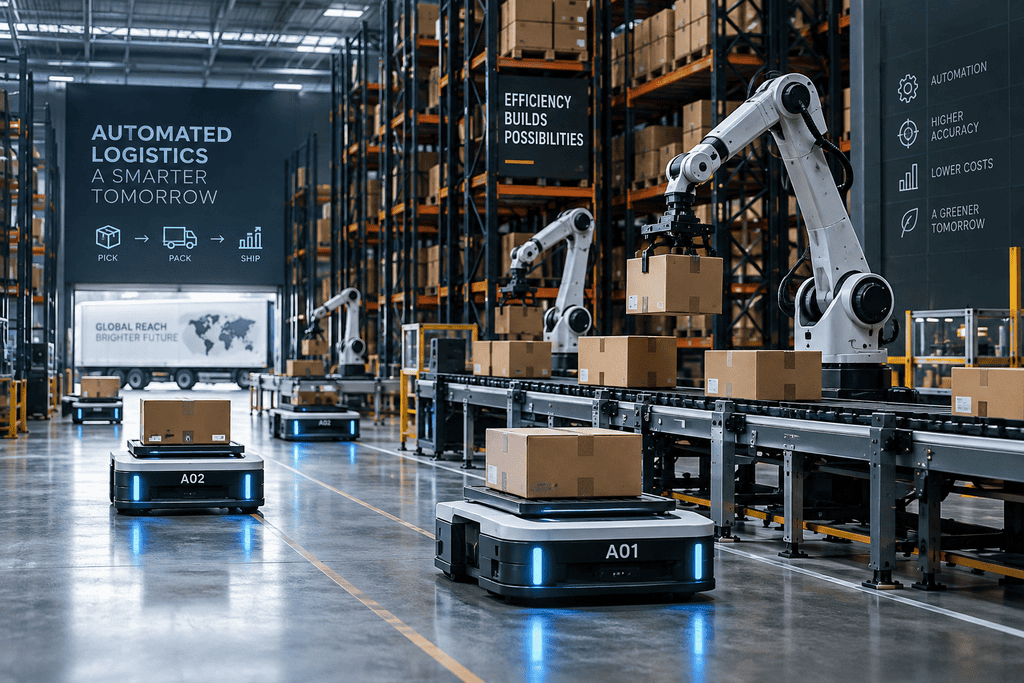
Automated logistics systems are integrated technologies and equipment designed to move, sort, store, and process products throughout a warehouse or distribution center with fewer manual interactions. Rather than relying on employees to transport every carton, pallet, or package between operational areas, automation uses mechanical equipment, robotics, and software controls to coordinate material movement.
Century Conveyor Systems takes a comprehensive approach to automated logistics systems by engineering solutions that address the complete material handling process. Rather than treating individual pieces of equipment as isolated investments, the company focuses on developing systems that work together to support the facility’s operational goals.
Its capabilities include several important technologies:
- Conveyor systems: Belt, roller, pallet, and extendable conveyors transport products between different warehouse operations.
- Sortation systems: Automated sorting equipment directs packages toward their appropriate destinations, shipping lanes, or processing areas.
- Robotic fulfillment: Automated guided vehicles (AGVs) and autonomous mobile robots (AMRs) help transport products, cartons, and totes throughout facilities.
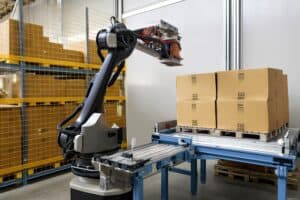
- Robotic palletizing: Robotic arms and automated palletizing equipment streamline the process of organizing products onto pallets.
- Warehouse controls and software: Programmable logic controllers (PLCs), warehouse management systems (WMS), and warehouse control systems (WCS) coordinate equipment and material movement.
- Storage and picking solutions: Shelving, racking, mezzanines, and automated storage technologies help businesses organize inventory and improve accessibility.
By bringing these capabilities together, Century helps businesses develop an automated logistics systems strategy that reflects their facility layout, product characteristics, order volumes, and long-term objectives.
The primary advantage of this integrated approach is that businesses can improve multiple operational processes rather than addressing only one isolated bottleneck.
2. How Can Automated Logistics Systems Improve Warehouse Order Fulfillment?
Order fulfillment involves every step between receiving an order and preparing the associated products for shipment. This includes picking, transporting, consolidating, packing, sorting, and moving completed orders to the shipping dock.
When these processes depend heavily on manual transportation and handling, employees can spend significant amounts of time moving products between workstations instead of completing tasks that directly contribute to order processing.
Century Conveyor Systems designs automated order fulfillment solutions to reduce unnecessary movement, improve throughput, and create more efficient workflows.
Conveyor systems are particularly important because they establish consistent transportation pathways throughout a facility. Products can move between picking areas, packing stations, sortation equipment, and shipping operations without requiring employees to manually carry or transport every item.
Additional technologies can further improve fulfillment performance. For example, automated diverts can direct cartons toward designated processing lines, while robotic systems can transport inventory or completed orders between different operational areas.
These improvements offer several advantages:
- Reduced time spent transporting products manually.
- More consistent movement between fulfillment stages.
- Improved coordination between picking, packing, and shipping.
- Fewer opportunities for handling-related product damage.
- Increased capacity to process orders during periods of high demand.
Century’s approach also considers how each touchpoint affects the overall fulfillment process. Improving the speed of one workstation will have limited value if products continue to accumulate at another stage.
By engineering the complete workflow, businesses can create a more balanced operation in which equipment, employees, and technology work together to maintain consistent productivity.
3. What Types of Automated Logistics Systems Are Available Through Century Conveyor Systems?
Conveyors are among the most important components of automated logistics systems because they provide the physical infrastructure necessary to move products throughout a facility.
However, not every product requires the same type of transportation equipment. Cartons, polybags, pallets, drums, and oversized materials have different handling requirements. Selecting the appropriate conveyor technology is essential for maintaining reliable product movement and avoiding unnecessary operational complications.
Century Conveyor Systems offers several conveyor configurations designed for different applications.
Live roller and gravity conveyors
Live roller conveyors use powered rollers to transport cartons and other materials, while gravity conveyors rely on gravity to move products along the conveyor bed.
These systems are commonly used in packing lines, divert operations, and end-of-line applications. Gravity conveyors can be especially useful in areas where manual induction or straightforward product movement is required.
Belt conveyors
Belt conveyors provide a stable transportation surface that works particularly well for smaller packages, polybags, irregular carton sizes, and products that may not move reliably across rollers.
They can also accommodate inclines, declines, and product spacing requirements, making them useful in facilities that need greater flexibility in their transportation layouts.
Modular belt conveyors
Modular belt conveyors use interconnected belt sections instead of a single traditional belt. Their construction allows individual sections to be removed, cleaned, or modified more easily.
These conveyors can be particularly beneficial in specialized product handling applications where traction, tight transfers, or easier maintenance are important considerations.
Pallet conveyors
Pallet conveyors are designed to handle heavier products and larger loads. Depending on the application, Century can incorporate pallet drag chains, gravity systems, chain-driven live rollers, and Poly-V conveyors.
Extendable conveyors
Extendable conveyors are telescoping systems that can extend into trailers to help transport packages directly to loading associates. Once loading is complete, the equipment can retract.
This can reduce the distance employees need to travel while loading trucks and create a more efficient shipping operation.
Choosing the right conveyor configuration requires an understanding of the products being handled, the facility’s available space, throughput expectations, and the relationship between different warehouse processes.
4. Can Automated Logistics Systems Reduce Labor Costs Without Sacrificing Productivity?
Yes. One of the primary reasons businesses invest in automated logistics systems is to reduce the amount of repetitive manual work required to keep warehouse operations moving.
However, reducing labor costs does not necessarily mean eliminating employees. Instead, automation allows businesses to use their existing workforce more strategically.
Consider a warehouse where employees regularly transport cartons between picking stations, packing areas, and shipping docks. These transportation tasks consume time that could otherwise be spent on order processing, quality checks, exception handling, and other important responsibilities.
By introducing conveyor systems and mobile robotics, businesses can automate many of these repetitive transportation activities.
Century Conveyor Systems offers technologies that address different types of labor-intensive operations.
For example, AGVs can transport pallets, cartons, or other materials along established routes. AMRs offer additional flexibility because they can navigate facilities without being restricted to fixed tracks. These technologies can support goods-to-person operations, end-of-line transportation, and other material handling applications.
Robotic palletizing systems can also reduce the physical demands associated with repeatedly stacking products onto pallets.
The resulting benefits extend beyond immediate labor savings. Businesses may also experience:
- More consistent material transportation.
- Reduced employee fatigue from repetitive handling.
- Better allocation of employees across operational departments.
- Increased ability to process higher order volumes.
- Less dependence on manual transportation between workstations.
The most effective automation strategies identify tasks that consume significant employee time without requiring extensive human judgment.
By automating these activities, businesses can improve productivity while allowing employees to focus on responsibilities where their experience and decision-making provide greater value.
5. How Do Century Conveyor Systems’ Automated Logistics Systems Help Prevent Product Damage and Fulfillment Errors?
Product damage and fulfillment mistakes can create expensive problems for warehouses and distribution centers. Damaged shipments may require replacements, additional transportation, customer service involvement, and returns processing.
Similarly, incorrect sorting or inefficient product handling can delay shipments and negatively affect the customer experience.
Automated logistics systems can help reduce these problems by creating more controlled and consistent material handling processes.
Century Conveyor Systems incorporates several equipment options designed to improve product handling throughout a facility.
One example is zero-pressure accumulation conveyor technology. These systems use sensors and controls to maintain separation between individual products as they move along a conveyor line.
By preventing packages from touching one another, zero-pressure accumulation can help reduce the possibility of damage caused by contact between products.
Minimum-pressure accumulation offers a different approach. Instead of maintaining complete separation, the system allows products to make light contact when necessary.
Automated conveyor diverts also contribute to more organized material movement by directing packages toward designated destinations. This helps reduce the need for employees to manually reposition every carton as it moves through the facility.
When combined with appropriate warehouse controls, automated sorting and transportation can also improve process consistency.
It is important to recognize that automation does not automatically eliminate every fulfillment error. Accurate inventory information, properly configured software, employee training, and equipment maintenance remain essential.
However, a well-engineered system can reduce unnecessary handling, establish more predictable workflows, and minimize opportunities for avoidable mistakes.
6. Are Century Conveyor Systems’ Automated Logistics Systems Scalable for Growing Businesses?
Scalability is an important consideration when investing in warehouse automation. A system that meets today’s requirements should also support reasonable increases in order volume, inventory movement, and operational complexity.
Businesses that install automation without considering future growth may eventually discover that their equipment cannot accommodate additional demand without significant modifications.
Century Conveyor Systems addresses this challenge by engineering solutions around each facility’s operational requirements and potential expansion needs.
Some automation technologies are particularly well suited to incremental implementation.
For example, AGVs and AMRs can offer flexibility because additional robotic units can be introduced as operational requirements change. Unlike many fixed conveyor installations, mobile robotic systems are not permanently restricted to a single physical route.
Conveyor systems can also be designed with additional automation capabilities in mind. Businesses may initially implement basic transportation equipment and incorporate additional sortation, controls, or robotic technologies as their needs evolve.
This makes it possible to approach automation as a longer-term investment rather than requiring every potential upgrade to be installed immediately.
Scalability also involves considering how individual technologies interact. Adding more conveyor capacity will not necessarily improve overall throughput if packing stations, sortation equipment, or shipping operations cannot handle the increased volume.
Century’s engineering approach considers the broader facility workflow so that automation investments support the performance of the complete operation.
For businesses anticipating growth, this forward-looking planning can help protect the value of their investment and reduce the likelihood of costly redesigns.
7. Does Century Conveyor Systems Handle the Design, Installation, and Integration of Automated Logistics Systems?
Yes. Century Conveyor Systems provides turnkey material handling automation services, meaning businesses can work with one integration partner throughout multiple stages of an automation project.
Implementing automated logistics systems involves considerably more than purchasing equipment. Businesses must evaluate facility requirements, determine appropriate technologies, develop equipment layouts, coordinate controls, manage installation, and validate system performance.
Century’s services cover several important stages of this process.
System design and engineering: The project begins with understanding the facility’s requirements and identifying opportunities to improve material movement, throughput, and operational efficiency.
Controls engineering: Automated equipment requires properly configured controls to coordinate transportation, sortation, and other processes. Century provides controls engineering, programmable logic controls, and control panel design and fabrication.
Project management: Coordinating equipment, installation activities, and project schedules is essential for keeping automation projects organized.
Mechanical and electrical installation: Proper installation ensures that equipment is positioned, connected, and configured to work within the facility’s operating environment.
System validation and startup: Before an automated system becomes fully operational, its equipment and controls must be checked to verify that the installation functions as intended.
Ongoing service and maintenance: Preventative maintenance, repairs, replacement parts, and technical support help businesses maintain their automation investments over time.
Having one integration partner coordinate these stages can make complex projects easier to manage. It also provides greater continuity between the original engineering decisions and the final installed system.
8. What Ongoing Support Is Available After an Automated Logistics System Is Installed?
Automation is a long-term operational investment, and maintaining equipment performance is just as important as selecting the right technology.
Conveyor breakdowns, worn components, electrical issues, and improperly maintained equipment can interrupt material movement and create bottlenecks throughout a warehouse.
Century Conveyor Systems offers ongoing service and parts support to help businesses maintain their conveyor and material handling equipment.
Its capabilities include conveyor preventative maintenance, mechanical repairs, replacement parts, equipment installation, and technical support.
The company also provides 24/7 support services and has an established conveyor service department with experienced technicians and service vehicles.
Preventative maintenance is particularly important because it helps identify potential equipment problems before they develop into more serious operational disruptions.
For example, regularly inspecting conveyor belts, rollers, motors, and other mechanical components can help identify wear that may affect system reliability.
Maintaining accurate information about replacement parts is another important consideration. Having access to the correct components can simplify repairs and reduce the time spent identifying equipment requirements.
Century’s support capabilities help businesses consider equipment maintenance as part of their overall automation strategy rather than treating it as an afterthought.
The goal is to help facilities maintain dependable operations throughout the useful life of their material handling systems.
9. How Should a Business Determine Which Automated Logistics System Is Right for Its Facility?
There is no universal automation solution that works equally well for every warehouse or distribution center.
The right system depends on several factors, including facility size, product characteristics, order volume, available labor, existing equipment, and future business objectives.
Before investing in automated logistics systems, businesses should evaluate their current operations to identify the processes that create the greatest inefficiencies.
For example, a facility experiencing excessive manual transportation may benefit most from conveyor systems or mobile robotics. A distribution center struggling with package routing may need automated sortation equipment. A business experiencing palletizing bottlenecks may benefit from robotic palletizing solutions.
Other important considerations include:
- Product dimensions and weight: Equipment must accommodate the materials being transported, including cartons, polybags, pallets, and oversized products.
- Facility layout: Available floor space, ceiling height, dock locations, and existing infrastructure influence equipment selection.
- Throughput requirements: The system must support current order volumes while allowing for anticipated growth.
- Existing technology: New automation should integrate appropriately with existing warehouse management and control systems.
- Maintenance requirements: Equipment reliability, replacement parts, and service availability should be considered before installation.
- Return on investment: Businesses should evaluate how automation may affect labor requirements, throughput, error rates, and operating expenses.
Century Conveyor Systems works with businesses to evaluate these considerations and engineer solutions around their specific operational requirements.
This customized approach helps prevent businesses from investing in equipment that addresses one problem while creating another elsewhere in the facility.
10. Why Choose Century Conveyor Systems for Automated Logistics Systems?
Selecting an automation partner is an important decision because the quality of the engineering, equipment integration, installation, and ongoing support can directly affect the success of a project.
Century Conveyor Systems brings together material handling engineering, conveyor technologies, robotics, warehouse controls, project management, and service capabilities.
One of the company’s primary strengths is its ability to approach warehouse automation as a complete operational solution.
Rather than focusing exclusively on individual equipment installations, Century considers how different technologies can work together to improve the movement of products throughout a facility.
Its experience includes conveyor systems, robotic fulfillment, sortation, palletizing, storage solutions, and warehouse controls. This broad range of capabilities allows businesses to explore different automation strategies through a single integration partner.
Century also emphasizes project management and turnkey implementation, helping coordinate the process from initial system design through installation and startup.
Ongoing maintenance and parts support provide another important advantage for businesses that depend on their material handling systems to maintain daily operations.
With offices in New Jersey, California, and Kentucky, Century serves businesses across the United States and has completed more than 1,500 installations over the past five years, according to its company information.
For organizations looking to modernize their distribution facilities, this combination of engineering, automation integration, and lifecycle support provides a foundation for developing more efficient warehouse operations.
Final Thoughts: Investing in the Future of Automated Logistics Systems
Automated logistics systems are becoming an increasingly important part of modern warehouse and distribution operations. From conveyor transportation and robotic fulfillment to automated sortation and warehouse controls, these technologies help businesses improve productivity, reduce repetitive manual work, and create more consistent material handling processes.
However, successful automation requires more than purchasing advanced equipment. Businesses need solutions designed around their products, facility layouts, operational challenges, and long-term growth plans.
Century Conveyor Systems offers a comprehensive approach to warehouse automation, providing system design, engineering, equipment integration, installation, and ongoing support.
Whether a business is planning a new distribution facility, upgrading an existing conveyor line, or looking to automate specific fulfillment processes, Century can help identify opportunities to improve operational performance.
Ready to explore automated logistics systems for your facility? Contact Century Conveyor Systems to discuss your warehouse automation goals and begin planning a material handling solution engineered around your business’s needs.