A well-designed live roller conveyor system can make a significant difference in warehouse productivity, order fulfillment, and overall material handling efficiency. For distribution centers and fulfillment facilities that need dependable carton movement, a live roller conveyor can provide an effective way to transport products between different stages of an operation.
Century Conveyor Systems specializes in designing, integrating, and supporting automated material handling systems for warehouses, distribution centers, and fulfillment facilities. Its conveyor solutions include powered roller conveyors, gravity conveyors, belt conveyors, pallet handling equipment, and other technologies that help businesses streamline product movement.
But how does a live roller conveyor work? Where does it fit into an order fulfillment operation, and how can businesses determine whether it is the right solution?
Below are answers to some of the most frequently asked questions about Century Conveyor Systems’ live roller conveyor solutions, including their applications, advantages, and role in modern warehouse automation.
Table of Contents
1. What Is a Live Roller Conveyor?
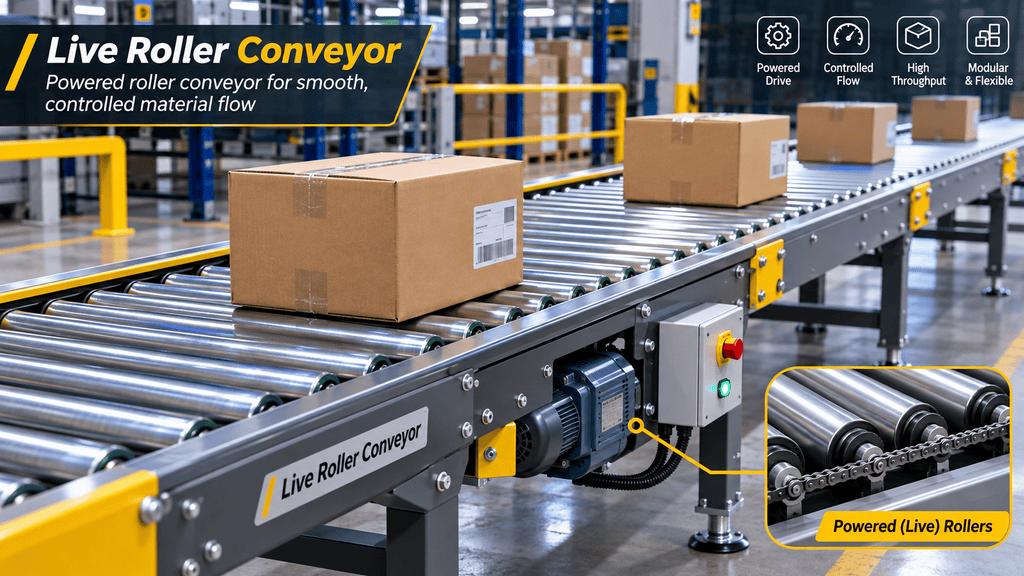
A live roller conveyor is a powered material handling system that uses rotating cylindrical rollers to move cartons, packages, and other products along a designated path. Unlike gravity conveyors, which depend on an incline and gravity to move materials, live roller conveyors use a motor to provide the power necessary to transport products.
According to Century Conveyor Systems, live roller and gravity conveyors utilize cylindrical pins to propel cartons and products forward. The primary difference is that live roller sections are powered by a motor, while gravity conveyors operate without a motor.
This distinction makes live roller conveyors useful in facilities where products need consistent, controlled movement without relying on manual pushing or naturally sloped conveyor sections.
In warehouse environments, these systems are commonly incorporated into packing lines, divert lines, extendable conveyors, and end-of-line (EOL) operations. Their relatively slower operating speeds and ability to interface with manual induction make them particularly useful for processes where employees interact directly with packages.
Rather than viewing a live roller conveyor as an isolated piece of equipment, businesses should consider how it supports the movement of products throughout the larger material handling system.
Century Conveyor Systems approaches conveyor installations as part of a complete automation solution, considering how individual conveyor sections connect with other equipment and contribute to overall facility performance.
2. How Does a Live Roller Conveyor Improve Warehouse Productivity?
One of the primary advantages of a live roller conveyor is its ability to automate repetitive product transportation.
In a warehouse without sufficient conveyor automation, employees may spend considerable time moving cartons between picking, packing, processing, and shipping areas. Although these individual movements might seem relatively minor, they can consume substantial labor hours when repeated across hundreds or thousands of orders.
A powered roller conveyor helps reduce this unnecessary transportation work by moving products between designated operational points.
For example, consider a packing operation where employees prepare orders at several workstations. Once a carton is packed and sealed, it can be placed onto a live roller conveyor and transported toward the next stage of processing. Employees can focus on their primary responsibilities instead of manually carrying packages across the facility.
This creates several potential productivity improvements:
- Reduced manual transportation: Employees spend less time physically moving packages between work areas.
- More consistent product movement: Motorized rollers provide powered transportation along designated conveyor paths.
- Improved workstation coordination: Conveyor sections connect different stages of an operation, creating a more organized workflow.
- Better use of available labor: Employees can concentrate on picking, packing, inspection, and other value-added activities.
- More efficient end-of-line operations: Packages can move toward shipping and loading areas without requiring employees to transport each carton individually.
Century Conveyor Systems designs conveyor solutions around operational requirements, with the goal of increasing output while lowering labor costs through automation.
The greatest productivity benefits typically come from integrating the conveyor into a thoughtfully designed material handling process rather than simply installing equipment wherever space is available.
3. Where Are Live Roller Conveyors Typically Used?
Live roller conveyors are especially useful in warehouse environments where cartons and packages need to travel between workstations while maintaining opportunities for employee interaction.
Century Conveyor Systems identifies several common applications for live roller conveyors, including packing lines, divert lines, extendable conveyors, and end-of-line operations.
Each application serves a different operational purpose.
Packing lines: Live roller conveyors can transport completed or partially completed packages between packing stations and subsequent processing areas. Their ability to interface with manual induction makes them appropriate for operations where employees regularly place products onto the conveyor.
Divert lines: Conveyor systems frequently need to move packages from a primary transportation path toward different destinations. Live roller sections can form part of these arrangements, helping move cartons through the facility toward their designated processing areas.
Extendable conveyors: Powered conveyor equipment can support operations where packages need to move between a warehouse conveyor line and a truck-loading area. Extendable systems can provide a connection between fixed warehouse equipment and temporary loading positions.
End-of-line operations: At the end of an order fulfillment process, packages must be transported toward shipping, staging, or loading areas. Live roller conveyors can help organize this movement and reduce the amount of manual transportation required.
The appropriate application depends on package characteristics, operating speed, available space, and how the conveyor interacts with surrounding equipment.
Century Conveyor Systems works with businesses to engineer conveyor arrangements that address the specific requirements of their warehouse operations.
4. What Is the Difference Between a Live Roller Conveyor and a Gravity Conveyor?
Although live roller and gravity conveyors can look similar, they operate differently and serve somewhat different material handling requirements.
A live roller conveyor uses a motor to rotate its rollers and propel products forward. A gravity conveyor, on the other hand, does not use a motor. Instead, products move along the rollers through gravity, typically with assistance from an inclined conveyor bed.
The distinction affects where each conveyor type makes the most sense.
A live roller conveyor is useful when a facility needs powered product transportation along a designated route. It can move cartons through areas where a natural incline is unavailable or where relying on employees to push products would be inefficient.
Gravity conveyors can be a practical option when products can move naturally along a sloped path. Because they do not require powered roller movement, they may be appropriate for staging areas, manual transfer points, and other applications where powered transportation is unnecessary.
The decision should account for the entire material handling process rather than focusing exclusively on equipment cost.
For instance, a warehouse might use gravity conveyors at certain manual loading or staging points while relying on live roller conveyors to transport products through other sections of the operation.
Century Conveyor Systems offers both types of conveyor solutions, allowing businesses to incorporate different technologies into a coordinated material handling layout.
5. How Does a Live Roller Conveyor Support Order Fulfillment?
Order fulfillment involves considerably more than moving a completed package to a shipping dock. It encompasses the activities that take place between receiving an order and preparing the associated products for delivery.
These activities can include picking, packing, processing, sorting, staging, and shipping.
A live roller conveyor can support several of these steps by connecting individual work areas and reducing the need for manual product transportation.
For example, imagine a distribution center processing a high volume of individual customer orders. Employees pick products from storage locations and bring them to packing stations. After the products are packed into cartons, the packages can enter a conveyor line that transports them toward subsequent processing or shipping areas.
This arrangement helps establish a more continuous flow of materials throughout the facility.
Century Conveyor Systems emphasizes optimizing order fulfillment operations at every touchpoint. Its approach focuses on improving output performance, reducing errors that can lead to returns or damaged products, and processing items faster with fewer manual interactions.
Live roller conveyors can contribute to these objectives by supporting the transportation portion of the workflow.
However, the conveyor should be considered alongside other technologies. Depending on operational requirements, a complete order fulfillment system might also incorporate belt conveyors, sortation equipment, diverts, robotic fulfillment solutions, and warehouse control systems.
The goal is to create an integrated operation in which each piece of equipment supports the next stage of the fulfillment process.
6. Can a Live Roller Conveyor Be Integrated With Other Warehouse Automation Equipment?
Yes. One of the most important considerations when selecting a live roller conveyor is how it will interact with the other equipment in a warehouse.
A conveyor system rarely operates independently in a modern distribution center. Instead, it forms part of a larger network responsible for moving, processing, sorting, and distributing products.
For example, a live roller conveyor might transport cartons from packing stations toward a divert system. The divert equipment can then direct products toward different destinations based on the facility’s shipping or processing requirements.
Other possible integrations include:
- Belt conveyors: These can provide stable transportation for products that require a different conveying surface.
- Sortation systems: Automated sortation equipment can direct packages toward designated destinations.
- Warehouse control systems: Software and controls can coordinate conveyor activity with broader material handling processes.
- Robotic fulfillment equipment: Automated guided vehicles (AGVs) and autonomous mobile robots (AMRs) can support transportation between conveyor systems and other operational areas.
- Extendable conveyors: These can connect warehouse conveyor lines with truck-loading operations.
Century Conveyor Systems provides conveyor integration, controls engineering, programmable logic controls, warehouse control systems, and other automation services.
This broader capability is important because equipment compatibility, system controls, and overall facility layout all influence how effectively a conveyor installation performs.
When planning a live roller conveyor project, businesses should evaluate the existing automation infrastructure and consider opportunities for future expansion.
7. Is a Live Roller Conveyor Suitable for Every Type of Package?
No. Although live roller conveyors are useful for many carton and package transportation applications, they are not necessarily the best choice for every product.
Package dimensions, weight, shape, bottom surface, stability, and overall handling requirements all influence conveyor selection.
For example, standard cartons with relatively flat bottoms are generally easier to transport across roller surfaces than irregularly shaped products that cannot maintain stable contact with the rollers.
Small polybags and parcels may also require a different conveying approach. Century Conveyor Systems identifies belt-over conveyors as a useful alternative for smaller polybags, parcels, and irregular carton sizes because the belt provides a more stable conveying surface.
Belt-over conveyors can also offer advantages when an application requires inclines, declines, or gapping between packages.
For larger and heavier products, specialized pallet conveyor technologies may be more appropriate. Century offers solutions such as chain-driven live roller conveyors and Poly-V conveyors for particular pallet and bulk material handling applications.
The important takeaway is that conveyor selection should be based on the products being handled and the performance requirements of the operation.
A qualified conveyor integrator can evaluate these characteristics and recommend an appropriate combination of conveyor technologies rather than attempting to force every product through the same equipment.
8. How Does Century Conveyor Systems Approach Live Roller Conveyor System Design?
Century Conveyor Systems takes a comprehensive approach to warehouse conveyor and material handling automation.
Rather than focusing exclusively on individual equipment installations, the company provides system design, engineering, implementation, and ongoing support.
Its website describes a turnkey integration process that includes system design and validation, installation, startup support, and lifetime parts and service.
This matters because a live roller conveyor must fit into the physical and operational environment of the facility.
During system planning, several factors should be evaluated:
Facility layout: The conveyor must fit within the available warehouse space while supporting practical product movement between operational areas.
Product characteristics: Carton dimensions, package weights, and product stability help determine the appropriate roller configuration and conveyor arrangement.
Operational requirements: The required throughput, transportation distance, workstation locations, and employee interaction points all influence system design.
Equipment integration: The live roller conveyor should connect effectively with surrounding conveyor sections, controls, and other automation technologies.
Future requirements: Businesses should consider whether their operation may require additional conveyor sections, new workstations, or expanded automation capabilities as order volumes change.
Century’s engineering and integration services help address these considerations as part of a larger warehouse optimization project.
The objective is to develop a conveyor system that supports current operational demands while providing a practical foundation for future improvements.
9. What Maintenance Does a Live Roller Conveyor Require?
Like any mechanical material handling equipment, a live roller conveyor requires regular maintenance to maintain reliable operation.
Because the system relies on powered rollers and associated mechanical and electrical components, maintenance should address both the conveyor’s moving parts and its power and control systems.
A preventative maintenance program may include:
- Inspecting rollers for excessive wear, damage, or restricted movement.
- Checking motor and drive components for signs of deterioration.
- Inspecting conveyor frames and mechanical connections.
- Checking electrical components and controls for proper operation.
- Identifying unusual noises, vibration, or inconsistent product movement.
- Removing accumulated debris that could interfere with conveyor operation.
- Replacing worn or damaged components before they contribute to larger equipment problems.
The frequency and scope of maintenance should reflect the conveyor’s operating environment, utilization, and manufacturer recommendations.
Century Conveyor Systems provides conveyor preventative maintenance, repair services, replacement parts, and equipment installation.
The company also highlights its service department, which has more than 40 years of conveyor experience, along with a fleet of service vans serving facilities in the New Jersey, Pennsylvania, and New York metropolitan area.
For businesses investing in conveyor automation, access to experienced service technicians is an important consideration. A well-maintained system can help reduce unexpected interruptions and support dependable warehouse operations over the long term.
10. How Can Businesses Determine Whether They Need a Live Roller Conveyor?
The best way to determine whether a live roller conveyor is appropriate is to evaluate the specific transportation challenges within the facility.
Businesses should begin by identifying where employees currently spend time moving cartons and packages manually. They should also examine bottlenecks between packing, processing, and shipping operations.
If products regularly need to travel between workstations along a defined path, a powered roller conveyor may be worth considering.
Other questions to evaluate include:
- Are employees spending too much time manually transporting packages?
- Do products need to move between multiple packing or processing stations?
- Would powered transportation improve the consistency of package movement?
- Does the facility have sufficient space for a conveyor installation?
- Will the conveyor need to connect with existing automation equipment?
- Are there plans to increase order volume or expand warehouse operations?
Businesses should also consider whether another conveyor technology would better address their requirements.
For example, belt conveyors may be more appropriate for smaller, irregularly shaped packages, while gravity conveyors may provide a simpler solution for certain staging and transfer applications.
Century Conveyor Systems can help evaluate these operational requirements and develop a material handling solution that aligns with the facility’s goals.
11. Why Choose Century Conveyor Systems for a Live Roller Conveyor Project?
Choosing a conveyor system integrator is an important decision because the success of a material handling installation depends on more than the equipment itself.
Engineering, controls, installation, project coordination, and ongoing service all contribute to the long-term performance of a warehouse automation system.
Century Conveyor Systems offers a full-service approach that brings these capabilities together.
Its services include system design, controls engineering, mechanical engineering, electrical installation, project management, conveyor preventative maintenance, and repair services.
The company also works across several material handling applications, including conveyor systems, robotic fulfillment, sortation, pallet handling, storage systems, and warehouse control solutions.
This breadth of experience allows businesses to consider live roller conveyors within the context of their entire warehouse operation.
Century reports completing more than 1,500 installations over the past five years, demonstrating its involvement in material handling projects across the United States.
Another important consideration is the company’s ongoing support capability. Conveyor equipment represents a long-term operational investment, and access to parts, maintenance, and repair services can help businesses protect that investment.
For organizations looking to improve warehouse productivity, reduce unnecessary manual transportation, and develop a more coordinated fulfillment operation, working with an experienced systems integrator can make the planning and implementation process more manageable.
12. How Can I Get Started With a Live Roller Conveyor Solution From Century Conveyor Systems?
Getting started begins with understanding your facility’s current material handling challenges and identifying the improvements you want to achieve.
Whether you need to automate a packing line, improve end-of-line transportation, connect different warehouse workstations, or modernize an existing conveyor system, the first step is to discuss your operational requirements with an automation expert.
Useful information to prepare includes:
- Your facility’s current layout and available installation space.
- The dimensions, weights, and types of products being transported.
- Current order volumes and anticipated future throughput.
- Existing conveyor equipment and automation infrastructure.
- Areas where manual transportation or workflow bottlenecks are creating challenges.
- Your desired project timeline and operational objectives.
Century Conveyor Systems can use this information to begin evaluating potential solutions and developing a system design that supports your goals.
The company offers turnkey conveyor and material handling automation services, helping businesses move from initial system planning through engineering, installation, startup, and ongoing service.
To learn more about live roller conveyor options and other warehouse automation solutions, visit Century Conveyor Systems at https://www.centuryconveyor.com/ or explore its Conveyor and Order Fulfillment Systems page at https://www.centuryconveyor.com/solutions/order-fulfillment/.
For businesses seeking to improve product transportation, streamline packing operations, and build a more efficient distribution environment, a properly engineered live roller conveyor can be an important part of a larger warehouse automation strategy.