A lot of warehouse conveyor systems share the same biography. Installed when the business was booming. Expanded once, maybe twice. Then the maintenance budget got trimmed, the tech who knew the system best retired, and the equipment kept running — because it had to.
The problem isn’t that aging systems fail. It’s that nobody knows exactly how close they are to failing until something forces the question.
For one of our customers, a mid-size apparel manufacturer, that something was a facility-wide power outage. This is the story of what a formal conveyor system audit found, what a controls takeover is fixing, and how to know if your operation is quietly carrying the same risk.
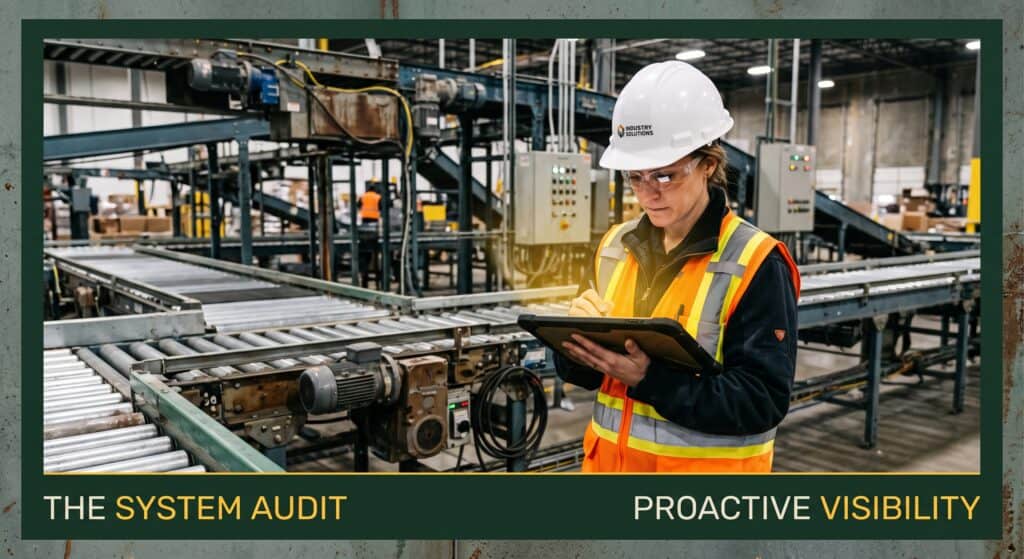
The Setup: 30 Years of Equipment, Zero Audits
The customer’s conveyor system was installed in the early 1990s. The last significant expansion wrapped in 2006. In the two decades since, preventive maintenance was gradually scaled back until a single on-site technician was managing the entire system — largely on instinct, memory, and routine.
That’s not unusual. In our experience, it’s closer to the norm than the exception for legacy material handling systems. Three patterns show up over and over:
Legacy equipment with no documented baseline. Original manufacturers change ownership. Panel components go obsolete. Replacement parts get harder to source — quietly, and then suddenly. When the veteran tech retires, the institutional knowledge walks out the door with him.
Reactive maintenance disguised as a maintenance plan. When it breaks, you fix it. When it doesn’t, you move on. This works until it doesn’t — and the moment it doesn’t is almost always during the worst possible week of the year.
No visibility when something goes wrong. A blocked photo eye, a failing sensor, an intermittent fault. Without modern controls, diagnosing any of these means waiting for a technician to drive out, assess, and report back. That’s a lot of downtime for a solvable problem.
Then the power went out. The system — aging, under-maintained, running on 1990s-era panel infrastructure — didn’t handle the disruption gracefully. What should have been a routine recovery exposed how fragile the operation had become. Our team made multiple site visits and brought in our service group for a formal system audit: the first comprehensive assessment the facility had ever had.
What a Conveyor System Audit Actually Covers
A conveyor system audit is a full-facility assessment of your material handling infrastructure. Not what it was spec’d to do in 1998 — what it’s actually doing now, and what it needs to keep doing it. Ours covers three core deliverables.
Equipment status review
A complete accounting of what’s in the facility: what condition each piece is in, how close it is to end of life, and where the single points of failure are hiding. For most legacy operations, this is the first time anyone has written it all down.
Repair vs. upgrade assessment
Not everything needs to be replaced — but some things do. The audit produces a clear breakdown of what falls into each bucket, prioritized by risk and operational impact. That distinction matters, because it’s the difference between a targeted capital project and a blank-check rebuild.
A documented starting point
For operations that have never had a formal audit, this alone is transformative. You now have a baseline: something to maintain, something to measure against, and something to hand to the next person in the role instead of hoping the knowledge transfers by osmosis.
[INTERNAL LINK: /services “Century Conveyor service and support”]
Controls Modernization: Replacing the Brains, Not the Building
For this customer, the audit was step one. Step two is a controls takeover — and this is where the real transformation happens.
The legacy panels in the facility are running on antiquated internal components: the guts of the system’s brains. We’re replacing that infrastructure with modern LaFayette controls — serviceable, documented, and built for remote access.
Here’s the part that surprises people: the conveyor structure itself usually doesn’t need to go. Rollers, frames, and belts are mechanical and fixable. The intelligence driving them is what goes obsolete. A controls retrofit — new PLCs, new panel internals, modern networking — modernizes the system for a fraction of the cost of a rip-and-replace.
[INTERNAL LINK: /conveyor-systems “warehouse conveyor systems”]
Remote Diagnostics: What Changes When Someone Can Actually See Your System
Once modern controls are in place, our technicians can connect to the system remotely via VPN from our Danville facility. The entire conveyor infrastructure — real-time status, fault conditions, operational data — becomes visible on a screen without anyone stepping on-site.
Take a blocked photo eye. The old way: call for service, schedule a truck, wait for a tech to drive out, assess, and drive back. The new way: a technician opens a laptop, connects through the VPN, pulls up the system, and tells you exactly what broke and how to fix it — over the phone or a Teams call, often in the same conversation the fault is reported.
For an operation that previously had one person managing a 30-year-old system on memory and routine, that’s a fundamental change in what “support” means.
Four Outcomes That Actually Stick
No more guessing. You know exactly what your system is, what shape it’s in, and where the risk lives. The first audit is the hardest one; every audit after that is maintenance.
Faster response times. Remote VPN access means a technician can be looking at your system in minutes, not days.
Modern serviceability. Current-era components, documented configurations, and a support team that can actually see what you’re running.
Capital planning you can defend. Replace what needs replacing now, plan the rest over time. The audit gives you a prioritized roadmap that makes the case to leadership — before the next outage makes it for you.
Is Your System Overdue?
If any of these sound familiar, an audit is worth a conversation:
- Your system is 15+ years old and has never had a formal assessment
- Maintenance knowledge lives in one or two people’s heads
- Replacement parts are getting harder to source
- Faults require an on-site visit just to diagnose
- Your maintenance plan is “fix it when it breaks”
You don’t need a power outage to find out what your system is hiding.
FAQ
What is a conveyor system audit?
A conveyor system audit is a comprehensive on-site assessment of a facility’s conveyor and material handling equipment. It documents the condition of every component, identifies end-of-life equipment and single points of failure, and produces a prioritized repair-vs-upgrade roadmap.
How do I know if my conveyor system needs a controls upgrade?
Common signs include obsolete PLCs or panel components that are no longer manufactured, difficulty sourcing replacement parts, faults that can’t be diagnosed remotely, and reliance on one or two people’s institutional knowledge to keep the system running.
Do I have to replace my whole conveyor system to modernize it?
Usually not. The mechanical structure — frames, rollers, belts — often has decades of life left. A controls retrofit replaces the aging panel internals and PLCs with modern, serviceable components, typically at a fraction of the cost of full system replacement.
What is remote conveyor diagnostics?
With modern controls in place, technicians connect to your conveyor system through a secure VPN and view real-time status and fault data from off-site. Many issues are diagnosed — and resolved — in a single phone or Teams call instead of an on-site service visit.
How long does a system audit take?
It depends on facility size and system complexity, but most audits involve one or more site visits followed by a documented findings report. Contact us for a scope and timeline for your operation.
Start With a System Audit
If you’re running a legacy conveyor system and haven’t had a formal assessment in years — or ever — we can help you understand exactly what you have, what it needs, and what it will take to modernize it for the next decade.
Rick Maldonado, New Business Development Manager (908) 205-0625 | rmaldonado@centuryconveyor.com