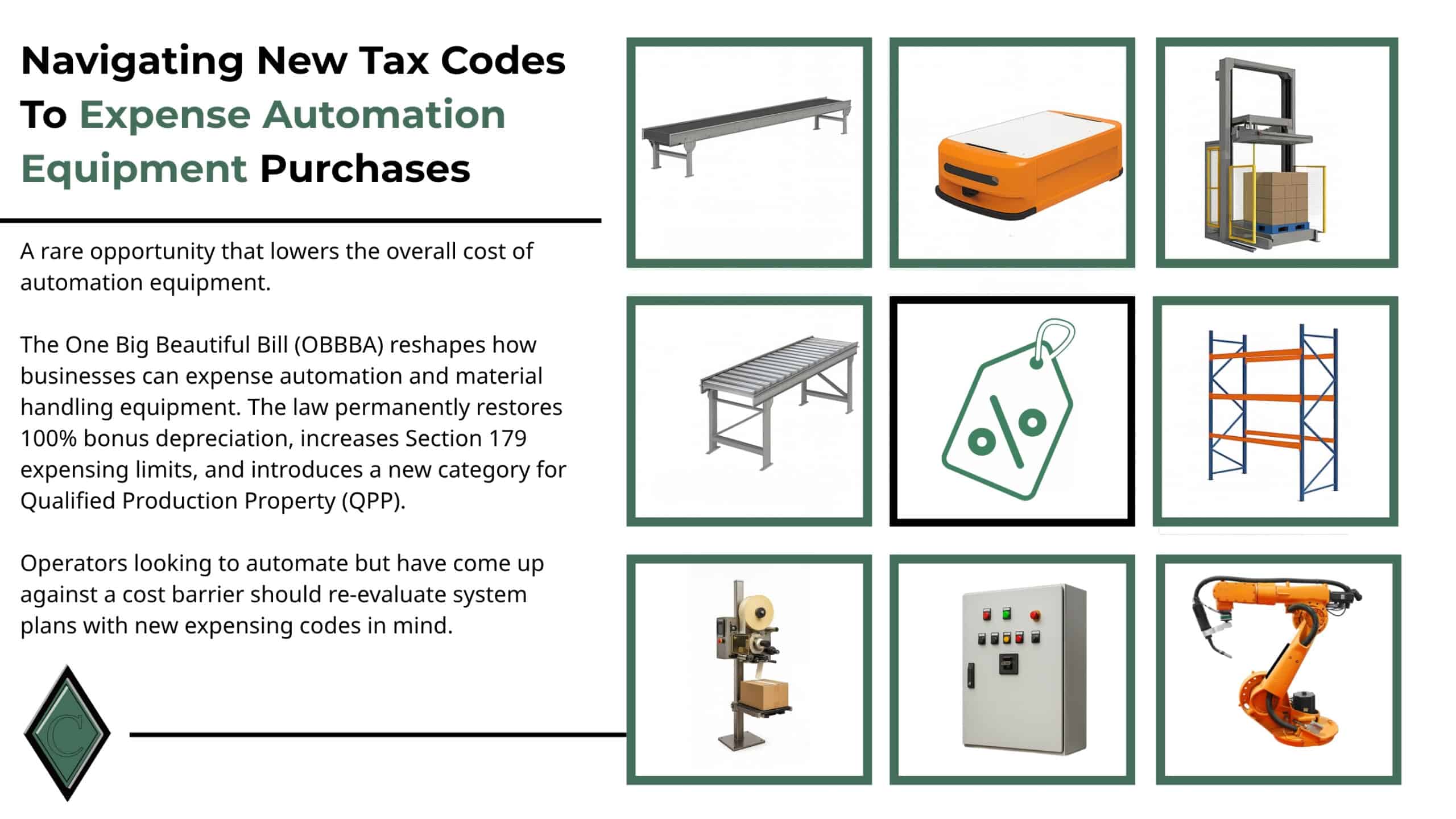
Take advantage of new OBBBA tax codes to enable automation.
The One Big Beautiful Bill (OBBBA) reshapes how businesses can expense automation and material handling equipment. The law permanently restores 100% bonus depreciation, increases Section 179 expensing limits, and introduces a new category for Qualified Production Property (QPP -139 STAT. 198)
For warehouse operators, integrators, and distributors — this means you can immediately deduct most automation investments if the requirements are met.
Under Sections 179 and 168(k), eligible equipment is defined as:
- Tangible personal property used in an active trade or business.
- Qualified improvement property (non-structural interior upgrades).
- Machinery and equipment with a useful life over one year.
- Sec. 70301: Full expensing for “qualified business property”
- Sec. 70306: Raises expensing cap to $2.5 M with a $4 M phase-out
- Sec. 168(k): Permanently reinstates 100% bonus depreciation
- Sec. 168(n): Creates a new category for “qualified production property” used in U.S. manufacturing or production.
These provisions apply to property acquired and placed in service after Dec 31, 2024 (for QPP, construction beginning after Jan 19, 2025).
What Equipment Is Eligible?
Equipment Type | Eligible for Deduction? |
|---|---|
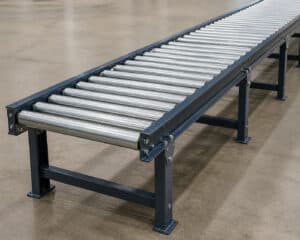
Overhead conveyors, belt conveyors, roller conveyors (bolted or mobile) | High probability of qualifying as sec. 179 or sec. 168(k) property (movable, not structural) |
AGVs, AMRs, sorters, robotic arms | Typically qualifies as machinery, assuming they are not permanently integrated into walls/structure |
Palletizers, pallet conveyors, depalletizers | Typically qualifies as machinery, assuming they are not permanently integrated into walls/structure |
Picking/GTP systems, order fulfillment equipment | If considered interior improvements/nonstructural, may qualify under sec.179 or sec.168(k) |
Mezzanine floor add-ons for sortation / conveyor access | If considered interior improvements/nonstructural, may qualify under sec.179 or sec.168(k) |
Racking systems | If considered interior improvements/nonstructural, may qualify under sec.179 or sec.168(k). Ceiling supporting racking may not be eligible |
Embedded track systems or conveyors within floors | May be considered structural – eligibility assessment would be required |
Elevators and lifts built into building structure | Usually considered structural and excluded from eligibility |
Electrical distribution, wiring, controls, compression, safety systems | Eligible to the extent they are deployed for qualifying machinery (and are not for the general facility structure) |
Because the line between “machinery” and “structural” can be difficult to define, the utility of the equipment, method of integration, and whether the system can be moved or reconfigured will all factor into the evaluation
Qualified Production Property (QPP)
This new category allows 100% expensing for equipment directly tied to production activities, such as conveyors or MHE systems.
Key criteria:
- Construction must begin Jan 19, 2025 – Jan 1, 2029
- Must be placed in service by Jan 1, 2031
- “Original use” starts with the taxpayer
- Must elect this treatment on your tax return
QPP property used for non-production (like offices or parking) does not qualify.
Why Should I Act Now?
- Sec. 179 enhancements and bonus depreciation under OBBBA apply only to property placed in service after December 31, 2024.
- The law also raises the caps but those limits might evolve or be tightened in the future if funds or political winds shift.
- QPP’s window for construction start is January 19, 2025 to January 1, 2029, and service by January 1, 2031
- Because these rules are new, IRS guidance or auditing practices may take a conservative view in early years. Early adopters who document to current regulation may get a proactive benefit.
- Although Sec.168(k) bonus depreciation is now permanent under OBBBA, that doesn’t guarantee there won’t be future legislative changes that peel back current code.
- The No. 1 risk is delaying: if you push a capital project into a later year, you may lose certainty, or face stricter scrutiny or regulatory adjustments.
In short: the sooner you plan and execute qualifying automation or material handling investments, the more likely you can lock in favorable treatment under current law.
Contact Century
How Century Can Help
Century specializes in engineering automation systems that meet budget and efficiency goals. We can evaluate your facility for qualifying improvements – the majority of equipment we integrate would be eligible for the new deductions.
Our proposals include detailed equipment and materials documentation for deduction filing and if a project is started now (estimate a year on average for a system integration) the tax stipulations can be met quickly before any future rollbacks or adjustments are made.
If you are planning your next system, there hasn’t been a more favorable time to make the automation leap.