Pallet racking is the steel storage structure that holds palletized loads off the floor in rows and levels so lift trucks can put away and retrieve them. The main types of pallet racking are selective, double-deep, drive-in and drive-through, push-back, pallet flow, and very narrow aisle racking, and each one trades access to individual pallets against how many pallets you can fit in the same floor space.
Choosing between them is less about the rack and more about your inventory. How many SKUs you carry, how many pallets you hold of each, whether product has to rotate first in, first out, and what kind of lift truck you run will point to the right rack type faster than any catalog will.
This guide walks through each type of pallet racking, what it’s good at, where it struggles, and how to match rack to your operation. It also covers the parts of a rack system, load capacity and inspection, and how racking fits with pick modules, conveyor, and automated storage.
This article is general information, not engineering advice. Rack capacity, anchoring, seismic design, and fire protection have to be engineered for your building, your loads, and your local codes.
At a glance
- Selective pallet racking gives direct access to every pallet and suits operations with many SKUs and few pallets of each.
- Double-deep, drive-in, push-back, and pallet flow racking trade some access for more pallets per square foot.
- Drive-in and push-back are last in, first out. Pallet flow and drive-through are first in, first out.
- Your lift truck, clear height, and sprinkler layout limit which pallet racking types will work.
- Every rack bay should show its rated load, and damaged uprights should be unloaded and repaired before they fail.
- Pallet racking is often the backbone of a pick module, and the conveyor and controls around it decide how fast product actually moves.
Table of Contents
Why the Type of Pallet Racking Matters
Most warehouses start with selective rack because it’s simple, flexible, and every forklift driver knows how to work it. That’s often the right call. The trouble starts when the inventory profile changes and the racking doesn’t. A building that once held 800 SKUs at two pallets each now holds 300 fast movers at 20 pallets each, and the aisles that made sense before are now wasted floor.
The type of pallet racking you choose sets three things for years: how many pallet positions you get in the building, how quickly a driver can reach the pallet they need, and whether product rotates the way your business needs it to. Rack is relatively easy to buy and relatively hard to change once it’s anchored, loaded, and permitted, so the decision deserves the same attention as any other piece of material handling equipment.
The Four Questions That Pick Your Pallet Racking
Before comparing rack types, answer these four questions about your operation.
- How many SKUs, and how many pallets of each? Many SKUs with one to three pallets each favors selective rack. A few SKUs with deep pallet counts favors dense storage like drive-in, push-back, or pallet flow.
- Does product have to rotate first in, first out? Food, beverage, pharmaceuticals, and anything with a date code usually need FIFO. Lumber, building materials, and slow-dated goods can often run last in, first out.
- What lift trucks will work the rack? Counterbalance trucks need wide aisles. Reach trucks work narrower aisles and can handle double-deep rack. Very narrow aisle turret trucks and order pickers need guided aisles and a very flat floor.
- What happens to the pallet next? If pallets go straight to the dock, storage density may matter most. If cases get picked from the pallet, pick-face access and replenishment matter more, and the rack becomes part of a pick module.
Write the answers down with real numbers from your warehouse management system before you talk to anyone selling rack. They will settle most of the debate.
7 Types of Pallet Racking Compared
| Pallet racking type | Access to each pallet | Rotation | Storage density | Typical fit |
|---|---|---|---|---|
| Selective | Every pallet | Any | Lowest | Many SKUs, few pallets each |
| Double-deep | Front pallet direct, rear pallet behind it | Mostly LIFO | Medium | Two or more pallets per SKU, reach trucks |
| Drive-in | Front of each lane only | LIFO | High | Many pallets of few SKUs, slow-dated goods |
| Drive-through | Both ends of each lane | FIFO | High | Many pallets of few SKUs, rotation required |
| Push-back | Front of each lane only | LIFO | Medium to high | Several pallets per SKU, faster access than drive-in |
| Pallet flow | Load one end, pick the other | FIFO | High | Date-coded product, high throughput per SKU |
| Very narrow aisle (VNA) | Every pallet | Any | High for a selective system | Tall buildings, many SKUs, guided turret trucks |
Cantilever racking, which uses arms instead of beams, is built for long loads like pipe, lumber, and bar stock rather than pallets, so it’s outside the scope of this guide.
1. Selective pallet racking
Selective rack is the standard single-deep system: upright frames, horizontal load beams, and one pallet deep on each side of an aisle, usually installed back to back. Every pallet faces an aisle, so a driver can reach any pallet without moving another one.
Good at: flexibility. It works with almost any lift truck, handles any rotation rule, and adapts easily when SKUs change. Beam levels can be moved as load heights change.
Weak at: density. Because every row needs an aisle, a large share of your floor is aisle rather than storage.
Use it when: you carry many SKUs with only a few pallets each, or when your SKU mix changes often. It’s also the usual choice for the pallet levels above a pick face, where reserve pallets sit above the cases being picked.
2. Double-deep pallet racking
Double-deep racking places two selective rows back to back on each side of the aisle, so each aisle serves pallets two deep. A reach truck with extendable forks reaches the rear pallet.
Good at: cutting the number of aisles compared with selective rack while keeping the structure simple.
Weak at: access. The rear pallet is blocked by the front one, so double-deep works best when each SKU has at least two pallets. It also requires a reach truck or a truck with a double-deep attachment.
Use it when: most SKUs carry two or more pallets and you already run reach trucks.
3. Drive-in and drive-through pallet racking
Drive-in racking removes the beams inside each lane and supports pallets on rails attached to the uprights. A lift truck drives into the lane to place or retrieve pallets, and lanes can be many pallets deep. In drive-in racking the lane is closed at the back, so the last pallet in is the first one out. Drive-through racking is open at both ends, so you load from one aisle and retrieve from the other for FIFO rotation.
Good at: density. Drive-in rack packs the most pallets into a footprint of any lift-truck-served rack, which makes it common in cold storage where every cubic foot costs money to cool.
Weak at: selectivity and rack damage. Each lane should hold a single SKU, and drivers working inside the structure are more likely to strike uprights. Drive-in also works best with consistent, good-condition pallets, because each pallet rests on its edges on the rails.
Use it when: you hold large quantities of a few SKUs, rotation is not critical (drive-in) or rotation matters and you can give up an aisle at each end (drive-through).
4. Push-back pallet racking
Push-back racking stores pallets on nested carts that ride on inclined rails, typically two to six pallets deep. The driver sets a pallet on the front cart; loading the next pallet pushes the first one back up the incline. When the front pallet is removed, the ones behind roll forward to the face.
Good at: dense storage with faster access than drive-in, because the truck never enters the rack. Each lane can hold a different SKU, so it handles more SKUs than drive-in at similar depth.
Weak at: rotation, since it’s last in, first out. The carts and rails also add cost and parts to maintain compared with static rack.
Use it when: SKUs carry several pallets each, LIFO is acceptable, and you want density without drivers working inside the structure.
5. Pallet flow racking
Pallet flow racking, sometimes called gravity flow or live storage, uses slightly pitched lanes of rollers or wheels. Pallets load at the high end and roll by gravity to the low end, where they’re picked. Speed controllers and brakes keep the pallets moving at a controlled pace, and separators at the pick end hold back the line so the front pallet can be removed without pressure from the ones behind it.
Good at: FIFO rotation and throughput. Loading and unloading happen in separate aisles, so replenishment drivers and pickers don’t compete for the same space. It’s well suited to date-coded product and fast-moving SKUs.
Weak at: cost and pallet quality. Flow lanes are more expensive per position than static rack, and they depend on pallets in good condition with consistent bottom boards. Mixed or damaged pallets can hang up in the lane.
Use it when: product must rotate FIFO, a few SKUs move in volume, and you can dedicate a loading aisle and a picking aisle. Pallet flow is also common at the bottom level of a pick module, where pickers take cases directly off a flowing pallet.
6. Very narrow aisle pallet racking
Very narrow aisle (VNA) racking is selective rack set on tight aisles that only guided turret trucks or swing-reach trucks can work. The trucks ride on wire guidance or rails, which lets the rack go taller and the aisles go narrower than conventional selective rack.
Good at: density without giving up access. Every pallet still faces an aisle.
Weak at: flexibility and building demands. VNA needs specialized trucks, a very flat floor, guidance systems, and often a taller building to justify it. It also changes how pallets move between the rack and the dock, since turret trucks usually hand pallets off at the aisle ends.
Use it when: you have clear height, many SKUs, and a long-term commitment to the layout. Century’s pick modules page notes that racking can be laid out for VNA and for ASRS from the start.
7. Mobile and automated pallet racking
Two more categories are worth knowing. Mobile racking mounts selective rack on powered carriages that slide on floor rails, so only one aisle is open at a time. It’s dense, but only one aisle can be worked at once, so it fits slow-moving or archive storage better than active picking.
Automated storage and retrieval systems (ASRS) use pallet racking as the structure for a crane that runs on floor and ceiling rails, picking and placing pallets with extendable forks. In tall rack-supported buildings, the rack also holds up the roof and walls. Century’s pick modules and storage systems page covers pallet ASRS and shuttle systems alongside conventional racking.
Parts of a Pallet Racking System
Every rack type is built from the same basic parts. Knowing the names helps when you read a quote or a damage report.
- Upright frames: two vertical columns joined by horizontal and diagonal bracing. The frame carries the load down to the floor.
- Load beams: horizontal members that connect frames and carry the pallets. Beam length and profile set the capacity of each level.
- Beam connectors and safety locks: the brackets that hook beams into the uprights and the clips or bolts that keep beams from lifting out when a forklift bumps them.
- Base plates and anchors: plates at the foot of each column, bolted into the slab.
- Wire decking and pallet supports: decking or cross bars that support pallets and catch loose product.
- Row spacers: ties that connect back-to-back rows.
- Column guards and end-of-aisle protectors: steel guards that absorb lift truck impacts before the upright does.
- Load capacity signs: placards showing the rated load per level and per bay.
Racking also comes in two broad construction styles. Roll-formed racking is cold-formed from sheet steel and is the most common in distribution. Structural racking uses hot-rolled steel sections and is heavier and more impact-resistant, so it’s often used in drive-in rack, freezers, and high-traffic areas. Beams and uprights from different manufacturers usually don’t interchange, so mixing parts during an expansion is a common mistake to avoid.
Load Capacity, Anchoring, and Codes
Once the type is settled, the next questions are how much a rack can hold and what rules apply to it.
How much weight can pallet racking hold?
There’s no single answer, because capacity depends on beam length and profile, the upright frame, the vertical spacing between beam levels, and how the rack is anchored. The rated capacity comes from the rack manufacturer or the engineer who designed the system, and it should be posted on a load sign at the rack. If your rack has no load signs and nobody has the original drawings, treat the capacity as unknown until an engineer evaluates it.
Two practical rules hold for every rack type. Raising or lowering a beam level changes the frame’s capacity, so beam changes should be checked against the manufacturer’s capacity tables. And a pallet heavier than the rack’s design load needs an engineering answer, such as heavier beams or a different location.
The standard behind pallet racking
In the United States, steel storage racks are designed to ANSI MH16.1, the specification for industrial steel storage racks published by the Rack Manufacturers Institute (RMI), an industry group of MHI. It covers design, testing, and use of pallet racking, including load signage and seismic design. It’s a paid standard, so we won’t quote it here; ask your rack supplier which edition the system is designed to.
What OSHA says about storage and aisles
OSHA’s general rule for handling materials, 29 CFR 1910.176, requires that storage not create a hazard and that tiered storage be stable and secure against sliding or collapse. It also requires safe clearances and clear, marked aisles wherever mechanical handling equipment is used. Lift truck operation itself falls under OSHA’s powered industrial truck rule, 29 CFR 1910.178.
Anchoring, seismic, and fire protection
Rack is normally anchored to the floor slab at every column, and your rack supplier’s design will specify the anchors. In seismic regions, building codes add design requirements for the rack and its anchorage, and many jurisdictions require a permit and engineered drawings for rack above a certain height. Fire protection matters too: sprinkler design (NFPA 13 and the local fire code) can require flue spaces between loads and, for some commodities and heights, sprinklers inside the rack. Bring your fire protection engineer and local authority into the layout early, because a sprinkler requirement can change which rack types are practical.
Pallet Racking Inspection and Damage
Pallet racking fails at the bottom. Most damage comes from lift trucks striking uprights near the floor, and a dented or bent column can lose a large share of its capacity without looking dramatic.
A simple inspection routine:
- Daily or per shift: drivers report any impact, even a small one, right away. Make reporting easy and blame-free.
- Weekly: a walk-through of high-traffic aisles looking for bent uprights, damaged bracing, missing beam locks, displaced pallets, and loose anchors.
- Periodically: a documented inspection by a qualified person, with a written record of damage found and repairs made.
When an upright is damaged, unload the affected bays and keep them empty until the rack is repaired or replaced per the manufacturer’s guidance. Column guards, end-of-aisle protectors, and well-marked aisles cost little compared with a rack repair or a collapse. If you see repeated strikes in one aisle, fix the cause: the aisle may be too narrow for the truck, the lighting may be poor, or the drivers may be rushed at that spot.
How Pallet Racking Works With Conveyor and Pick Modules
In a busy distribution center, pallet racking usually doubles as the frame for the pick operation.
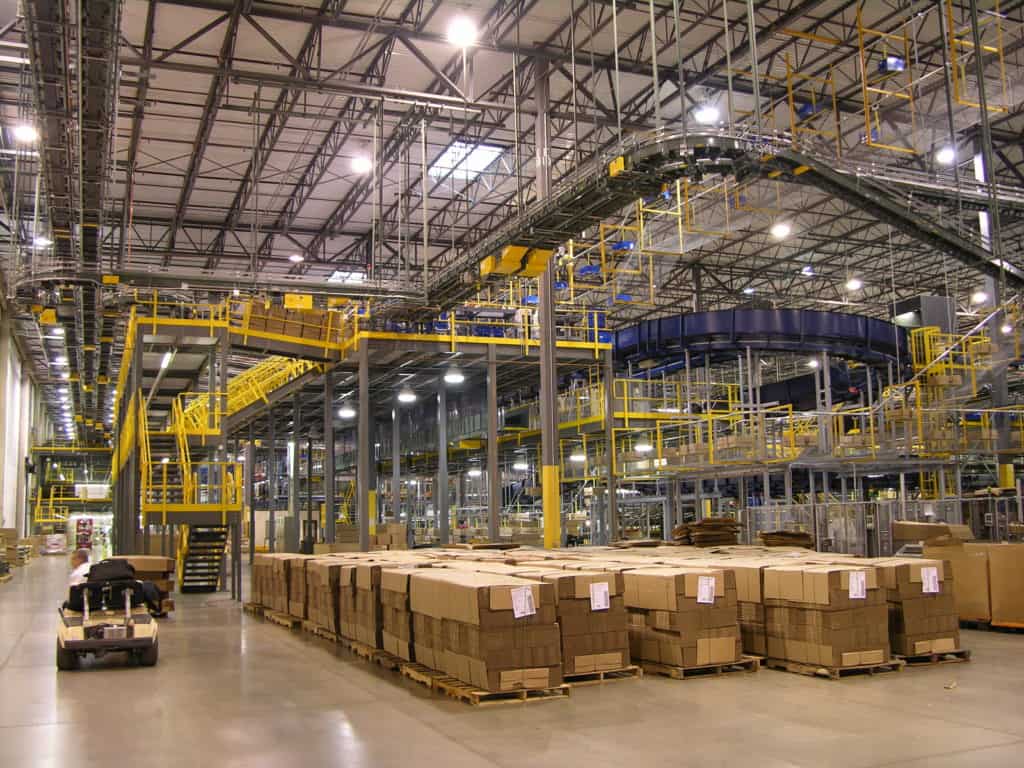
A pick module is a multi-level structure, often built from pallet racking, shelving, and carton flow, with picking on several levels and conveyor running through it. Reserve pallets sit in the upper rack levels. Pickers take cases from pallet flow or carton flow at the pick faces, place them on a takeaway conveyor, and the conveyor carries them to packing or shipping. Replenishment drivers refill the pick faces from the back side so they don’t block pickers.
That’s where the integrator’s view matters. The rack type sets how fast pick faces can be replenished. The conveyor sets how fast picked cases leave. The controls decide which zone a tote or carton visits. If any one of those is undersized, the other two can’t make up for it.
Century’s Barnes & Noble success story shows how that comes together at scale. The 1.2 million square foot distribution center used storage media ranging from high-rise narrow aisle pallet rack to flow rack to acres of multi-level shelving, with eight picking modules, each three levels high. Conveyors and sorters delivered replenishment inventory to the forward pick locations, and scanners and diverters routed cartons only to the zones where picks were needed.
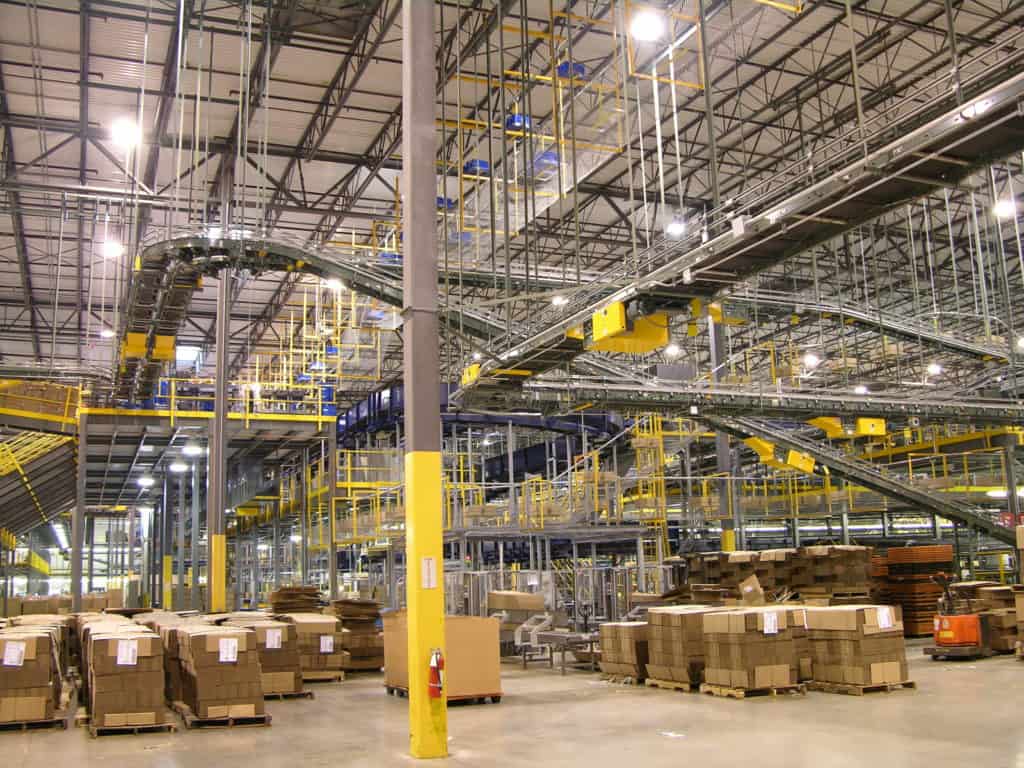
Pallets themselves often move on conveyor too. Pallet conveyor can carry full loads from receiving to rack aisles or from rack to the dock, and in an ASRS it feeds the crane’s pickup and drop-off stations. Century’s guide to pallet conveyor types explains the equipment that moves pallets between the rack and the rest of the building.
If your pick operation is the bigger question, Century’s post on picking methods for high-SKU distribution covers carton flow pick modules, zone picking, and goods-to-person.
Pallet Racking Cost: What Drives It
Pallet racking pricing changes with steel prices, so any number in an article goes stale quickly. What reliably drives the cost:
- Type of pallet racking. Static selective rack costs the least per position. Push-back carts and pallet flow lanes cost more per position but return more positions per square foot.
- Height and capacity. Taller frames and heavier beams cost more, and tall rack may need engineering and permitting.
- Accessories. Wire decking, column guards, end-of-aisle protection, and row spacers add up.
- Installation, anchoring, and permitting. Labor, anchors, drawings, and permit fees.
- Fire protection. In-rack sprinklers, when required, can be a major cost line.
- What comes with it. Lift trucks, conveyor, controls, lighting, and the floor itself. A rack that needs a new slab or a new truck fleet costs far more than its steel.
Compare options on cost per pallet position and cost per pick, not just cost per foot of rack.
Working With an Integrator on a Rack Layout
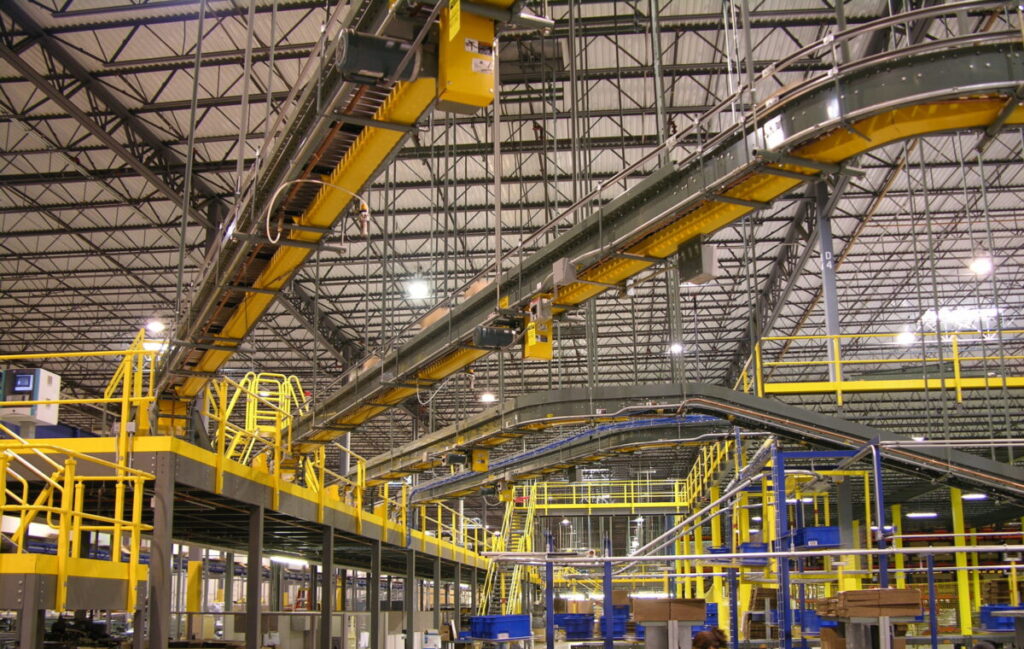
Pallet racking can be bought from a catalog, but a rack layout that ignores how product flows will cost you in labor every day. When you plan a new storage area or a re-rack, bring the person designing the material flow in at the start. They’ll look at your SKU data, your order profile, and your growth plan, then lay out storage, pick faces, conveyor, and dock flow together.
Century’s system design work starts from that data.
What are the main types of pallet racking?
The main types of pallet racking are selective, double-deep, drive-in, drive-through, push-back, pallet flow, and very narrow aisle racking. Mobile racking and ASRS racking are specialized versions. Cantilever racking is for long loads rather than pallets.
What is the most common type of pallet racking?
Selective pallet racking. It gives direct access to every pallet, works with almost any lift truck, and adapts easily when your SKU mix changes. Its trade-off is lower storage density, because every row needs an aisle.
What is the difference between drive-in and push-back racking?
In drive-in racking, the forklift drives into the lane and pallets sit on rails, so each lane should hold one SKU. In push-back racking, pallets ride on carts and the truck stays in the aisle. Both are last in, first out, but push-back is faster to work and easier on the rack.
Which pallet racking types are first in, first out?
Pallet flow racking and drive-through racking. Pallets load from one side and are removed from the other, so the oldest pallet is always the next one out. Selective racking can also run FIFO because every pallet is accessible.
How much weight can a pallet rack hold?
It depends on the beams, the upright frames, the spacing between beam levels, and the anchoring. The rated capacity comes from the manufacturer or the rack engineer and should be posted on a load sign at the rack. Changing beam levels can change the frame’s capacity.
Does pallet racking need to be bolted to the floor?
In most installations, yes. Pallet racking is normally anchored at each column per the manufacturer’s design, and seismic regions add specific anchorage requirements. Check your rack design and local codes.
How often should pallet racking be inspected?
Drivers should report impacts immediately, a supervisor should walk high-traffic aisles regularly, and a qualified person should perform a documented inspection periodically. Unload damaged bays until they’re repaired.
Can pallet racking be used in a pick module?
Yes. Pick modules often use pallet racking for reserve storage above pick faces, with pallet flow or carton flow at the picking levels and conveyor carrying picked cases away.
Match the Rack to the Operation
The right type of pallet racking comes from your data: SKU count, pallets per SKU, rotation, lift trucks, and what happens to each pallet next. Selective rack is still the right answer for many buildings. When density, FIFO, or throughput start to matter more, push-back, pallet flow, drive-in, and VNA each solve a specific problem, and the conveyor and controls around the rack decide whether the whole system keeps up.
Century Conveyor has been designing and integrating material handling systems since 1981. If you’re planning new storage, a re-rack, or a pick module, see Century’s pick modules and storage systems or contact our team to talk through your layout.