A vertical lift module (VLM) is an enclosed automated storage system with two columns of trays and a lift between them that brings the tray you need to an operator at a waist-high opening. Instead of a picker walking aisles of shelving and climbing ladders, the VLM stores small parts and cases floor to ceiling and delivers them to one workstation.
That simple idea solves three common problems: shelving that eats floor space, pickers who spend most of the day walking and searching, and small, valuable inventory that’s hard to keep accurate on open shelves. A VLM isn’t the right answer for every SKU, though. It has a throughput ceiling, it needs software to earn its keep, and it has to connect to the rest of the building.
This guide explains how a vertical lift module works step by step, what it stores well and what it doesn’t, how it compares with carousels, shelving, shuttles, and cube storage, and how a VLM pod connects to conveyor and your warehouse management system.
At a glance
- A vertical lift module stores trays in two columns inside a tall enclosure, with an extractor in the middle that retrieves trays and presents them at an access opening.
- VLMs fit small parts, slow and medium movers, MRO spares, tooling, and kitting, where density and accuracy matter more than raw picks per hour.
- One extractor serves one unit, so busy operations group two or three VLMs in a pod and let the operator pick from one while the others fetch the next trays.
- Software decides most of the result: pick-to-light or a pointer at the opening, batch picking, and an interface to your WMS or WCS.
- A pod in front of a tote conveyor turns a VLM from a storage cabinet into part of the fulfillment flow.
- Floor loading, fire protection, and guarding at the access opening need to be checked before installation.
Table of Contents
What Is a Vertical Lift Module?
A vertical lift module is a type of automated storage and retrieval system (ASRS) built for small items. From the outside it looks like a tall steel cabinet with a work counter and an opening at waist height. Inside, it has three main parts:
- Two columns of trays, one at the front and one at the back, holding trays on shelf supports at close vertical spacing.
- An extractor, sometimes called the inserter or lift, that travels up and down the center of the unit between the columns. It pulls a tray out of its slot, carries it to the access opening, and returns it when the operator is done.
- Controls and software that know where every tray and every item lives, and tell the operator what to pick.
Trays hold product directly or in bins and dividers, so one tray can carry many SKUs. Because the extractor measures the height of each tray’s contents as it stores the tray, the VLM can slot short trays closer together and tall trays farther apart, using the height of the unit instead of wasting space above short items. That height-optimized storage is the main reason a VLM holds so much more than the shelving it replaces.
The MHI ASRS Industry Group covers vertical lift modules alongside carousels and other automated storage, and it’s a useful neutral starting point if you’re comparing equipment types.
How a Vertical Lift Module Works in 6 Steps
- An order is released. The WMS or the VLM’s own software sends a pick list, often grouped as a batch of orders.
- The extractor retrieves the tray. It travels to the tray’s slot, pulls the tray onto the lift, and brings it to the access opening.
- The system shows what to pick. A light bar, laser pointer, or screen points to the exact bin and shows the quantity. In batch picking, put lights on a nearby rack or cart show which order gets each item.
- The operator picks and confirms. The operator takes the item, places it in the right tote or order location, and confirms with a button, scan, or screen tap.
- The tray goes back. The extractor returns the tray to an open slot, which may be a different slot than it came from if the software is optimizing storage.
- The next tray is already waiting. In a pod of two or three vertical lift modules, the next unit has already retrieved its tray, so the operator turns and keeps picking while the first unit works.
Put-away works the same way in reverse. The operator scans incoming product, the system calls the tray with space for it, and the light shows where to place it.
What a Vertical Lift Module Stores Well
A VLM does its best work when items are small, inventory is broad, and accuracy matters.
- MRO and spare parts. Maintenance storerooms with thousands of small, valuable parts are a classic VLM application. The unit is secure, and every access can be logged.
- Small-parts distribution. Fasteners, electrical components, hardware, automotive aftermarket parts, and other high-SKU, small-cube inventory.
- Slow and medium movers. The long tail of SKUs that don’t justify a pick face on a conveyor-fed pick module but still need to be picked accurately.
- Kitting and assembly. Bringing all the components for a kit to one station.
- Controlled or high-value items. Pharmaceuticals, electronics, and anything where access control and audit trails matter.
- Tooling, dies, and fixtures. Heavier items stored on reinforced trays, depending on the model.
It’s a weaker fit for full cases of fast movers, very large or long items, and SKUs that need very high picks per hour from a single location. Those belong on carton flow, in a pick module, or in a different type of automation.
Vertical Lift Module vs. Shelving, Carousels, and Other ASRS
| Option | How product reaches the picker | Strengths | Limits |
|---|---|---|---|
| Static shelving | Picker walks to it | Low cost, flexible, unlimited pickers | Floor space, walking, search time, accuracy |
| Vertical lift module | Extractor brings one tray to an opening | Height-optimized density, accuracy, security, ergonomics | One extractor per unit sets the pace |
| Vertical carousel | Whole set of shelves rotates to the opening | Simple, fast for small loads | Fixed shelf spacing wastes height; the whole load moves for every pick |
| Horizontal carousel | Bins rotate on a loop to the operator | Good for high pick rates in groups | Floor space, fixed bin sizes |
| Shuttle or mini-load ASRS | Shuttles or cranes bring totes to a workstation by conveyor | High throughput, many SKUs | Larger investment and footprint, complex integration |
| Cube or robotic goods-to-person storage | Robots retrieve bins from a dense grid or cube | Very high density and scalable throughput | Larger investment; best for bigger SKU and order volumes |
The most common comparison is the vertical lift module against a vertical carousel. Both bring shelves to an opening at waist height. A vertical carousel rotates every shelf in the unit to bring one to the opening, so shelf spacing is fixed and the whole load moves with every pick. A vertical lift module moves only the tray you need and stores trays at the spacing their contents require, which usually means more storage in the same height and heavier trays.
Above the VLM sits a larger class of goods-to-person systems. Century’s goods-to-person solutions page describes Attabotics’ cubic storage structure, where robots travel horizontally and vertically inside the structure to reach any storage location. That class of system is built for higher order volumes across a whole building, while a vertical lift module is usually a department-sized answer: a storeroom, a small-parts zone, or the slow-moving tail of a larger pick operation.
Throughput: The Limit to Plan Around
Every VLM has one extractor, and it can only fetch one tray at a time. The trip from slot to opening takes time, and so does the pick itself. That cycle sets the ceiling for one unit, and no amount of operator speed gets past it.
Three design choices raise the effective rate:
- Pods. Grouping two or three units in front of one operator keeps the operator busy while the extractors work.
- Batch picking. Picking several orders from each tray presentation means fewer tray trips per order line. Put lights at the station tell the operator which order gets each item.
- Slotting. The software can keep the fastest-moving trays near the opening height so trips are shorter, and group items that are often ordered together on the same tray.
The rated cycle time and picks per hour depend on the manufacturer, the unit height, and the order profile, so ask for a simulation using your own order data rather than a brochure number. Software: Where a VLM Earns Its Keep
A VLM without software integration is a very expensive cabinet. With it, the unit becomes a goods-to-person station that knows every item’s location and quantity.
What the software layer should do:
- Inventory and location control: item, quantity, tray, and position for everything in the unit.
- Order processing: receive orders from your WMS or ERP, batch them, and sequence tray calls across the units in a pod.
- Operator guidance: pick-to-light, pointers, and put lights so the operator never searches.
- Access control: user logins and an audit trail of who took what, which matters for MRO, pharma, and high-value inventory.
- Integration: send confirmations back to the WMS, and hand completed totes to conveyor through the warehouse control system.
That last point is where most of the value lives in a fulfillment operation. Century’s warehouse control system work ties equipment like this to the WMS and to the conveyor and sortation that carry orders downstream.
Where a Vertical Lift Module Fits Next to Conveyor
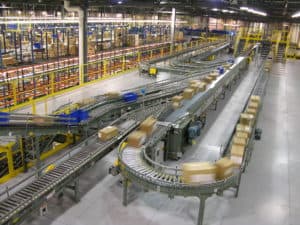
On its own, a VLM ends at the operator’s hands. In a distribution center, picked items still need to get to packing, consolidation, or shipping. That’s where conveyor comes in.
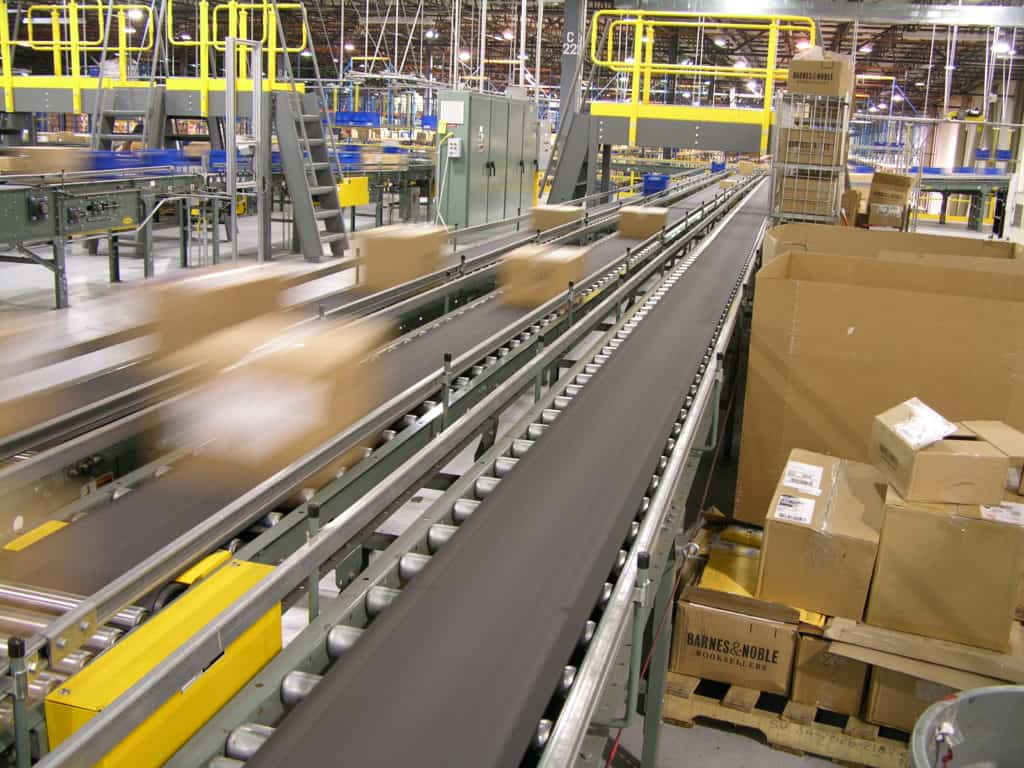
A typical layout puts a pod of vertical lift modules along a tote conveyor:
- Empty order totes are inducted onto the conveyor and routed to the pod.
- The operator picks from the VLM trays into the totes at the station, guided by put lights.
- When a tote is complete, the operator pushes it onto the takeaway conveyor or presses a button to release it.
- The conveyor carries the tote to the next zone if the order needs items from elsewhere in the building, or straight to packing if it’s complete.
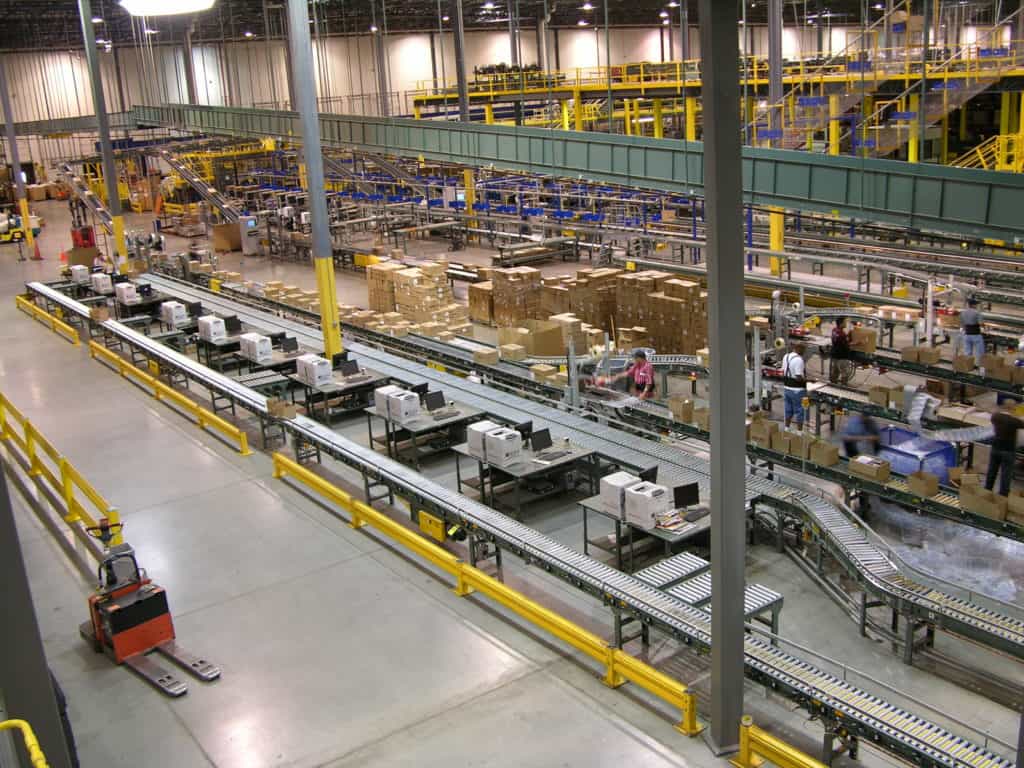
In a zone-routing system, scanners read each tote and diverters send it only to the zones where it has picks, so a tote might visit a carton flow zone, a pallet flow zone, and a VLM pod before reaching packing. Century’s Barnes & Noble success story describes that kind of routing at scale: scanners and diverters directed cartons only to the zones where picks were required, across eight three-level pick modules.
The conveyor and controls questions to settle early:
- Where the pod sits relative to replenishment, so restocking the VLMs doesn’t cross the tote flow.
- How totes get released and what happens when the takeaway line backs up. Accumulation in front of and behind the pod keeps the operator from waiting.
- How the system knows a tote is complete and where it goes next, which is a WCS decision.
- How replenishment arrives: by cart, by pallet, or by conveyor from receiving.
Century’s pick modules and storage systems page describes how storage, picking, and conveyor are laid out together.
Planning a Vertical Lift Module Installation
A VLM is heavy, tall, and permanent once it’s in. Check these before you commit.
Floor. A loaded VLM concentrates a lot of weight on a small footprint. Have the slab evaluated against the manufacturer’s floor-loading data.
Clear height. Units are built to the height you order, up to the limits of the building and the model. Taller units store more but add travel time per tray.
Multiple floors. Some VLMs pass through a mezzanine or upper floor, with an access opening on each level, so one unit serves two areas.
Fire protection. An enclosed, tall unit full of product changes how sprinklers reach it. Your fire protection engineer and local fire authority may require sprinklers inside the unit or other measures. Raise it early.
Guarding and safety. The access opening is where the operator meets moving equipment. Manufacturers protect it with light curtains or similar devices that stop the extractor when something is in the opening. OSHA’s general machine guarding rule, 29 CFR 1910.212, requires guarding against hazards created by machine operation, so make sure those devices stay in place and get tested.
Service and uptime. A VLM is one machine holding a lot of inventory. Ask how the unit can be accessed if the extractor stops, what the manufacturer’s service coverage looks like, and what preventive maintenance it needs.
This section is general information, not engineering advice. Floor loading, seismic anchoring, and fire protection have to be engineered for your building and local codes.
Vertical Lift Module Cost: What Drives It
Century doesn’t publish equipment prices, and vertical lift module pricing varies widely by size and options. What drives the cost:
- Height and width of each unit, and the tray load rating.
- Number of units in the pod, and number of access openings.
- Options at the opening: light bars, pointers, tilt trays, displays, and safety devices.
- Software licensing and the WMS or ERP interface.
- Installation: rigging, assembly in place, floor work, and fire protection.
- What surrounds it: conveyor, put walls, workstations, and controls.
The return usually comes from floor space recovered, picker walking eliminated, and fewer picking errors. Build the business case from your own numbers: current pick rate, error rate, labor cost, and the floor space the VLM would free up.
Is a Vertical Lift Module Right for Your Operation?
A vertical lift module is worth a serious look if several of these are true:
- Small-parts shelving takes up a large share of your floor, and you need the space.
- Pickers spend more time walking and searching than picking.
- Pick accuracy on small items is a recurring problem.
- You carry many small SKUs with low to moderate velocity.
- You need access control and an audit trail for valuable inventory.
- Your order volume fits what a few units in a pod can deliver.
If your volume is far higher, or most of your SKUs are fast movers, a conveyor-fed pick module or a larger goods-to-person system may fit better. Century’s post on picking methods for high-SKU distribution walks through how to match the method to the inventory profile.
What is a vertical lift module?
A vertical lift module is an enclosed automated storage system with two columns of trays and an extractor in the middle. The extractor retrieves the tray holding the item you need and presents it at a waist-high access opening, so the operator picks without walking or climbing.
How does a vertical lift module work?
The software receives an order, the extractor retrieves the right tray and brings it to the opening, a light or pointer shows the item and quantity, the operator picks and confirms, and the tray returns to storage. In a pod, the next unit has its tray ready while the first one returns.
What is the difference between a VLM and a vertical carousel?
A vertical carousel rotates all of its shelves to bring one to the opening, with fixed shelf spacing. A vertical lift module moves only the tray you need and stores trays at the spacing their contents require, which usually means more storage in the same height.
What can you store in a vertical lift module?
Small parts, MRO spares, tooling, electronics, pharmaceuticals, kitting components, and other items that fit on trays. It’s best for slow and medium movers and inventory where accuracy and security matter.
How many picks per hour can a vertical lift module handle?
It depends on the unit height, the order profile, and how many units share an operator. One extractor sets the ceiling for each unit, so pods, batch picking, and good slotting raise the effective rate. Ask for a simulation using your own order data.
Can a vertical lift module connect to conveyor?
Yes. A common layout puts a pod of vertical lift modules along a tote conveyor. Operators pick into order totes at the pod, release them onto the takeaway conveyor, and the conveyor and warehouse control system route each tote to its next zone or to packing.
Does a vertical lift module need special fire protection?
Often. An enclosed, tall unit full of product can block ceiling sprinklers from reaching the contents, so the fire authority may require sprinklers inside the unit or other measures. Involve your fire protection engineer early.
Does a vertical lift module need to integrate with a WMS?
It can run on its own software, but integrating with your WMS or ERP is what makes it efficient. Integration lets orders flow in automatically, confirms picks back to inventory, and lets the warehouse control system hand completed totes to conveyor.
Make the VLM Part of the Flow
A vertical lift module saves floor space and walking, and it keeps small inventory accurate. Its real payoff in a distribution center comes when the pod, the software, and the conveyor around it are designed together, so picked totes leave the station as fast as the operator fills them.
Century Conveyor has been designing and integrating material handling systems since 1981. If you’re weighing a vertical lift module or another goods-to-person option, see Century’s pick modules and storage systems or contact our team to talk through your operation.