The U.S. auto-care industry is projected to grow 5.4% in 2026, with the light-vehicle aftermarket close behind at 5.2%. Those are healthy numbers — the kind that show up in board decks and press releases as unambiguously good news.
But growth in the aftermarket doesn’t arrive as a clean, evenly distributed lift. It arrives as more SKUs, more order lines, tighter delivery promises, and more returns flowing back through the same building you were already running at capacity. The distribution operations supplying this market are working harder than ever, and not all of their warehouse systems are keeping pace.
If your parts DC was designed for the order profile you had five years ago, growth is not going to feel like a win. It’s going to feel like overtime.
Parts Warehouses Are Not Generic Warehouses
There’s a tendency in material handling to treat all distribution centers as variations on a theme: receive, store, pick, ship. In practice, an automotive aftermarket facility has a distinct operational profile that generic warehouse design handles badly.
Consider what a regional parts DC is actually managing:
Extreme SKU density. A regional parts distribution center commonly carries 50,000 or more active SKUs. Filters, sensors, brake components, gaskets, electrical parts, body panels — items that vary wildly in size, weight, velocity, and value, all needing to coexist in one pick strategy.
Small-carton and tote formats. Aftermarket order lines skew small. A typical outbound order is a handful of pieces destined for a jobber, a dealership, or an installer bay — not a pallet. That changes everything about how the pick face should be built and how product should move between zones.
Multiple picking zones with wildly different velocities. The top 5% of SKUs may account for half your order lines. The bottom 40% may turn twice a year. Running both through the same pick methodology means either overbuilding for slow movers or starving your fast movers of the density they need.
Time-sensitive outbound alongside slow-moving warranty parts. The same building that has to hit a 4:00 PM cutoff for next-day delivery also has to process warranty parts and cores moving on a completely different clock.
Legacy systems inherited through M&A. This one is increasingly common. Private-equity-backed rollups in the aftermarket space have consolidated a lot of regional distributors, and each acquisition brings a building full of equipment installed by a different integrator, at a different time, running different controls. The result is a network where no two sites operate the same way and nobody has a consolidated view of throughput.
The pressure to run these operations more efficiently is real — and it’s growing right alongside the market.
Four Systems That Determine Whether Your DC Scales
When Century and the LaFayette Engineering family of companies evaluate a parts distribution operation, four areas consistently separate facilities that absorb growth from facilities that buckle under it.
1. Pick Modules Designed for Small-Carton and Tote Movement
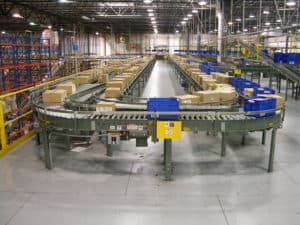
The pick module is where an aftermarket DC either earns or loses its productivity. High-density zone picking — carton-flow racks, live storage, and integrated conveyor takeaway — is purpose-built for exactly the SKU density and small-piece order profile that defines this vertical.
The design questions that matter: How many facings can you present per operator per hour without excessive travel? Is replenishment happening from behind the pick face so it doesn’t interrupt picking? Are your zones balanced so no single operator becomes the bottleneck for every order? Can you re-slot seasonally without rebuilding the module?
A well-designed multi-level pick module concentrates thousands of facings into a compact footprint with conveyor doing the horizontal travel instead of people. That’s the single biggest labor lever in most parts DCs.
2. Shipping Sortation and Print-and-Apply for High-Velocity Outbound
Outbound is where growth pressure shows up first and most visibly. When volume climbs, manual sortation to shipping lanes becomes the constraint — and the failure mode isn’t just slowness, it’s mis-sorts that turn into service failures and returns.
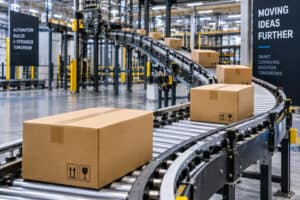
Automated shipping sortation paired with inline scan tunnels and print-and-apply labeling keeps outbound moving accurately at shift-peak volumes. Scan tunnels capture dimensional and identification data without an operator handling the carton. Print-and-apply removes the label station as a discrete step. Together they let you push more cartons through the same shipping dock footprint with fewer touches and better carrier compliance.
If your operation currently absorbs peak by adding a second shift or temp labor at the shipping end, that’s a sortation problem wearing a labor costume.
3. Returns and Warranty Processing Built Into the Flow
Returns are not an edge case in the automotive aftermarket. They’re structural. Warranty claims, core returns, and incorrect-part returns are a permanent, significant inbound stream — and in a lot of facilities they’re handled in whatever floor space happened to be available when the volume got noticeable.
That improvisation has a cost. When returns processing shares dock doors, staging space, or conveyor with outbound, inbound exceptions stall outbound throughput. A properly designed returns lane — with its own receiving point, inspection stations, and disposition paths back to stock, to scrap, or to the supplier — keeps that interference from happening.
Designing returns into the flow from the start is dramatically cheaper than retrofitting it after the fact.
4. WCS Controls Upgrades for Legacy and Acquired Systems
This is the quiet one, and often the highest-leverage.
When an operator acquires facilities, they inherit equipment from multiple original integrators, installed across a span of years, running whatever controls platform was current at the time. Site A has one vendor’s PLC logic, Site B has another’s, and neither talks to the WMS the same way. Corporate has no consistent throughput reporting, and troubleshooting requires institutional knowledge that lives in one maintenance tech’s head.
A Warehouse Control System upgrade brings visibility and consistency across a consolidated footprint. LaFayette WCS is designed to sit on top of existing mechanical assets — meaning you can standardize controls, reporting, and diagnostics without ripping out serviceable conveyor and sortation.
The financial argument is straightforward: a controls upgrade typically costs a fraction of a mechanical replacement and often unlocks meaningful throughput from equipment you already own. Before you budget for new steel, it’s worth knowing what your current system can do under better control.
Signs Your Warehouse Is Falling Behind the Market
Some practical diagnostics. If several of these are true, your systems are constraining your growth rather than supporting it:
- Peak season requires a second shift or significant temp labor to hit the same cutoff you used to hit on straight time
- Your pick module was designed before your SKU count grew 30%+ and you’ve been absorbing new items into whatever space existed
- Returns and warranty processing happen in space that was never designed for it
- You’ve acquired facilities and can’t produce a consolidated throughput report across sites
- Mis-ships and carrier compliance chargebacks are trending up
- Your maintenance team is sourcing parts for equipment the original integrator no longer supports
- Nobody can confidently answer “what’s our actual maximum daily order-line capacity in this building?”
That last one is telling. If you don’t know your ceiling, you’ll find it the hard way — usually during your busiest week of the year.
What Century and LaFayette Bring to a Parts DC
Whether you’re expanding an existing operation, consolidating sites after an acquisition, or modernizing a legacy system, the Century and LaFayette Engineering family of companies covers the full spectrum of what a parts distribution center needs:
- Pick modules and carton-flow systems
- Shipping sortation
- Scan tunnels and dimensioning
- Print-and-apply label systems
- WCS and HMI controls upgrades
- Returns and warranty lane design
- Preventive maintenance programs
- System audits for acquired facilities
That last item deserves emphasis. If you’ve recently acquired a facility and inherited a system you didn’t specify, a system audit gives you an objective read on what you have, what it’s capable of, and where the practical upgrade path runs — before you commit capital.
From Pick Module to Final Mile
The aftermarket’s growth is a genuine opportunity. Capturing it depends on whether your distribution operation can convert additional demand into shipped orders without proportionally adding cost, labor, and error.
That’s a design question, and it’s answerable. Whether you’re expanding, consolidating, or running a legacy system that’s starting to show its age, the Century and LaFayette family of companies can help you design a smarter, faster, and more serviceable parts operation.
Ready to talk through your parts distribution challenge? Start the conversation — no pitch, just an honest look at what your operation needs and what it takes to build it right.
Growth figures: Auto Care Association, 2026 projections.