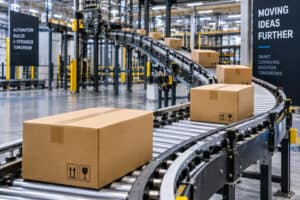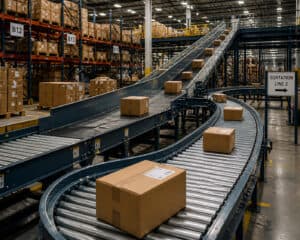
An accumulation conveyor is a powered conveyor that lets product stop and queue in line without crushing, pushing, or damaging what’s in front of it. It is the buffer that lets two processes running at different speeds share one line, so a sorter, packing station, or palletizer can pause without shutting down everything upstream.
Every distribution center has places where work arrives faster than the next step can take it, or arrives in bursts. Pick zones release cartons in waves. A print and apply station stops to swap a label roll. A shipping lane backs up while a trailer gets changed. Without accumulation, those moments turn into jams, damaged cartons, and people standing around waiting. With the right accumulation conveyor in the right place, the line absorbs them.
This guide covers what an accumulation conveyor does, the difference between zero-pressure and minimum-pressure designs, the five drive types you’ll be offered, how to size a buffer, and what to check before you buy or retrofit.
At a glance
- An accumulation conveyor holds product in a queue so upstream work keeps flowing when downstream work stops.
- Zero-pressure accumulation (ZPA) keeps a gap between items. Minimum-pressure accumulation lets items touch with light pressure.
- Five common drive types: 24V motor-driven roller (MDR) ZPA, pneumatic ZPA, belt-driven live roller, line shaft, and gravity.
- Size the buffer from the rate mismatch and the longest stoppage you need to ride through, not from the floor space you have left.
- Release mode (singulation or slug) matters as much as the conveyor type when the line feeds a merge or sorter.
Table of Contents
What Is an Accumulation Conveyor?
An accumulation conveyor is a section of powered conveyor built to stop and hold product in sequence while the conveyor keeps running or restarts by zone. A standard transport conveyor moves everything on it at once. If the far end stops, cartons keep coming and pile into each other, and drive pressure builds against the lead carton. An accumulation conveyor is designed so that doesn’t happen.
Most accumulation conveyors divide the line into short zones, each long enough to hold one carton or tote. A sensor in each zone (usually a photo eye) tells the controls whether the zone is occupied. When the zone ahead is full, the zone behind it stops driving, and the item waits. When the zone ahead clears, the waiting item moves up. The result is an orderly queue that fills from the front and empties from the front.
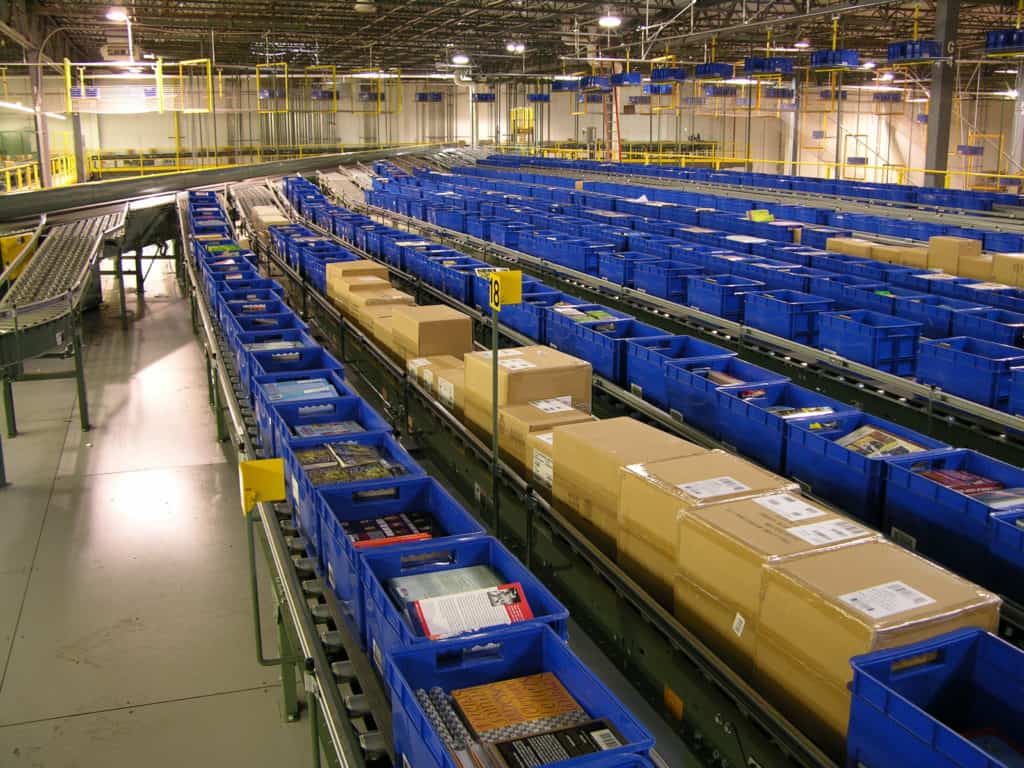
That queue is what makes an accumulation conveyor different from simply adding more transport conveyor. Extra transport conveyor gives you more product on the line. An accumulation conveyor gives you more product on the line that can stop safely and restart in order.
Why Accumulation Matters in a Distribution Center
Processes in a warehouse almost never run at the same rate minute to minute. A few common examples:
- Picking to packing. Pick zones release work in batches or waves, while packers work at a steady pace.
- Merges into a sorter. Several feed lines compete for one induction point. Each line has to hold product until the merge gives it a window.
- Print and apply, scanning, and weighing. These stations stop for label changes, no-reads, and rejects. The line in front of them needs somewhere to wait.
- Sorter to shipping. Shipping lanes fill while a trailer is swapped or a loader steps away.
- Palletizing. A robotic or manual palletizing cell takes product in patterns, not one carton at a time.
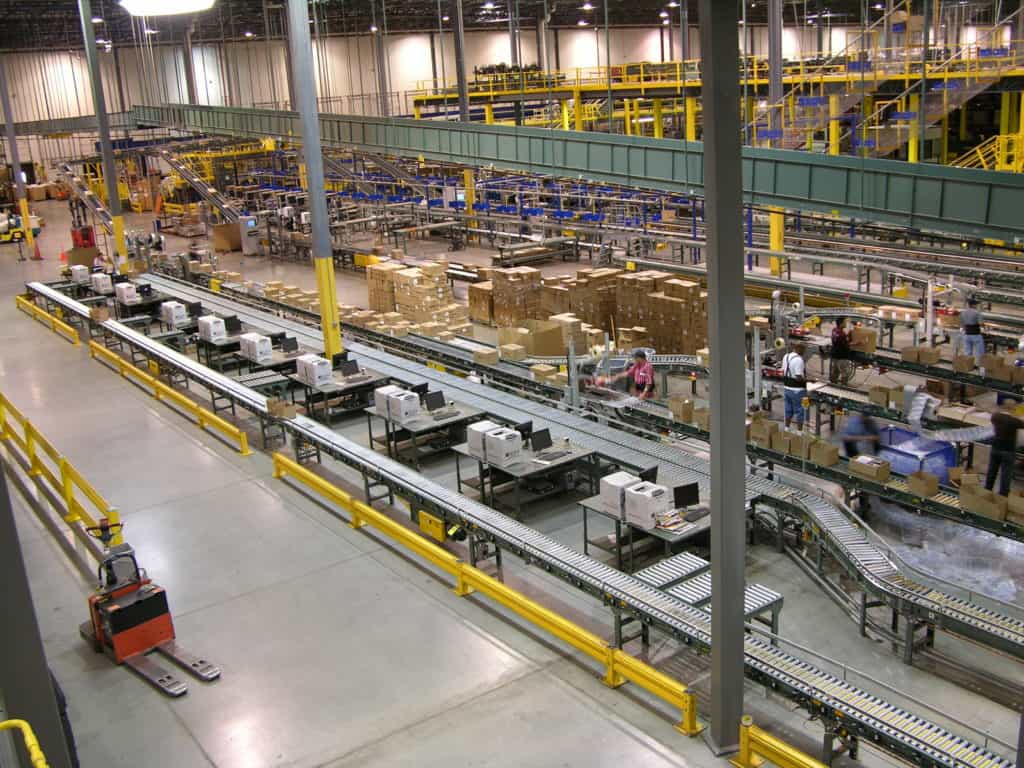
In each case the accumulation conveyor is the shock absorber. It protects throughput by keeping upstream processes running through short downstream stops, and it protects product by keeping cartons from crushing each other while they wait. For fragile goods such as wine, spirits, glass, and cosmetics, that second job is often the reason accumulation gets specified in the first place.
Zero-Pressure vs. Minimum-Pressure Accumulation Conveyor
The first decision is how much contact your product can tolerate in the queue.
Zero-pressure accumulation (ZPA) keeps items from touching. Each zone stops driving when the zone ahead is occupied, so the waiting item comes to rest with a gap in front of it. Nothing is pushed against anything.
Minimum-pressure accumulation lets items touch, but keeps the pushing force low. The drive slips or eases off under the stopped product, so cartons nudge together with light contact rather than full line pressure.
| Zero-pressure (ZPA) | Minimum-pressure | |
|---|---|---|
| Contact between items | None; gaps maintained | Light contact |
| How it stops product | Zone-by-zone control with a sensor per zone | Slipping or reduced drive under stopped product |
| Best for | Fragile, mixed, or crushable product; feeding scanners, merges, and sorters | Sturdy, uniform cartons; long low-cost buffer runs |
| Controls | More sensors and zone logic | Simpler |
| Typical cost | Higher per foot | Lower per foot |
| Gaps on release | Built-in, which helps scanning and sortation | Must be created downstream |
As a rule of thumb, if the accumulation conveyor feeds a scanner, a merge, or a sorter, zero-pressure is usually the better fit because the product leaves the queue already spaced. If the line is a long buffer of sturdy cases heading to a manual process, minimum pressure can do the job for less.
The 5 Accumulation Conveyor Drive Types
The pressure decision tells you what the accumulation conveyor has to do. The drive type decides how it does it, and that choice affects noise, energy, maintenance, and how easily you can change the line later.
| Drive type | Pressure | How it works | Plant air needed | Notes |
|---|---|---|---|---|
| 24V motor-driven roller (MDR) | Zero | A motorized roller in each zone drives its neighbors; a zone card and photo eye control it | No | Quiet; zones only run when product is present; easy to reconfigure |
| Pneumatic ZPA (live roller) | Zero | A common drive runs the line; air actuators engage or disengage each zone | Yes | Proven and widely installed; needs compressed air and air system upkeep |
| Belt-driven live roller | Minimum | A belt under the rollers drives them; pressure rollers let product slip when stopped | No | Handles a wide range of cartons; some line pressure in the queue |
| Line shaft | Minimum | A rotating shaft drives rollers through spools and drive bands that slip under load | No | Simple and economical for light loads; noisier on long runs |
| Gravity (roller or skate wheel) | Uncontrolled | Product rolls on a slight decline with no drive | No | No power; product pushes on product; only for short, low-risk queues |
24V MDR zero-pressure accumulation
MDR has become the default for many new carton and tote lines. Each zone has its own low-voltage motorized roller, so a zone only runs when it has something to move. That cuts noise and energy use on lines that spend a lot of time waiting, and it means a failed zone can usually be replaced without taking down a whole section. Zone cards can also be networked, which makes it easier for plant controls or a warehouse control system to see what each zone is doing.
Pneumatic zero-pressure accumulation
Many existing systems use a single motor driving the whole section, with air-operated mechanisms raising or lowering the drive under each zone. It works well and a lot of it is still running. The trade-offs are the compressed-air system itself (leaks, compressor capacity, moisture) and the noise of a constantly running drive. When these lines come up for modernization, converting zones to MDR is a common path.
Minimum-pressure live roller and line shaft
Belt-driven live roller and line shaft conveyors accumulate by letting the drive slip under stopped product. They are simple and cost less per foot, which makes them a reasonable choice for long buffers of uniform, sturdy cases. They are not the right choice for fragile goods, mixed product that can shingle or ride up, or lines that need clean gaps for scanning.
Gravity
Gravity conveyor is not true accumulation, because there’s no way to control pressure. Product rolls until it hits the item in front of it, and every item behind adds to the load. It still has a place: short lanes coming off a sorter, staging at a pack station, or temporary lines. For anything long, heavy, or fragile, use a powered accumulation conveyor instead.
Singulation Release vs. Slug Release
How the queue empties matters as much as how it fills.
Singulation release lets one item leave at a time. As the lead zone clears, the next zone moves up, then the next. Product leaves with gaps between items, which is what scanners, label applicators, and sorters want to see.
Slug release (sometimes called train release) lets a whole group of zones release together, so a block of product moves at once. Slug release is useful when a merge gives a feed line a short window and you need to empty as much of the queue as possible while it’s open. The trade-off is that items leave close together, so gapping has to happen downstream before scanning or sortation.
Many modern zone controls can do either, and switch modes based on what the downstream equipment is asking for. When you spec an accumulation conveyor that feeds a merge, ask how the release mode will be controlled as well as which conveyor is being supplied.
How to Size an Accumulation Conveyor Buffer
Buffer length is where many lines go wrong. The usual mistake is filling whatever floor space is left with conveyor and calling it accumulation. Start with the numbers instead.
- Find the rate mismatch. How many items per minute arrive, and how many can the downstream process take?
- Decide what stoppage you need to ride through. A label roll change, a sorter recirculation, a trailer swap. Pick a realistic duration.
- Multiply. Items per minute arriving times minutes of stoppage equals the number of items the buffer must hold.
- Convert to length. Multiply by zone length. On a ZPA conveyor, each item typically occupies one zone, and zones are sized to the longest item you run plus clearance.
A simple example: a pick area releases 30 cartons per minute into a line that feeds a print and apply station. You want to ride through a 3-minute stop. That is 90 cartons of buffer. If your zones are 30 inches long, you need 90 zones, or 225 feet of accumulation conveyor. If you only have room for 100 feet, you now know the stoppage you can absorb is closer to 80 seconds, and you can decide whether to change the layout, add a recirculation loop, or slow the upstream release.
Two more checks are worth making. First, a long carton that spans two zones can confuse zone logic, so confirm the zone length against your longest product, not your average. Second, check the smallest and lightest items. Polybags, small mailers, and very light cartons may not trip a photo eye cleanly or may slide on a stopped roller. They often need a belted zone, a different sensor arrangement, or a tote.
Choosing an Accumulation Conveyor: 7 Questions to Answer First
Before you compare quotes, get clear answers to these:
- What is the full product range? Smallest, largest, lightest, heaviest, and the bottom surface (corrugate, tote, polybag, shrink-wrapped tray).
- How fragile is it? Glass, liquids, and crushable packaging point to zero pressure.
- What feeds the line, and what does it feed? A scanner or sorter downstream favors ZPA with singulation release.
- How long a stoppage must it absorb? This sets buffer length.
- Is plant air available and reliable? If not, pneumatic ZPA adds a compressor system to maintain.
- Who maintains it? Your in-house team’s skills with zone cards, photo eyes, and air systems should influence the choice.
- Will the line change? MDR zones are generally easier to re-sequence or extend when the operation changes.
Where Accumulation Sits in a Real System
Accumulation conveyor rarely shows up as one big piece of equipment. It is spread through a system in short sections wherever two processes meet.
The Barnes & Noble distribution center that Century Conveyor integrated is a good example. The 1.2 million square foot building runs on more than 13 miles of Hytrol conveyor carrying cartons and totes from receiving to shipping. Receiving feeds a 380-foot shoe sorter running at up to 140 cartons per minute. Eight three-level pick modules use scanners and diverters to send cartons only to the zones where picks are required. Packing feeds taping, weighing, and print and apply stations, and a tilt-tray shipping sorter handles up to 170 cartons per minute.
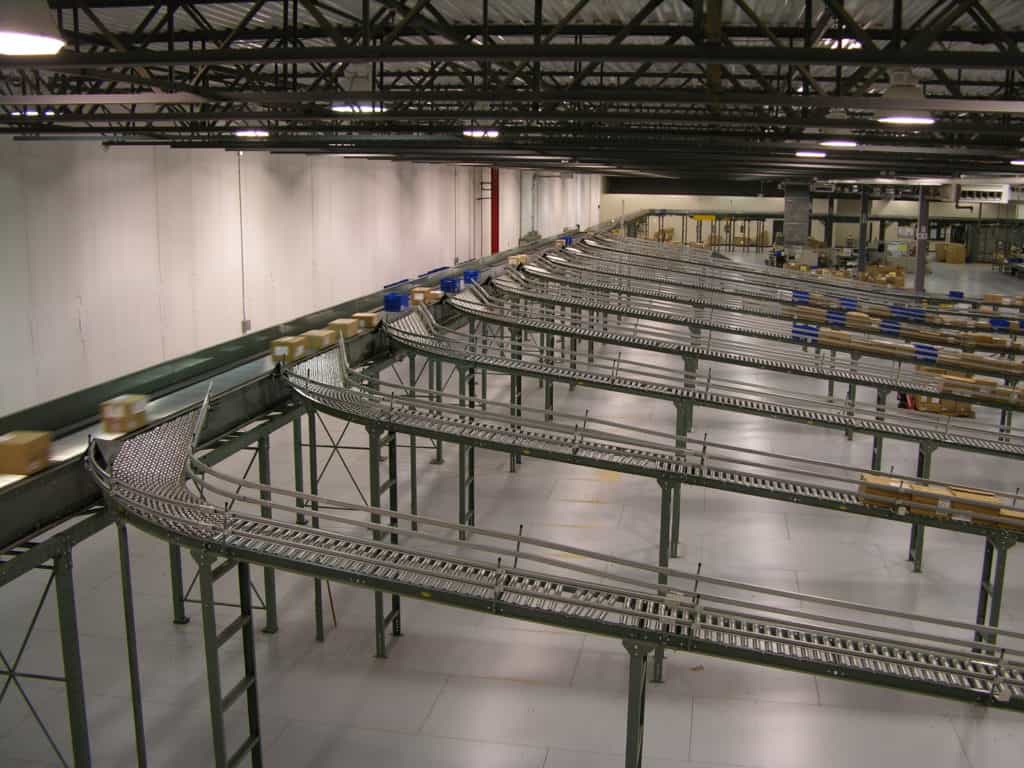
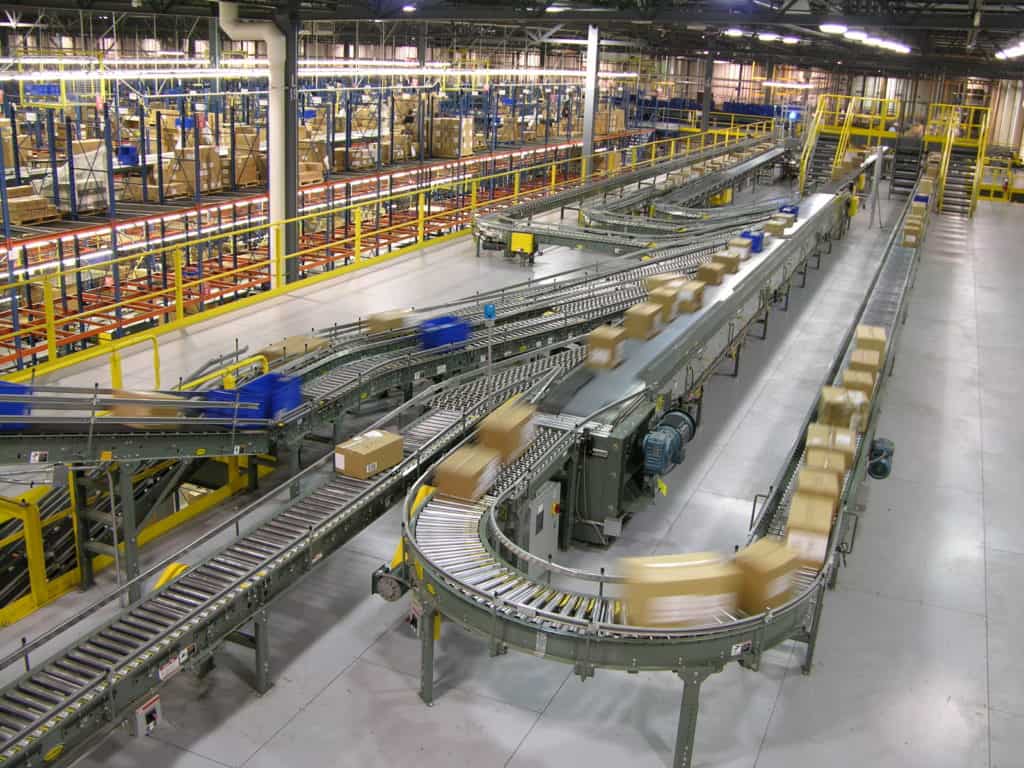
Every one of those handoffs needs somewhere for product to wait, and the photos in this article show what that looks like on the floor: curved lines turning into parallel queues, lanes stepping down from the sorter, and packing stations with product staged in front of them. Read the full Barnes & Noble story.
Common Accumulation Conveyor Problems and What Causes Them
When an accumulation conveyor starts causing trouble, the cause is usually one of a short list:
| Symptom | Likely cause | What to check |
|---|---|---|
| Cartons bump or collide in a ZPA section | Dirty, misaligned, or failed photo eye | Clean and realign sensors; check reflectors |
| A zone won’t run or won’t stop | Failed zone card, roller, or air actuator | Swap the zone component; check wiring or air lines |
| Product stops but slides forward | Light items or worn, contaminated rollers | Clean rollers; consider belted zones for light product |
| Whole section sluggish | Low air pressure (pneumatic) or worn drive belts and bands | Check compressor and leaks; replace worn drive components |
| Long cartons cause jams | Item spans two zones | Re-check zone length against longest product |
| Product rubs the side guide | Skewed rollers or guide rail set too tight | Adjust guides; check roller alignment |
Most of these are routine maintenance items, and most of them show up gradually before they become downtime. A preventive maintenance program with the same technicians visiting on a schedule is the most reliable way to catch them early. For a refresher on the components involved, see our guide to the parts of a conveyor.
Safety Around Accumulation Conveyor
Accumulation lines start and stop on their own, which is exactly what makes them easy to underestimate. A zone that looks idle can restart the moment the zone ahead clears.
- Guard the pinch points. Roller-to-roller and drive pinch points need guarding where people can reach them. OSHA’s general machine guarding requirements are in 29 CFR 1910.212.
- Lock out before reaching in. Clearing a jam means controlling hazardous energy, including stored air pressure on pneumatic sections. See OSHA’s lockout/tagout standard, 29 CFR 1910.147.
- Plan e-stops and pull cords along long accumulation runs so anyone working the line can reach one.
- Follow the conveyor safety standard. ASME B20.1 is the safety standard most conveyor systems are designed to.
This section is general information, not engineering or legal advice. Your system’s safety design should be reviewed for your specific layout and operation.
Retrofitting an Older Accumulation Line
Many facilities run accumulation conveyor that is decades old and still mechanically sound. The weak points are usually the controls, sensors, and drives, not the frames. That makes accumulation a good candidate for targeted modernization instead of full replacement.
Common retrofit moves include converting pneumatic or line shaft sections to 24V MDR zones, replacing obsolete sensors and control modules, and re-sizing zones for today’s product mix. Work can often be phased around operations so the line stays productive while it is upgraded. Century’s retrofit and modernization team handles projects ranging from a few thousand dollars to a few million, including reusing existing equipment where it makes sense.
What is the difference between zero-pressure and minimum-pressure accumulation?
Zero-pressure accumulation keeps a gap between items so they never touch while queued. Minimum-pressure accumulation lets items touch with light pressure. Zero pressure suits fragile or mixed product and lines feeding scanners or sorters; minimum pressure suits sturdy, uniform cartons on longer, lower-cost buffers.
Is gravity conveyor a type of accumulation conveyor?
Not in the controlled sense. Gravity conveyor will hold product, but every item pushes on the one in front, and there’s no way to manage pressure or release. It works for short, low-risk lanes such as sorter takeaways or pack-station staging. Longer or fragile queues need a powered accumulation conveyor.
How long should an accumulation zone be?
Long enough to hold your longest item plus clearance, so a single carton or tote sits in one zone. If items regularly span two zones, the zone logic can misread the line and cause collisions or jams. Confirm zone length against your full product range before ordering.
Does a 24V MDR accumulation conveyor need compressed air?
No. MDR zones are driven by low-voltage motorized rollers and controlled electrically, with no plant air required. Pneumatic ZPA, by contrast, uses compressed air to engage and disengage each zone.
What is slug release on an accumulation conveyor?
Slug release lets a group of zones release at the same time, moving a block of product together. It empties a queue quickly when a merge opens a short window. Singulation release lets one item go at a time, leaving gaps that scanners and sorters need.
Can polybags and small items run on accumulation conveyor?
Sometimes, but they need attention. Small or very light items may not trigger photo eyes reliably or may slide on stopped rollers. Belted accumulation zones, adjusted sensor placement, or running product in totes are common solutions.
Can accumulation be added to an existing conveyor line?
Yes. Sections of existing transport conveyor can often be converted to accumulation, or new accumulation sections can be added where two processes meet. Controls integration is the part to plan carefully, so the new zones work with the merges, scanners, and sorters around them.
Plan Your Accumulation Conveyor With an Integrator
An accumulation conveyor is one of the least glamorous parts of a material handling system and one of the most important. Get the pressure type, drive, zone length, buffer size, and release mode right, and the rest of the system runs closer to its rated throughput. Get them wrong, and you’ll see it every day as jams, damaged product, and stations waiting for work.
Century Conveyor has been installing and supporting conveyor systems since 1981. If you’re adding accumulation, troubleshooting a line that keeps backing up, or modernizing an older system, explore Century’s conveyor and order fulfillment systems or contact our team to talk through your layout.