A telescopic conveyor is a powered belt conveyor built in nested sections that slide out of each other, so the conveyor can extend from the dock into a trailer and retract again when the load is done. It brings cartons to the person loading or unloading the trailer, instead of making that person walk every carton from the dock door to the nose of the truck.
The dock is where a lot of carton handling still runs on legs and backs. Your building can have a sorter that sends 100 cartons a minute to a shipping door, and the last 50 feet still depends on someone carrying boxes into a trailer. Extendable trailer conveyors close that gap. They shorten every trip, keep product off the trailer floor, and let one loader keep pace with the line feeding the door.
This guide covers how a telescopic conveyor works, how it differs from a flexible (expandable) conveyor, the specs that matter when you size one, where extendables fit in a shipping or receiving system, and what to plan for in safety and maintenance.
At a glance
- A telescopic conveyor is a belt conveyor with nested boom sections that extend into a trailer and retract when loading or unloading is done.
- Flexible (expandable) conveyors are a different machine: accordion-style roller or skatewheel sections that stretch and bend, powered or gravity.
- The specs that matter most: retracted length, extended reach, number of stages, belt width, load rating, height control at the nose, and the base (fixed, traversing, or mobile).
- One extendable per door is common for shipping. Traversing bases let one unit serve several doors.
- Plan the controls, guarding, and trailer restraint with the conveyor. Lockout and routine belt and boom checks keep it running.
Table of Contents
What Is a Telescopic Conveyor?
A telescopic conveyor is a boom conveyor. A fixed base section sits at the dock, and two or more nested sections (“stages”) sit inside it like the tubes of a telescope. A drive moves the stages out toward the trailer and back. A single belt runs over all of the extended sections, so cartons ride continuously from the dock end to the nose of the boom.
At the nose, the operator controls the conveyor. Typical controls let the loader extend or retract the boom, run the belt forward or reverse, and stop it. Many units also let the operator raise or lower the nose, so the discharge point follows the height of the wall being built in the trailer.
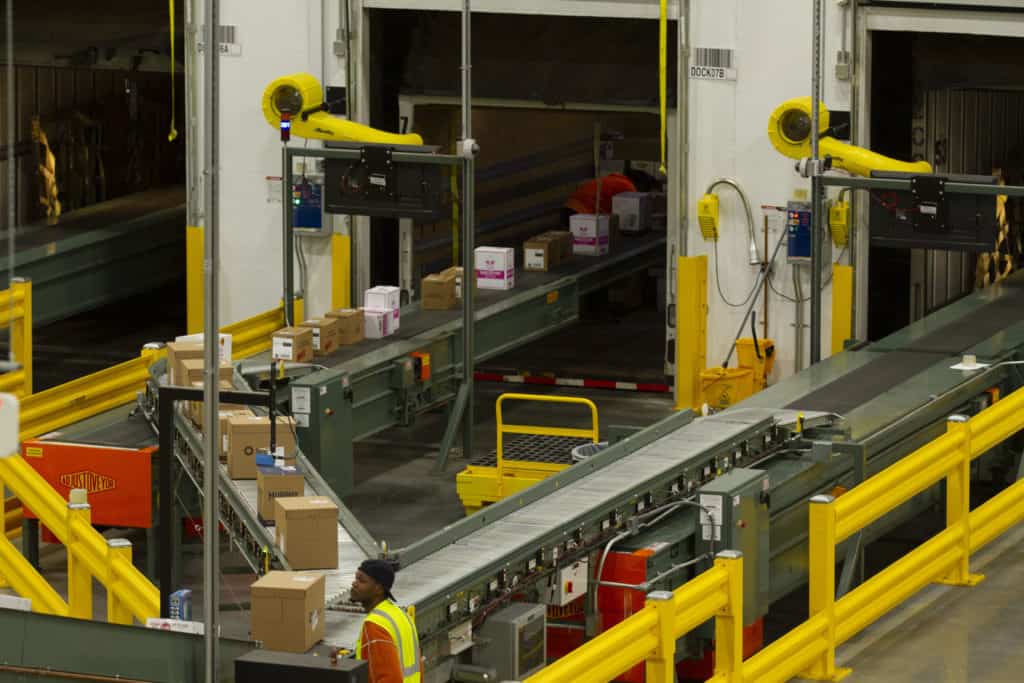
Century’s conveyor and order fulfillment systems page describes it simply: extendables are telescoping conveyors that extend into a trailer so packages travel directly to the loading associate, then retract once loading is complete. Powered versions use telescoping belts that move based on input from the loader.
The result is that the trailer, which used to be the longest walk in the building, becomes the shortest one.
Telescopic Conveyor vs. Flexible (Expandable) Conveyor
Both get called “extendable conveyor,” which causes confusion in quotes. They solve similar problems in different ways.
| Telescopic conveyor | Flexible (expandable) conveyor | |
|---|---|---|
| Construction | Rigid steel boom with nested sections | Accordion frame of rollers or skatewheels on legs and casters |
| Conveying surface | Continuous belt | Rollers or skatewheels |
| Powered | Yes (belt and boom drive) | Gravity or powered roller versions |
| Shape | Straight line from the dock into the trailer | Can curve and bend around obstacles |
| Reach into the trailer | Designed to reach deep into the trailer | Usually shorter; moved and stretched by hand |
| Installation | Fixed at a door or on a traversing base | Portable; rolls between doors |
| Typical fit | High-volume shipping or receiving doors | Lower-volume doors, temporary lines, mixed uses |
| Handles polybags and small items | Yes, on a belt | Harder on rollers and skatewheels |
Century’s order fulfillment page covers both. Gravity extendables use skatewheels to move product; powered versions use telescoping belts. Live roller and gravity conveyors are also common at extendables, because they interface well with manual work at the door.
A simple way to decide: if a door runs most of the shift and cartons arrive from a sorter or takeaway line, a telescopic conveyor usually earns its place. If the door is used a few times a day, or you need a line you can move, a flexible conveyor may be enough.
Why Loading Docks Get Extendable Conveyors
Floor loading is hard, repetitive work. A loader in a 53-foot trailer can walk the length of that trailer over and over during one load, carrying every carton. Without a conveyor, the work gets slower as the trailer fills from the nose toward the doors, and the most tired part of the shift happens at the far end of the trailer.
A telescopic conveyor changes the work in four ways:
- Shorter trips. The nose of the boom stays a few steps from the wall being built. The loader turns, picks the carton off the belt, and places it.
- Less lifting from the floor. Cartons arrive at working height instead of being picked up off the trailer floor or a pallet.
- Paced flow. The loader controls the belt, so cartons arrive at the rate the loader can place them.
- Fewer touches. On a sorter-fed door, the carton goes from the sortation lane to the trailer without being stacked, staged, and picked up again.
That last point is where the throughput gain usually comes from. In many buildings the door, rather than the sorter, sets the pace of shipping.
Where a Telescopic Conveyor Fits in Your System
Shipping: fluid loading from a sorter
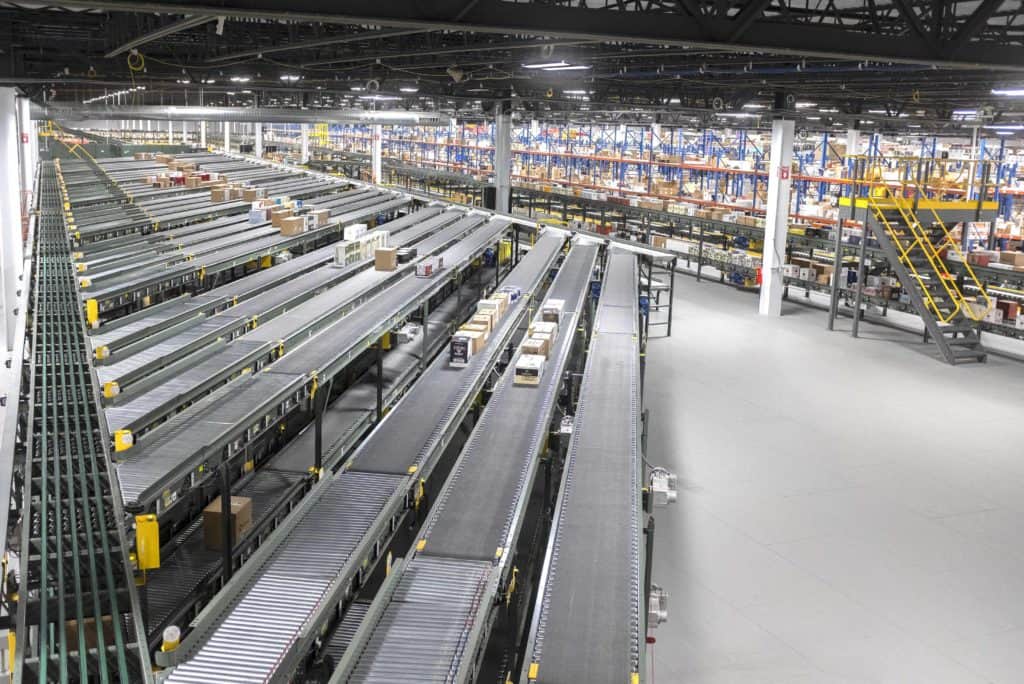
The most common use is fluid loading (also called floor loading) of outbound trailers. A shipping sorter diverts cartons to a lane for each door. The lane accumulates cartons and feeds the extendable, and the extendable carries them into the trailer.
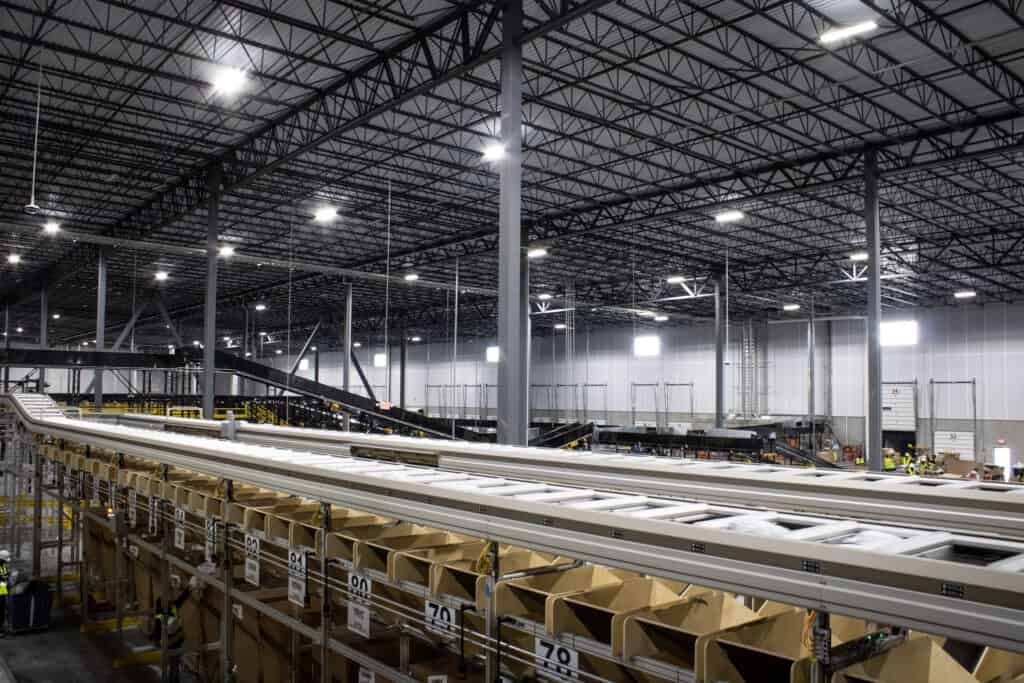
Barnes & Noble’s distribution center is a good example. Its shipping sorter is a single-loop tilt-tray design that sorts up to 170 cartons per minute to shipping doors and small-package Gaylord positions, and the shipping door positions are equipped with flexible, extendible conveyors for truck loading. Read the Barnes & Noble story.
Accumulation in the lane matters here. When the loader stops to restack a wall or the trailer is being swapped, the lane holds cartons so the sorter doesn’t recirculate or jam. Our accumulation conveyor guide covers how to size that buffer.
Receiving: unloading floor-loaded trailers and containers
At receiving, a telescopic conveyor runs in reverse. The boom extends to the wall of cartons in a floor-loaded trailer or container. The unloader places cartons on the belt, and the belt carries them out of the trailer onto receiving conveyor, scan tunnels, and sortation.
Salson Logistics, a port-to-shelf 3PL, shows how receiving can be built around this. Century’s system used five traversing trailer unloaders, which let five unload conveyors serve multiple inbound dock doors. Receiving scan tunnels on each pair of lines capture carton labels at 16 cartons per minute per receiving location, and a bi-directional slat sorter runs 95 cartons per minute to 23 palletizing lanes, 12 fluid-load truck lanes, and 10 more hand-palletizing lanes. Salson went from about 20,000 cartons a day processed manually to 100,000 with the system. Read the Salson Logistics story.
Crossdock and mixed doors
In a crossdock, the same building receives and ships at once, sometimes through the same doors at different times of day. A telescopic conveyor on a traversing base can serve a group of doors, or a door can be assigned to receiving in the morning and shipping in the afternoon. Century’s shipping and sortation systems page covers the sorters that sit upstream of these doors.
7 Telescopic Conveyor Specs to Know Before You Buy
Extendable conveyors look similar in brochures. The differences show up on the dock. Settle these seven specs before you compare quotes.
1. Retracted length
Retracted length is how much floor the telescopic conveyor takes up at the dock when it’s pulled back. It sets how far back from the door your takeaway or sorter lane must end, and whether you still have a clear aisle across the dock. Measure the space between the door and the nearest column, rack, or travel aisle before you settle on a model.
2. Extended reach
Extended reach is how far the nose travels from the dock face. To load all the way to the nose of a trailer, the reach has to cover the trailer length plus the gap between the base and the dock face. Shorter reach can still work, but the loader walks the difference at the start of every load. Check the longest trailer or container your doors actually handle, not the average.
3. Number of stages
More stages give more reach from a shorter retracted length. They also add moving parts: more rollers, more wear surfaces, and more belt path. Two-stage and three-stage booms are common at shipping doors. Choose the number of stages from the reach and retracted length you need, then confirm the maintenance access for each stage.
4. Belt width and product range
List the smallest, largest, and heaviest items that will cross the door. Polybags, mailers, and soft packs ride fine on a belt but need the right transfer from the sorter lane. Very long or wide cartons need belt width and side clearance at the nose. If a door ships totes or returnable containers, include them in the list.
5. Load rating and duty
Ask for the rated load per foot and for the heaviest single item, along with the duty cycle the drive is designed for. A door that runs two shifts a day, every day, needs a different design margin than a door used for a few trailers a week.
6. Height control at the nose
As the wall in the trailer grows from the floor to the roof, the best working height changes. A nose that raises and lowers lets the loader keep cartons near waist height. Some designs add an operator platform or an articulating front section. Height control has the biggest effect on how the job feels at the end of a shift, so treat it as a primary spec.
7. Base type: fixed, traversing, or mobile
- Fixed: one telescopic conveyor per door, anchored at the dock. Simple, and the right choice for doors that run all shift.
- Traversing: the base rides on rails across the dock so one unit can serve two or more doors. This is how Salson’s five unloaders served multiple inbound doors.
- Mobile: the unit rolls on wheels between doors. Useful for occasional doors. Plan the power, the controls connection, and the floor condition along the travel path.
Controls and Integration
A telescopic conveyor is a machine with its own drives, but it rarely works alone. Plan these connections:
- Interlock with the feed. When the loader stops the belt, the lane feeding it should accumulate rather than push cartons into a stopped belt.
- Lane status. Lights or displays at the door can show whether the lane is full, empty, or assigned to a different trailer.
- Sorter logic. The warehouse control system or sorter controls need to know which door and trailer each lane feeds, and what to do with cartons when a lane is full.
- Scanning. At receiving, the extendable feeds scan tunnels or manual scan points. At shipping, some operations verify each carton at the door before it enters the trailer.
Century handles the controls side through its controls engineering and warehouse control system work, so the door, the lane, and the sorter behave as one system instead of three separate machines.
Telescopic Conveyor Safety
An extendable conveyor puts a moving belt and a moving boom inside a trailer with a person. Plan for both.
- Guard the pinch points. Belt pulleys, nip points, and the points where stages slide over each other need guarding where people can reach them. OSHA’s general machine guarding requirements are in 29 CFR 1910.212.
- Put stops where the operator is. Emergency stops at the nose and at the base let the person in the trailer and the person at the dock stop the conveyor.
- Control boom movement. Boom travel should stop when it meets an obstruction or when the operator releases the control. Ask how the unit you’re buying detects contact at the nose.
- Lock out before maintenance. Belt changes, roller replacement, and jam clearing inside the boom require controlling hazardous energy. See OSHA’s lockout/tagout standard, 29 CFR 1910.147.
- Secure the trailer. If lift trucks or pallet jacks also enter the trailer, OSHA requires the brakes set and wheel chocks under the rear wheels of highway trucks being boarded with powered industrial trucks, in 29 CFR 1910.178(k). Many docks use vehicle restraints as well.
- Follow the conveyor safety standard. ASME B20.1 is the safety standard most conveyor systems, including extendables, are designed to.
For a wider look at guarding, stop devices, and lockout across a conveyor system, see our conveyor safety guide.
This section is general information, not engineering or legal advice. Your dock’s safety design should be reviewed for your specific equipment, layout, and operation.
Maintaining an Extendable Conveyor
A telescopic conveyor works harder than most conveyor in the building. It moves, it runs in reverse, and it often sits next to an open dock door with weather, dust, and debris coming in. The common wear points:
| Component | What to check | Why it matters |
|---|---|---|
| Belt | Tracking, lacing or splice, wear at edges | A wandering belt rubs the boom and wears out early |
| Boom rollers and guides | Wear, flat spots, debris | Worn guides make extension rough and noisy |
| Boom drive (chain or other) | Tension, lubrication, wear | Uneven tension causes jerky extension or binding |
| Cables and cable carriers | Chafing, pinch damage | A damaged cable can stop the whole door |
| Nose controls and e-stops | Function test | The operator depends on them every load |
| Lift mechanism at the nose | Smooth travel, hold position | Drift changes working height during the load |
Most of these show up gradually, as noise, slower extension, or a belt that keeps drifting, before they turn into a down door during a peak shift. A preventive maintenance program with the same technicians visiting on a schedule is the most reliable way to catch them early. Century’s PM contracts come with a 12-month guaranteed labor and travel rate and trip reports after each visit.
Telescopic Conveyor Cost: What Drives the Budget
Century doesn’t publish equipment pricing, and the cost of an extendable depends heavily on what it has to do. The budget is driven by:
- Reach and number of stages. Longer reach and more stages mean more steel, more belt, and more drive.
- Base type. A traversing base adds rails, a drive, and controls, but can replace a second or third fixed unit.
- Nose features. Height adjustment, operator platforms, and articulating sections add cost and usually pay back in how the job feels.
- Controls integration. Interlocks with the sorter lane, door lights, and WCS logic.
- Installation. Dock modifications, anchoring, power, and how the work is phased around live doors.
Retrofitting Extendables at an Existing Dock
Many docks add extendables after the fact, door by door. That works well if you plan for three things: space between the door and the takeaway line for the retracted unit, power and controls at each door, and how the sorter lanes will interlock with the new conveyor. Phasing the work by door keeps the dock shipping while the upgrade happens. Century’s retrofit and modernization team handles projects from a few thousand dollars to a few million, including phased work around live operations.
What is the difference between a telescopic conveyor and an extendable conveyor?
“Extendable conveyor” is the umbrella term. A telescopic conveyor is a rigid belt boom with nested sections that slide out into a trailer. A flexible (expandable) conveyor is an accordion-style roller or skatewheel conveyor that stretches and bends. Both are called extendables, so ask which type a quote includes.
How far does a telescopic conveyor extend?
It depends on the model and the number of stages. Size the extended reach from the longest trailer or container your doors handle, plus the distance from the base to the dock face. If the reach is shorter than the trailer, the loader walks the difference at the start of each load.
Can a telescopic conveyor be used for unloading as well as loading?
Yes. The belt runs in reverse for unloading. The boom extends to the wall of cartons in a floor-loaded trailer or container, the unloader places cartons on the belt, and the belt carries them out to receiving conveyor and scanning.
Can one telescopic conveyor serve more than one dock door?
Yes, on a traversing base that rides on rails across the dock, or on a mobile base that rolls between doors. Fixed units are simpler and suit doors that run all shift. Traversing units suit receiving docks where trailers arrive at different doors through the day.
Do telescopic conveyors handle polybags and small packages?
Generally yes, because they convey on a belt. Pay attention to the transfer from the sorter lane onto the extendable, where small or soft items can catch, and to belt width and side clearance for your largest cartons.
Is a flexible conveyor a cheaper alternative?
Often, and it’s portable. It suits lower-volume doors, temporary lines, and docks that need a conveyor that can curve. For doors that run most of the shift from a sorter, a telescopic conveyor usually handles the volume better and reaches deeper into the trailer.
What maintenance does a telescopic conveyor need?
Regular checks of belt tracking and condition, boom rollers and guides, the boom drive, cables and cable carriers, the nose lift, and the operator controls and e-stops. Because extendables move and sit near open dock doors, they usually need more frequent attention than fixed conveyor.
Plan Your Dock With an Integrator
A telescopic conveyor is the last few feet of a shipping system and the first few feet of a receiving system. Size the reach, base, and nose controls to your trailers and your people, connect it properly to the sorter and lanes behind it, and the dock stops being the place where the building slows down.
Century Conveyor has been installing and supporting conveyor systems since 1981, from the extendible conveyors at Barnes & Noble’s shipping doors to the traversing trailer unloaders at Salson Logistics. If you’re adding extendables, fixing a dock that can’t keep up with your sorter, or planning a new shipping area, explore Century’s conveyor and order fulfillment systems or contact our team to talk through your doors.