Industrial automation and robotics have become essential for warehouses, distribution centers, and fulfillment operations that need to increase throughput, improve order accuracy, and reduce reliance on repetitive manual labor. As customer expectations for faster shipping continue to rise, companies are investing in integrated automation systems that streamline every stage of material handling.
Century Conveyor Systems specializes in designing, integrating, installing, and supporting turnkey material handling industrial automation and robotics. Rather than supplying individual pieces of equipment, the company develops complete automation solutions tailored to each facility’s workflow and operational goals. Its offerings include conveyor systems, robotic fulfillment technologies, robotic palletizing, sortation systems, controls engineering, warehouse software integration, and long-term maintenance support.
Below are answers to some of the most common questions about industrial automation and robotics and how Century Conveyor Systems helps businesses modernize their operations.
Table of Contents
FAQ 1: What is industrial automation and robotics?
Industrial automation and robotics refer to the use of automated equipment, intelligent controls, software, sensors, conveyors, and robotic systems to perform material handling tasks with minimal manual intervention.
Instead of relying on employees to transport products throughout a warehouse, automated systems move products efficiently between receiving, storage, picking, packing, sortation, palletizing, and shipping.
At Century Conveyor Systems, industrial automation is viewed as an integrated solution rather than a collection of independent machines. The company’s engineers design complete material handling systems that combine:
- Conveyor systems
- Robotic fulfillment technologies
- Automated Guided Vehicles (AGVs)
- Autonomous Mobile Robots (AMRs)
- Robotic palletizing systems
- Warehouse Control Systems (WCS)
- Warehouse Management Systems (WMS)
- PLC controls
- Print-and-apply solutions
- Storage systems
By integrating these technologies into a unified system, facilities can improve productivity while reducing operational bottlenecks.
FAQ 2: How does Century Conveyor Systems approach industrial automation differently?
One of Century Conveyor Systems’ biggest strengths is its role as a full-service automation integrator.
Many companies simply sell conveyors or robotics equipment. Century manages the entire automation lifecycle, including:
- System analysis
- Facility layout planning
- Engineering
- Equipment selection
- Controls programming
- Software integration
- Installation
- Startup support
- Preventative maintenance
- Replacement parts
- Ongoing service
This turnkey approach reduces complexity for customers because they work with one automation partner throughout the project instead of coordinating multiple vendors.
The company emphasizes designing systems around operational objectives rather than forcing businesses into standardized equipment packages. Every project is engineered to match throughput goals, available space, product characteristics, labor requirements, and future growth plans.
FAQ 3: What types of robotic solutions does Century Conveyor Systems provide?
Industrial robotics encompasses much more than robotic arms, and Century Conveyor Systems supports several robotic technologies for warehouse and distribution environments.
Automated Guided Vehicles (AGVs)
AGVs travel along predefined navigation methods such as magnetic tape, laser guidance, QR codes, or inductive systems to transport materials throughout a facility.
These systems are well suited for repetitive transportation tasks that traditionally require forklifts.
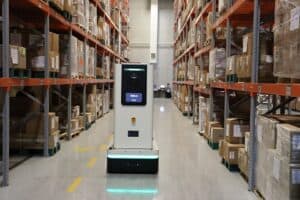
Autonomous Mobile Robots (AMRs)
Unlike AGVs, AMRs navigate dynamically using onboard sensors and mapping technologies.
Their flexibility allows warehouses to adapt layouts more easily while minimizing permanent infrastructure changes.
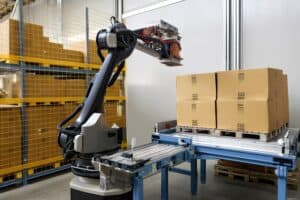
Robotic Palletizing
Century also integrates robotic palletizing systems that automate stacking products onto pallets while improving consistency and reducing physically demanding manual labor.
Together, these robotics solutions complement conveyor automation to create a more efficient material handling process from receiving through shipping.
FAQ 4: Why are conveyors still essential in industrial automation and robotics?
Although robotics often receives the most attention, conveyors remain the backbone of most automated warehouses.
Conveyors create continuous product flow between workstations, allowing robotics and employees to focus on value-added tasks rather than transportation.
Century Conveyor Systems engineers conveyor systems that support:
- Cartons
- Totes
- Pallets
- Polybags
- Drums
- Oversized products
Depending on the application, systems may include:
- Belt conveyors
- Roller conveyors
- Poly-V conveyors
- Pallet conveyors
- Accumulation conveyors
- Sortation conveyors
- Trailer extendable conveyors
These systems provide the foundation upon which robotics, software, scanners, and automated workstations operate efficiently.
Rather than replacing conveyors, robotics works alongside them to create an integrated automation ecosystem.
FAQ 5: How does industrial automation improve order fulfillment?
Order fulfillment involves far more than simply moving boxes.
A typical workflow includes:
- Receiving inventory
- Storage
- Picking
- Transport
- Packing
- Labeling
- Sortation
- Shipping
Century Conveyor Systems designs automation solutions that optimize each touchpoint.
Its published objectives include:
- Increasing throughput
- Reducing manual interactions
- Improving order accuracy
- Minimizing product damage
- Lowering return rates
- Processing orders faster
- Increasing profitability
By combining conveyors, robotics, controls, and warehouse software, businesses can create smoother workflows that keep products moving consistently throughout the facility.
This holistic approach helps eliminate bottlenecks that often develop when individual processes are optimized without considering the overall system.
FAQ 6: Can Century Conveyor Systems’ automation solutions scale as a business grows?
Yes. Scalability is one of the key advantages of Century’s automation philosophy.
Business needs rarely remain static. Seasonal demand, new customers, additional product lines, or facility expansions can all increase operational complexity.
Century’s automation systems are engineered with future growth in mind.
For example, the company notes that robotic fulfillment systems offer several scalability benefits:
- Additional robots can be deployed as demand increases.
- Mobile robotic systems are flexible and not permanently fixed in place.
- Solutions can be customized for changing operational requirements.
This allows organizations to expand automation over time rather than replacing entire systems as production requirements evolve.
FAQ 7: What role do software and controls play in industrial automation and robotics?
Modern industrial automation depends just as much on intelligent software as it does on mechanical equipment.
Century Conveyor Systems integrates controls and software that coordinate the movement of products throughout a facility.
These capabilities include:
- PLC programming
- Control panel fabrication
- Warehouse Management System (WMS) integration
- Warehouse Control System (WCS) integration
These systems enable automated routing decisions, synchronize conveyors with robotic equipment, monitor equipment performance, and help maintain consistent product flow.
Without integrated controls, even advanced robotics would struggle to operate efficiently within a complex warehouse environment. Century’s emphasis on controls engineering helps ensure that mechanical and digital systems function together as one coordinated operation.
FAQ 8: Why is long-term service and support important for industrial automation systems?
Installing automation is only the beginning of the investment.
As systems continue operating, they require maintenance, replacement parts, upgrades, and technical support to maintain peak performance.
Century Conveyor Systems provides ongoing support that includes:
- Preventative maintenance
- Conveyor repair
- Replacement parts
- Mechanical service
- Electrical service
- Controls support
- Modernization and retrofit services
This lifecycle approach helps customers extend equipment longevity, minimize unplanned downtime, and protect the value of their automation investment.
Instead of treating installation as the end of the project, Century positions long-term support as an integral part of successful warehouse automation.
FAQ 9: Which industries benefit most from Century Conveyor Systems’ industrial automation and robotics solutions?
Century Conveyor Systems focuses on material handling environments where speed, accuracy, and efficiency are essential.
Its automation solutions are particularly well suited for:
- Distribution centers
- Warehouses
- E-commerce fulfillment centers
- Manufacturing facilities
- Third-party logistics (3PL) operations
- Shipping and sortation facilities
Any operation that regularly moves products in boxes, totes, pallets, drums, polybags, or similar containers can benefit from customized automation that reduces manual handling while improving productivity.
Because each system is engineered around the customer’s workflow, Century can tailor solutions for facilities with different layouts, product mixes, and throughput requirements.
FAQ 10: Why should businesses choose Century Conveyor Systems for industrial automation and robotics?
Choosing an automation partner involves much more than comparing equipment specifications.
Century Conveyor Systems distinguishes itself through a comprehensive approach that combines engineering expertise, turnkey project delivery, and long-term customer support.
Key advantages include:
- Complete turnkey system integration
- Customized engineering instead of one-size-fits-all solutions
- Integration of conveyors, robotics, controls, and software
- Order fulfillment expertise
- Scalable automation solutions
- Full installation and startup management
- Preventative maintenance and lifecycle support
- Experience serving warehouses and distribution centers
Rather than focusing on a single piece of automation technology, Century designs complete systems that improve overall operational performance. This integrated approach helps businesses increase throughput, reduce labor-intensive tasks, improve order accuracy, and prepare their facilities for future growth.
For organizations exploring industrial automation and robotics, partnering with an experienced systems integrator can simplify implementation while maximizing the long-term value of the investment. Century Conveyor Systems’ emphasis on customized design, coordinated project management, and ongoing service makes it a strong choice for companies seeking comprehensive material handling automation solutions.