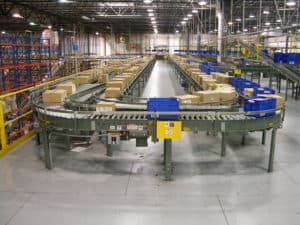
An MDR conveyor (motor-driven roller conveyor) is a powered roller conveyor in which a low-voltage motor built inside one roller drives a short section of the line, called a zone. Instead of one large motor running the whole conveyor, each zone has its own motorized roller and controller, so a zone only runs when there is product to move.
That one design change explains most of why MDR has become the default for new carton and tote lines in many distribution centers. It is quieter, uses less power on lines that spend time waiting, and makes zero-pressure accumulation simple. It is also a different kind of system to maintain, with zone cards, power supplies, and photo eyes taking the place of drive shafts and air lines.
This guide explains how an MDR conveyor works, how it compares with line shaft, belt-driven live roller, and pneumatic accumulation, where it fits and where it doesn’t, and what to check before you buy, convert, or maintain one.
At a glance
- An MDR conveyor divides the line into zones. Each zone has a 24-volt DC motorized roller, a zone controller card, and usually a photo eye.
- The motorized roller drives the other rollers in its zone through O-bands or poly-V bands.
- Zones run only when product is present, which cuts noise and energy use on lines with stop-and-go flow.
- MDR conveyor makes zero-pressure accumulation (ZPA) the normal mode, with no compressed air.
- Line shaft and belt-driven live roller still make sense for simple, low-cost, continuous transport.
- Many older lines can be converted to MDR section by section.
Table of Contents
What Is an MDR Conveyor?
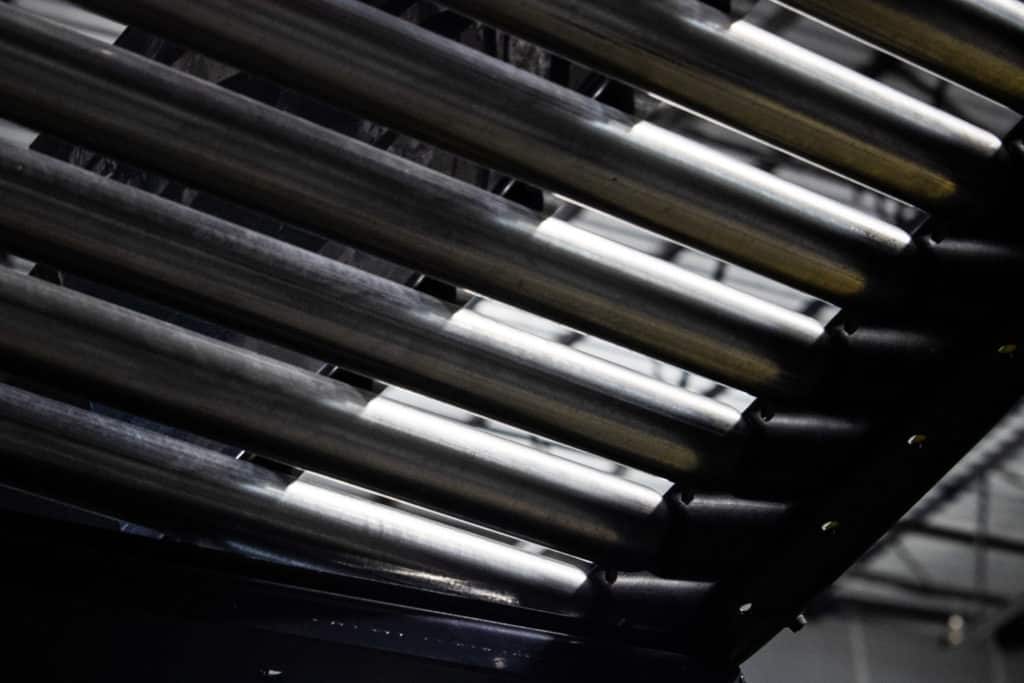
An MDR conveyor is a roller conveyor where the drive is distributed along the line rather than concentrated in one place. Every few feet, one roller is not a plain roller at all. It contains a small DC motor, a gearbox, and in many designs the motor electronics, all sealed inside the roller tube. When it receives power and a run signal, the roller turns and drives the rollers around it.
The stretch of conveyor driven by one motorized roller is a zone. A zone is usually sized to hold one carton or tote. Each zone has:
- A motorized roller, which is the drive.
- Idler (slave) rollers, linked to the motorized roller with elastic O-bands or poly-V bands so they turn together.
- A zone controller card, which decides when the motorized roller runs, how fast, and in which direction.
- A sensor, usually a photo eye, that tells the card whether the zone is occupied.
- A 24V DC power supply, which typically feeds several zones from a cabinet or a box mounted along the conveyor.
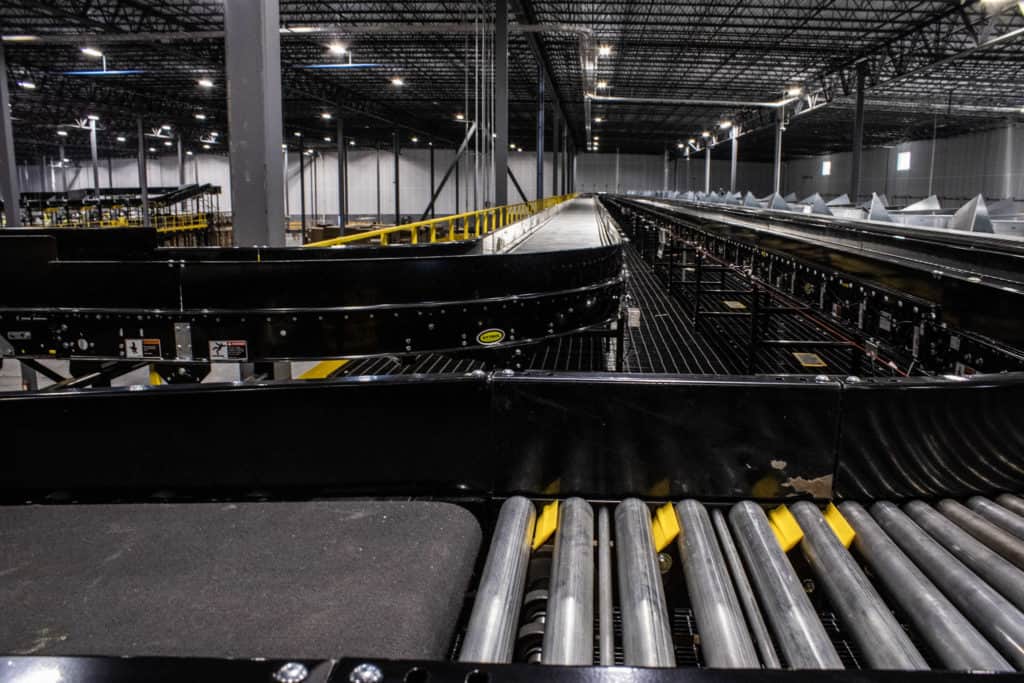
Because each zone has its own drive and its own decision-maker, the line behaves like a chain of small conveyors that talk to each other. That is what makes it useful.
How MDR Conveyor Zones Work
The basic logic is simple, and it’s worth understanding because it explains both the benefits and the most common faults.
- A carton enters a zone and breaks the photo eye.
- The zone card checks the zone ahead. If the next zone is clear, the card runs its motorized roller and passes the carton forward.
- If the next zone is full, the card stops its roller and the carton waits in place with a gap in front of it.
- When the zone ahead clears, the waiting carton moves up, and the zone behind it can move up too.
- When a zone has been empty for a set time, its roller stops. Nothing runs when there is nothing to move.
This is zero-pressure accumulation (ZPA) built into the conveyor. Items never push against each other because each zone only drives when it has somewhere to go. For a deeper look at accumulation modes, release logic, and buffer sizing, see our accumulation conveyor guide.
Release modes
Most MDR zone cards can release product in two ways. Singulation release lets one carton leave at a time, with gaps that scanners and sorters need. Slug release moves a group of zones together to empty a queue quickly when a merge opens a window. Many cards can switch between the two based on a signal from the downstream equipment.
Speed, direction, and soft start
Zone cards typically let you set roller speed, acceleration, and direction. Gentle acceleration helps with tall, top-heavy, or unstable product such as bottles in cases. Reversible zones are useful at transfers and in recirculation loops.
Networked zones
Simple MDR conveyor zones talk only to their neighbors. Networked zone cards can also report status and accept commands from a PLC or a warehouse control system, so the controls can see which zones are full, which have faulted, and where product is. That visibility is one of the quieter advantages of MDR over older drive types, and it is where good programmable logic controls design pays off.
MDR Conveyor vs. Line Shaft, Belt-Driven Live Roller, and Pneumatic ZPA
Most carton and tote lines use one of four powered roller drives. Here is how they compare.
| MDR conveyor | Line shaft | Belt-driven live roller | Pneumatic ZPA | |
|---|---|---|---|---|
| How it drives | 24V motorized roller in each zone | One motor turns a shaft under the rollers; spools and bands drive each roller | One motor drives a belt pressed against the underside of the rollers | One motor drives the line; air actuators engage or disengage each zone |
| Accumulation | Zero pressure, built in | Minimum pressure (bands slip) | Minimum pressure (belt slips) | Zero pressure |
| Runs when empty | No | Yes | Yes | Yes |
| Noise | Low | Moderate, higher on long runs | Moderate | Moderate, plus air exhaust |
| Compressed air | No | No | No | Yes |
| Typical load | Light to medium cartons and totes | Light loads | Wide range, including heavier cartons | Wide range |
| Reconfiguring | Zones are modular; easier to re-sequence or extend | Mechanical changes | Mechanical changes | Mechanical and air changes |
| Main maintenance items | Zone cards, power supplies, photo eyes, motorized rollers, bands | Drive bands, spools, shaft bearings | Drive belt, pressure rollers | Compressor, air lines, valves, actuators, drive belt |
MDR conveyor vs. line shaft
Line shaft conveyor uses a single rotating shaft along the length of the bed. Each roller is driven by a urethane band wrapped around a spool on the shaft. When product stops, the bands slip, which creates light accumulation pressure. Line shaft is simple, quiet enough on short runs, and economical for light loads. It also runs continuously, cannot hold true zero-pressure gaps, and gets louder and less efficient on long runs.
MDR conveyor beats line shaft when the line spends time waiting, when product is fragile or needs gaps, when noise matters, or when the layout is likely to change. Line shaft can still win on cost for short, simple transport lines carrying light, uniform product.
MDR conveyor vs. belt-driven live roller
Belt-driven live roller conveyor runs a flat belt under the rollers, held against them by pressure rollers. It handles a wide range of carton sizes and weights and is common in older systems. Like line shaft, it runs continuously and accumulates with light pressure. MDR is usually preferred for accumulation and stop-and-go flow. Belt-driven live roller remains a solid choice for heavier cartons on continuous transport.
MDR conveyor vs. pneumatic zero-pressure accumulation
Pneumatic ZPA achieves the same zero-pressure result as MDR, but with a constantly running drive and air-operated mechanisms at each zone. Plenty of it is still running well. The cost of ownership comes from the compressed air system: compressor capacity, leaks, moisture, and the valves and actuators at every zone. MDR removes the air system entirely, which is a big reason pneumatic sections are common candidates for conversion.
Benefits of MDR Conveyor
Energy use. A motorized roller only runs when its zone has product to move. On lines that spend part of every shift idle or waiting on a downstream process, that adds up. A line shaft or belt-driven line runs its motor whenever the conveyor is on.
Noise. Fewer moving parts run at any moment, and low-voltage motorized rollers are quiet. Operations that put conveyor near packing stations or offices notice the difference.
Zero-pressure accumulation without air. Product keeps a gap in the queue, which protects fragile cases and gives scanners and sorters clean separation.
Modularity. Zones are short, self-contained, and largely identical. Adding, removing, or re-sequencing conveyor is easier when every section carries its own drive.
Fault isolation. When a zone fails, it usually affects that zone, not a whole section. A technician can often swap a zone card or motorized roller quickly.
Visibility. Networked zones can report status to the controls, which helps with troubleshooting and with routing logic in a warehouse control system.
Limitations to Know Before You Choose MDR Conveyor
MDR conveyor is not the right answer for every line.
- Heavy loads. Each zone’s capacity depends on the motorized roller’s torque and the number of rollers it drives. Very heavy cartons, long heavy items, and pallets usually belong on other conveyor types, such as chain-driven live roller for pallets.
- Small or very light product. Polybags, small mailers, and light cartons may not break a photo eye reliably or may slide on stopped rollers. Belted zones, closer roller centers, or totes are common fixes.
- More electronics. Zone cards, power supplies, cables, and sensors replace mechanical drive parts. Your maintenance team needs to be comfortable diagnosing electrical faults, and you need the right spares on the shelf.
- Product length vs. zone length. A carton that spans two zones can confuse zone logic. Zones are sized to your longest product plus clearance, and product needs enough rollers underneath it to travel smoothly. A common rule of thumb is at least three rollers under the shortest item.
- Up-front cost. MDR conveyor generally costs more per foot than line shaft. Whether it pays back depends on how much of the day the line waits, the value of zero-pressure accumulation for your product, and your energy and maintenance costs.
Where MDR Conveyor Fits in a Distribution Center
MDR conveyor shows up wherever product has to stop, wait, and restart in order:
- Pick-and-pass and zone-picking lines, where totes stop at pick stations and move on when the picker releases them.
- Merges into sortation, where several feed lines hold product until the merge gives them a window.
- Pack stations, where cartons and totes queue in front of each packer.
- Print and apply, scanning, and weighing stations, which stop for label changes, no-reads, and rejects.
- Palletizing infeeds, where a robot or a person takes product in bursts.

Long, continuous transport runs with no need to stop, such as a takeaway line to a trash compactor or a long run between buildings, are often better served by belt conveyor or simpler live roller. Most systems mix drive types and put MDR zones where its zone control earns its cost. Century’s conveyor and order fulfillment systems cover the full range, from live roller and gravity to belted, modular belt, accumulation, spirals, and pallet conveyor.
Converting Line Shaft or Pneumatic Conveyor to MDR
Many facilities run conveyor frames that are mechanically sound but carry drives and controls that are hard to support. Converting those sections to MDR is a common modernization step. A typical conversion:
- Survey the existing beds. Check frame condition, roller centers, bed widths, and whether the side channels can mount motorized rollers, cards, and power supplies.
- Map the zones. Size zones to today’s product mix, not the product the line was built for.
- Plan power. Decide where 24V power supplies go and how the line’s power distribution and e-stop circuits will be wired.
- Plan the controls. Decide whether zones run peer-to-peer or networked to a PLC, and how they hand off to merges, scanners, and sorters.
- Phase the work. Convert section by section during planned downtime so the operation keeps running.
Century’s retrofit and modernization work includes updating obsolete control modules, sensors, and motors on existing equipment, and projects range from a few thousand dollars to a few million.
Maintaining an MDR Conveyor
An MDR conveyor has fewer wearing mechanical parts than line shaft or belt-driven live roller, but it still needs regular attention.
| Symptom | Likely cause | What to check |
|---|---|---|
| One zone won’t run | Failed motorized roller, zone card, cable, or power supply | Check card status lights; swap card or roller; check supply output |
| Several zones dead together | Power supply or upstream wiring fault | Check the supply feeding that group and the e-stop circuit |
| Cartons bump or collide | Dirty, misaligned, or failed photo eye | Clean and realign; check reflectors and sensor settings |
| Zone runs but product hesitates | Worn or broken O-bands or poly-V bands | Replace bands; check roller alignment |
| Product slides when stopped | Light items, contaminated rollers | Clean rollers; consider belted zones or totes |
| Zones run when empty | Sensor timer or card settings | Check sleep timer and card configuration |
A practical maintenance routine includes keeping photo eyes and reflectors clean, inspecting bands, checking card status lights and connectors, and stocking spare motorized rollers, zone cards, bands, and at least one power supply for each type on site. Century’s preventive maintenance program sends the same technician team on scheduled visits with trip reports, which is the most reliable way to catch these issues before they cause downtime. For a refresher on the components involved, see our guide to the parts of a conveyor.
MDR Conveyor Safety
Low voltage makes MDR conveyor safer to work on electrically, but the mechanical hazards are the same as any powered roller conveyor, and one is easier to miss.
- Zones start on their own. A zone that looks stopped can start the moment the zone ahead clears. Treat an idle MDR line as a running conveyor.
- Guard pinch points. Roller-to-roller, band, and transfer pinch points need guarding where people can reach them. OSHA’s general machine guarding requirements are in 29 CFR 1910.212.
- Lock out before reaching in. Clearing a jam or replacing a roller means controlling hazardous energy at the right disconnect, which may be a power supply feeding several zones. See OSHA’s lockout/tagout standard, 29 CFR 1910.147.
- Plan e-stops and pull cords along the line so anyone working nearby can reach one, and confirm the e-stop circuit removes power from the motorized rollers.
- Design to the conveyor safety standard. ASME B20.1 is the safety standard most conveyor systems are designed to.
This section is general information, not engineering or legal advice. Your system’s safety design should be reviewed for your specific layout and operation.
MDR Conveyor Checklist: 7 Questions to Answer First
- What is the full product range? Shortest, longest, lightest, heaviest, and the bottom surface (corrugate, tote, polybag, tray).
- Does the line need to stop and wait? If it runs continuously, simpler drives may do the job.
- Does product need gaps? Fragile goods, scanners, and sorters point to zero-pressure MDR zones.
- What are the heaviest loads per zone? This sets motorized roller and roller-center choices.
- How will zones be controlled? Peer-to-peer, networked to a PLC, or tied to a warehouse control system.
- Who maintains it? Make sure your team is trained on cards, supplies, and sensors, and that spares are on site.
- Will the layout change? If so, MDR’s modular zones make future changes easier.
What does MDR stand for in conveyors?
MDR stands for motor-driven roller. An MDR conveyor uses a roller with a built-in motor to drive each short zone of the line, instead of one large motor driving the whole conveyor.
What voltage do MDR conveyors use?
Most MDR conveyor systems run motorized rollers on 24 volts DC, supplied by power supplies mounted along the conveyor or in a nearby panel. Some higher-power motorized rollers run at 48 volts DC.
Is an MDR conveyor zero-pressure accumulation?
Usually, yes. Each zone stops when the zone ahead is full, so product waits with a gap and never pushes against the item in front. That makes zero-pressure accumulation the normal operating mode, without compressed air.
What is the difference between MDR and line shaft conveyor?
Line shaft conveyor uses one motor turning a shaft that drives every roller through spools and bands, and it runs continuously. MDR puts a motor in one roller per zone, and zones run only when they have product. MDR offers zero-pressure accumulation and lower noise; line shaft is simpler and often cheaper for light, continuous transport.
Does an MDR conveyor need compressed air?
No. MDR zones are driven and controlled electrically. Pneumatic zero-pressure accumulation uses compressed air to engage and disengage each zone, which is one reason pneumatic sections are often converted to MDR.
Can an existing conveyor be converted to MDR?
Often, yes. Many line shaft, belt-driven live roller, and pneumatic accumulation sections can be converted by fitting motorized rollers, zone cards, sensors, and power supplies to existing frames. The frames need to be in good condition, and the controls need to be planned so the new zones work with merges, scanners, and sorters.
Can MDR conveyor handle heavy cartons?
Within limits. Each zone’s capacity depends on the motorized roller’s torque and how many rollers it drives. Heavy cartons may need higher-torque rollers or shorter zones, and pallets and very heavy loads usually belong on pallet conveyor such as chain-driven live roller.
What happens when a motorized roller fails?
Typically only that zone stops, and product backs up behind it. A technician can usually replace the motorized roller or zone card without taking down the whole line, which is why keeping spares on site matters.
Plan Your MDR Conveyor With an Integrator
An MDR conveyor is one of the most practical upgrades a carton or tote line can get: quieter, more efficient on stop-and-go flow, gentle on product, and easier to change later. The details still decide whether it performs: zone length against your product, roller and power sizing, sensor placement, and controls that hand off cleanly to the rest of the system.
Century Conveyor has been designing, installing, and supporting conveyor systems since 1981. If you’re planning a new line, converting older line shaft or pneumatic sections, or troubleshooting an MDR conveyor that keeps faulting, explore Century’s conveyor and order fulfillment systems or contact our team to talk through your layout.