Warehousing services play an essential role in helping businesses store, move, process, and distribute products efficiently. As order volumes increase and customer expectations for fast delivery continue to rise, warehouses and distribution centers must find ways to improve productivity without unnecessarily increasing labor costs or operational complexity. Material handling automation, conveyor systems, robotic fulfillment, and integrated warehouse controls can all contribute to a more streamlined operation.
Century Conveyor Systems provides engineered material handling automation solutions for warehouses, distribution centers, and fulfillment facilities. Its capabilities include conveyor systems, robotic fulfillment, sortation equipment, storage modules, warehouse controls, and ongoing conveyor maintenance and service. Rather than treating warehouse equipment as isolated components, Century focuses on designing and implementing integrated systems that support the movement of goods throughout a facility.
The following frequently asked questions explain how Century Conveyor Systems approaches warehousing services, what its solutions can accomplish, and how businesses can determine which warehouse automation capabilities best fit their operational needs.
Table of Contents

1. What are warehousing services, and how does Century Conveyor Systems support warehouse operations?
Warehousing services encompass the processes, equipment, and operational capabilities required to receive, store, handle, process, and distribute inventory. Depending on the facility, these activities may include unloading incoming shipments, transporting products between workstations, storing pallets or cartons, picking orders, packing packages, sorting shipments, and preparing goods for dispatch.
However, effective warehousing involves more than having sufficient storage space. The way products move through a building can influence productivity, labor requirements, order accuracy, and the facility’s ability to meet shipping deadlines. Bottlenecks in one area can affect every subsequent step, making it important to evaluate the warehouse as a connected operation.
Century Conveyor Systems supports these requirements through material handling automation and system integration. Its engineers design, validate, and implement turnkey systems intended to improve warehouse output and reduce labor costs through automation. The company also manages project activities ranging from initial system design to implementation, installation, startup support, and ongoing parts and service.
Its capabilities cover several essential warehouse functions:
- Conveyor transportation: Belt, roller, and pallet conveyor systems move products through designated processing and distribution routes.
- Order fulfillment: Integrated material handling solutions help coordinate the movement of items from order processing through packing and shipping.
- Sortation and distribution: Automated equipment directs packages toward the appropriate destinations or shipping lanes.
- Robotic material handling: Automated guided vehicles and autonomous mobile robots transport goods through suitable warehouse environments.
- Storage and picking infrastructure: Shelving, racking, mezzanines, platforms, and other storage modules support organized inventory handling.
- Warehouse controls and software: Programmable logic controllers and warehouse control solutions help coordinate equipment and material movement.
- Maintenance and replacement parts: Preventative maintenance, repairs, and parts support help businesses maintain their conveyor equipment.
These capabilities allow businesses to explore improvements across multiple stages of warehouse operations. The appropriate combination depends on existing infrastructure, product characteristics, order volume, available floor space, and long-term growth plans.
2. How can Century Conveyor Systems’ warehousing services improve order fulfillment efficiency?
Order fulfillment is one of the most important areas to evaluate when improving warehouse performance. It involves the activities that take place after an order is received and before the shipment reaches the shipping dock. Depending on the business, this process may include retrieving inventory, picking individual items or complete cases, consolidating products, packing orders, sorting packages, and moving shipments to their appropriate destinations.
When these activities rely heavily on manual transportation, employees may spend substantial time moving products between workstations rather than performing tasks that require direct attention. Congested aisles, poorly coordinated handoffs, and inefficient packing or shipping arrangements can further slow the process.
Century Conveyor Systems engineers order fulfillment solutions designed to improve throughput, reduce errors that can contribute to returns or product damage, and process items faster with fewer manual interactions.
Conveyor automation is one way to achieve these objectives. A carefully designed conveyor network can establish consistent transportation routes between picking, packing, accumulation, sortation, and shipping areas. Instead of repeatedly moving cartons by hand, employees can focus on picking accuracy, inspection, packing quality, and exception handling.
The specific conveyor technology matters, too. Live roller and gravity conveyors can support packing lines, manual induction points, and end-of-line operations. Belt conveyors can provide stable movement for smaller packages, polybags, and irregularly sized cartons. Divert mechanisms can route packages from a primary line to different destinations, while accumulation conveyors can regulate spacing between products.
Robotic solutions offer another option. Automated guided vehicles (AGVs) can transport pallets, cartons, and other loads along established routes. Autonomous mobile robots (AMRs) can navigate more flexibly through a facility, including in applications where mobile robots bring totes or products to order fulfillment personnel.
By connecting these technologies appropriately, a warehouse can reduce unnecessary handling, improve the consistency of product movement, and make better use of its available workforce.
The goal is not simply to move more packages. It is to create a coordinated fulfillment process that supports reliable shipping performance while accommodating the actual requirements of the business.
3. What types of warehouse conveyor systems are available through Century Conveyor Systems’ warehousing services?
Different products and operational environments require different transportation methods. A conveyor that works well for standard shipping cartons may not be suitable for small polybags, fragile merchandise, heavy pallets, or oversized loads. Choosing the right configuration requires considering product dimensions, weight, stability, throughput requirements, and the layout of the facility.
Century Conveyor Systems offers several conveyor technologies that address different material handling applications.
Live roller and gravity conveyors are useful for packing lines, manual induction areas, divert points, and end-of-line operations. Powered live roller conveyors use motors to move products, while gravity conveyors rely on gravity to advance items along an appropriately configured path. These systems can support operations that require practical integration between manual workstations and automated transportation.
Belt conveyors provide a continuous conveying surface that can improve stability when handling smaller parcels, polybags, and cartons with irregular dimensions. Depending on the application, belt conveyors can also support inclines, declines, and controlled gaps between products. This makes them useful when product stability or reliable transitions between conveyor sections are important.
Modular belt conveyors use connected belt segments rather than a single conventional belt. Their construction can make individual sections easier to remove, clean, or modify. Depending on the belt design, these systems may be appropriate for specialized handling applications that require additional traction, close transfers, or easier maintenance.
Conveyor diverts route cartons from one conveyor path to another. These mechanisms can direct packages toward packing stations, shipping lanes, or other destinations without requiring a separate large-scale sortation system for every application. Different divert technologies can accommodate different product characteristics and routing requirements.
Zero-pressure and minimum-pressure accumulation conveyors help regulate the spacing between products. Zero-pressure systems are designed to prevent products from touching, while minimum-pressure systems allow products to approach one another with limited contact. Such arrangements can be valuable when package damage, product separation, or controlled accumulation is a concern.
Extendable conveyors can be extended into a trailer or adjusted to provide a temporary loading or unloading path. Depending on the configuration, these systems can be gravity-powered or motorized. They can help reduce the distance employees must carry or manually move packages during truck loading and unloading.
Spiral conveyors transport products between different elevations using a compact, curved conveying path. They can help facilities connect ground-level operations with elevated platforms or other levels without relying exclusively on multiple inclined conveyor sections.
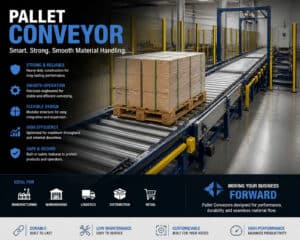
Pallet conveyors accommodate heavier loads and palletized materials. Depending on the weight and handling requirements, options include chain-driven systems, gravity pallet conveyors, and powered live roller conveyors.
The right choice depends on how products move through the facility and what the business needs to accomplish. A warehouse may use several conveyor types together, with each component serving a particular purpose within the broader material handling system.
4. Can Century Conveyor Systems’ warehousing services help warehouses automate operations without replacing every existing system?
Yes. Warehouse automation planning does not necessarily require removing all existing equipment and rebuilding the facility from scratch. In many cases, businesses can improve performance by modernizing specific areas, adding new automation components, or integrating additional capabilities with their current infrastructure.
Century Conveyor Systems offers retrofit and modernization solutions alongside system design, controls engineering, installation, and maintenance services. These capabilities provide a starting point for evaluating how existing equipment can fit into an improved warehouse operation.
The first step is identifying the problems that need to be solved. For example, a distribution center might have adequate conveyor capacity but struggle with manual sorting. Another facility might process orders efficiently until packages reach the shipping area, where loading delays create congestion. A warehouse with increasing order volumes might need additional picking capacity but have limited room for expanding its building.
Each situation calls for a different approach.
A facility experiencing shipping congestion could benefit from improved accumulation, more effective package routing, or extendable conveyors. A warehouse with excessive travel between storage and packing stations might investigate goods-to-person processes or mobile robotics. An operation struggling with inconsistent equipment coordination might need improved controls and system integration.
Modernization also requires attention to compatibility. Existing conveyors, sensors, control panels, software, and mechanical equipment must work together safely and reliably. Before introducing new technology, businesses should assess equipment condition, available space, electrical and controls requirements, and the expected impact on daily operations.
A phased implementation can be worth considering when a complete shutdown would disrupt fulfillment commitments. Project phasing allows a business to evaluate how improvements might be introduced in manageable stages, although the appropriate schedule depends on the facility and the scope of work.
The key is to base automation decisions on measurable operational needs rather than purchasing equipment simply because it is available. A targeted improvement may deliver more practical value than an extensive installation that fails to address the facility’s main bottleneck.
5. How do robotic fulfillment solutions fit into modern warehousing services?
Robotic fulfillment can help warehouses move products more efficiently while reducing the amount of repetitive transportation performed manually. These systems are particularly relevant when employees spend significant time moving totes, cartons, pallets, or carts between storage areas, picking stations, packing lines, and shipping operations.
Century Conveyor Systems supports robotic fulfillment applications using automated guided vehicles and autonomous mobile robots. Although both technologies can transport materials, they differ in how they navigate and the kinds of workflows they typically support.
Automated guided vehicles (AGVs) follow established navigation arrangements. Depending on the system, these may use technologies such as magnetic tape, QR codes, inductive wires, or laser-based guidance. AGVs can be appropriate when a warehouse has recurring transportation tasks along relatively predictable routes. They can move pallets, cartons, and certain non-conveyable items, and may be configured with attachments suited to the loads being handled.
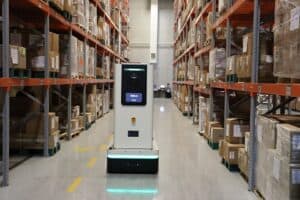
Autonomous mobile robots (AMRs) use sensors and programming to navigate through a facility without relying on the same fixed-route approach as many AGV installations. Their flexibility can be useful in environments where transportation needs vary or where mobile robots must navigate among different work areas. In goods-to-person applications, AMRs can bring totes or inventory to fulfillment employees or transfer items toward packing operations.
The potential advantages include reduced repetitive travel, more flexible material movement, and opportunities to scale transportation capacity as requirements change. Mobile robots can also complement conveyor systems rather than replace them. For example, a conveyor network might transport cartons through a fixed processing area while robots handle movements between storage locations and workstations.
Successful implementation still requires planning. Warehouse traffic, load characteristics, charging requirements, pedestrian interaction, software integration, and exception handling all influence how effectively robots perform. Businesses should also consider whether their order patterns and transportation routes justify the investment.
Robotic fulfillment is therefore not a universal solution for every warehouse. Its value depends on selecting the appropriate technology for the tasks involved and integrating it into a coherent operational workflow.
6. How can warehouse automation help reduce product damage and fulfillment errors in warehousing services?
Product damage and order errors create costs beyond the immediate handling problem. A damaged package may require replacement inventory, additional labor, customer service intervention, and return processing. An incorrectly sorted or packed shipment can lead to similar expenses while affecting customer satisfaction and delivery performance.
Warehouse automation can help reduce these risks by creating more consistent handling processes and controlling how products move between operational stages.
Century Conveyor Systems identifies reducing errors that cause returns or item breakage as an objective of its order fulfillment solutions. Several equipment choices can contribute to this goal when appropriately specified.
For products that require stable transportation, belt conveyors can offer a more consistent conveying surface than certain roller arrangements. This may be useful for small packages or irregular cartons that could otherwise move unpredictably during transportation.
Controlled accumulation can provide another layer of protection. Zero-pressure accumulation is designed to prevent packages from touching, which can be valuable when contact between products creates a risk of damage. Minimum-pressure accumulation provides a different operating approach for applications where limited contact is acceptable.
Divert systems also help establish more consistent package routing. Rather than relying entirely on manual movement between destinations, appropriately configured diverts can direct products toward designated processing lines. This can simplify material flow, although routing accuracy still depends on the broader identification, controls, and operational processes involved.
Automation can also reduce unnecessary manual handling. Every additional transfer creates another opportunity for a package to be dropped, mishandled, or sent to the wrong location. Reducing avoidable transfers can therefore support better product protection and process consistency.
However, automated equipment alone cannot guarantee error-free fulfillment. Accurate order data, appropriate packaging, effective inventory processes, equipment maintenance, and employee training remain important. Businesses should evaluate error rates and damage incidents before and after implementation to determine whether a particular solution is delivering the intended improvement.
7. Do Century Conveyor Systems’ warehousing services include storage solutions and warehouse controls?
Yes. Effective warehousing requires coordination between physical storage, product movement, and the systems that manage equipment behavior. Storage capacity alone does not guarantee efficient operations if employees cannot retrieve inventory easily or if products encounter bottlenecks on their way to packing and shipping.
Century Conveyor Systems offers storage-related solutions that include shelving and racking, ergonomic picking and packing systems, automated storage and retrieval systems, mezzanines, platforms, and other warehouse structures. These options can help businesses evaluate how to use their available space and organize their inventory-handling processes.
For instance, a facility with limited floor space might consider a mezzanine or elevated platform to create additional usable operational levels, subject to building conditions and design requirements. A warehouse experiencing inefficient picking workflows could assess storage configurations that reduce unnecessary movement or place frequently accessed items in more practical locations.
Warehouse controls are another important component of warehousing services. Century’s capabilities include control panel design and fabrication, programmable logic controls, and warehouse control system solutions. These technologies can help coordinate equipment activity and support communication between different parts of an automated material handling system.
A warehouse management system (WMS) and a warehouse control system (WCS) serve related but distinct purposes. A WMS generally supports inventory and warehouse workflow management, while a WCS focuses more directly on coordinating automated material handling equipment. Their responsibilities and integration requirements vary by implementation.
When storage infrastructure, conveyors, robotics, and controls are designed with the same operational goals in mind, businesses can reduce the risk of investing in disconnected systems that do not work well together.
The objective is to create a warehouse environment in which inventory can be stored appropriately, retrieved efficiently, and transported through the facility with fewer unnecessary interruptions.
8. What maintenance and support should businesses consider when investing in warehouse automation for warehousing services?
Warehouse automation is a long-term operational investment, so equipment performance after installation matters just as much as the initial system design. Conveyors, motors, sensors, controls, and mechanical components require appropriate maintenance to help sustain reliable performance and identify developing problems before they cause significant disruption.
Century Conveyor Systems offers conveyor preventative maintenance, repair services, replacement parts, and installation support. Its broader project capabilities also include startup support and ongoing service for implemented systems.
Preventative maintenance helps businesses establish a planned approach to equipment care rather than relying exclusively on repairs after a failure occurs. Depending on the equipment, a maintenance program may include inspections, checks of moving components, assessment of belt condition and alignment, sensor testing, and verification of relevant mechanical and electrical functions.
Replacement parts availability is another consideration. If a critical component fails, delays in sourcing the correct part can extend downtime. Businesses should understand which components are essential to their operation, what spare parts they should keep available, and how replacement equipment can be obtained.
Support planning should also reflect the operational importance of each system. A conveyor serving a noncritical process may tolerate a different response arrangement from equipment that supports the primary shipping line. Understanding these distinctions helps facilities prioritize maintenance resources and develop realistic contingency plans.
When evaluating warehousing services, businesses should ask not only how a system will improve performance but also how it will be supported throughout its operating life. Clear maintenance responsibilities, suitable spare parts planning, employee training, and access to qualified technical assistance can all contribute to a more sustainable automation investment.
9. How should a business determine whether Century Conveyor Systems is the right partner for its warehousing services project?
Choosing an automation partner begins with defining the operational challenge. Businesses should identify where delays occur, which processes consume the most labor, what types of products move through the facility, and how future order volumes may affect capacity requirements.
Century Conveyor Systems is a potential partner for organizations evaluating conveyor automation, robotic fulfillment, warehouse controls, storage modules, sortation, and related material handling improvements. Its integrated project approach spans system design, validation, implementation, installation, startup support, and ongoing parts and service.
Before beginning a project, businesses should prepare information about their current operation. Useful details include facility dimensions, existing equipment, product sizes and weights, average and peak order volumes, picking methods, shipping schedules, current bottlenecks, and planned growth.
It is also important to define success in measurable terms. Depending on the project, relevant indicators might include packages processed per hour, labor hours per order, order accuracy, product damage rates, equipment uptime, or the time required to move products from picking to shipping.
These measures help establish a baseline against which proposed improvements can be evaluated. They also make it easier to compare different technical approaches and determine whether an investment aligns with the company’s priorities.
Businesses should discuss project phasing, integration with existing equipment, maintenance expectations, and the practical effects of installation on day-to-day operations. The best solution is one that addresses actual constraints while remaining appropriate for the facility’s space, workforce, product mix, and future needs.
To begin evaluating a project, organizations can contact Century Conveyor Systems through its website and provide information about their facility, current challenges, and desired outcomes. That information can help establish the next steps toward assessing a suitable material handling automation solution.
Final Thoughts: Choosing the Right Warehousing Services for Long-Term Efficiency
Warehousing services encompass much more than storage. Efficient operations depend on how products move through a facility, how employees interact with equipment, how inventory is retrieved, and how consistently orders progress toward shipment.
Century Conveyor Systems offers a range of material handling automation capabilities designed to address these interconnected requirements. Conveyor systems can streamline transportation, sortation equipment can improve package routing, robotic fulfillment can reduce repetitive movement, and storage and controls solutions can support a more coordinated warehouse environment. Maintenance and service capabilities also help businesses plan for equipment reliability beyond installation.
The most effective approach begins with understanding the facility’s specific challenges. Some warehousing services may need a targeted conveyor improvement, while others may benefit from integrated fulfillment automation or a phased modernization project. Evaluating operational data, product-handling requirements, existing infrastructure, and long-term business goals can help determine which investments make the most sense.
For businesses looking to improve warehouse throughput, manage labor demands, and build a more scalable distribution operation, exploring Century Conveyor Systems’ warehousing services and order fulfillment solutions is a practical starting point.