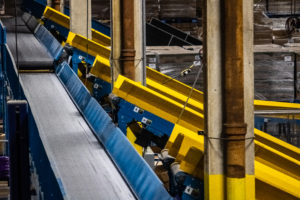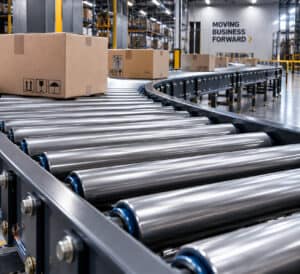
Conveyor safety is the set of guards, stop devices, procedures, and habits that keep people from being hurt by moving conveyor equipment. In a warehouse that means guarding the nip points and drives, putting emergency stops and pull cords where people can reach them, controlling hazardous energy before anyone reaches into the line, and giving people a safe way across.
Conveyors look harmless compared with forklifts or robots. They run at walking speed, they’re quiet, and most of the time nobody is near the moving parts. That’s exactly why conveyor safety gets neglected. The injuries that happen tend to happen during the ordinary work of clearing a jam, reaching under a frame for a fallen carton, or stepping over a line to save a walk.
This guide covers the seven hazards that matter most on warehouse conveyor, what OSHA’s rules and the ASME B20.1 conveyor safety standard expect at a high level, how e-stops and pull cords should work, how lockout/tagout applies to jams and maintenance, and a simple daily checklist your team can use.
This article is general information, not engineering or legal advice. Your conveyor safety program should be built for your equipment, your layout, and the regulations that apply to your facility.
At a glance
- Most conveyor injuries happen at nip and pinch points, at drives, and during jam clearing and maintenance.
- OSHA requires guarding of ingoing nip points and rotating parts, and enclosure of chains, sprockets, belts, and pulleys within seven feet of the floor or platform.
- E-stops and pull cords stop the conveyor. They don’t make it safe to reach in. Lockout/tagout does that.
- Zoned conveyor (24V MDR and accumulation) can start on its own when product moves. Treat a stopped zone as live.
- Never ride, climb, or step over conveyor. Use crossovers and gates.
- Test stop devices on a schedule and write down the results.
Table of Contents
What Conveyor Safety Covers
Conveyor safety covers four layers, and a good program uses all of them.
- Design and guarding. Guards over nip points and drives, side guards, under-guarding where product or parts can fall, and crossovers so people don’t climb the line.
- Stop devices and controls. Emergency stop buttons, pull cords, start-up warnings, and controls that don’t restart the system by surprise.
- Energy control. Lockout/tagout for maintenance and for jam clearing that puts hands in the danger zone.
- People. Training, clear rules, daily checks, and a culture where stopping the line to do it right is normal.
Most facilities have the first two conveyor safety layers in place from the original installation. Over time, guards come off and don’t go back on, pull cords go slack, e-stop buttons get blocked by staged pallets, and the original training fades. Conveyor safety is as much about keeping what you have working as it is about what was designed in.
The 7 Conveyor Hazards That Cause Most Injuries
| Hazard | Where you find it | How it’s controlled |
|---|---|---|
| Ingoing nip points | Where a belt meets a pulley or snub roller; where rollers meet drive belts or bands | Nip guards, finger guards, enclosed ends |
| Pinch and shear points | Between rollers, at transfers, at diverters and gates, between moving and fixed parts | Guarding, spacing, roller covers, side guards |
| Drives and power transmission | Motors, reducers, chains, sprockets, drive belts and sheaves | Full enclosure within reach; guards that stay on |
| Entanglement | Rotating shafts, rollers, and pulleys that catch loose clothing, gloves, hair, and rags | Guarding; dress rules; no reaching into running conveyor |
| Falling product and parts | Overhead conveyor, inclines, mezzanine edges, spirals | Under-guards, netting, side guards, toe boards, restricted areas |
| Unexpected start-up | Zoned accumulation and MDR lines, remote starts, automatic restarts | Start-up warnings, controls design, lockout/tagout |
| Stored energy | Inclines and declines holding product, pneumatic systems, take-up springs and counterweights | Lockout/tagout steps that release or block stored energy |
Nip points and pinch points
A nip point is where two parts move together and draw something in, such as a belt wrapping a pulley. A pinch point is where a moving part closes against another part. On warehouse conveyor they are everywhere: belt ends, snub rollers, roller-to-roller gaps on live roller conveyor, the drive bands on line shaft, and every transfer and diverter. A hand or glove that touches one can be pulled in faster than a person can react.
Drives
The drive end of a belt conveyor or the drive unit on a live roller line has chains, sprockets, sheaves, and shafts. These should be fully enclosed wherever someone can reach them. A common conveyor safety failure is simple: a drive guard was removed for maintenance and never reinstalled.
Unexpected start-up
Modern zoned conveyor stops and starts on its own. On a 24V MDR conveyor or a zero-pressure accumulation conveyor, a zone that looks idle can start the moment the zone ahead clears. A stopped conveyor is not a de-energized conveyor. That single fact is behind many of the conveyor safety rules below.
Stored energy
Turning off the power doesn’t always remove the hazard. An incline full of product can roll back. Pneumatic sections can hold air pressure. Take-up assemblies hold tension. Your lockout procedure has to account for each of these.
What OSHA Requires for Conveyor Guarding
OSHA’s general industry rules don’t have one “conveyor standard” for warehouses, but several sections apply directly. Here is what they say, in plain terms.
General machine guarding, 29 CFR 1910.212. Employers must provide guarding to protect operators and other employees from hazards such as ingoing nip points and rotating parts. Guards should be attached to the machine where possible, and a guard must not create a hazard itself.
Mechanical power-transmission apparatus, 29 CFR 1910.219. This section covers belts, pulleys, shafting, sprockets, chains, and gears. It requires sprocket wheels and chains to be enclosed unless they are more than seven feet above the floor or platform, and it sets guarding requirements for belts, pulleys, and shafting within seven feet of the floor or working platform.
Lockout/tagout, 29 CFR 1910.147. Covered below.
Seven feet is the conveyor safety number to remember. If a person standing on the floor or a platform can reach a moving drive part, it needs a guard. That includes platforms and mezzanines, which is easy to forget when a conveyor runs past a work deck at waist height.
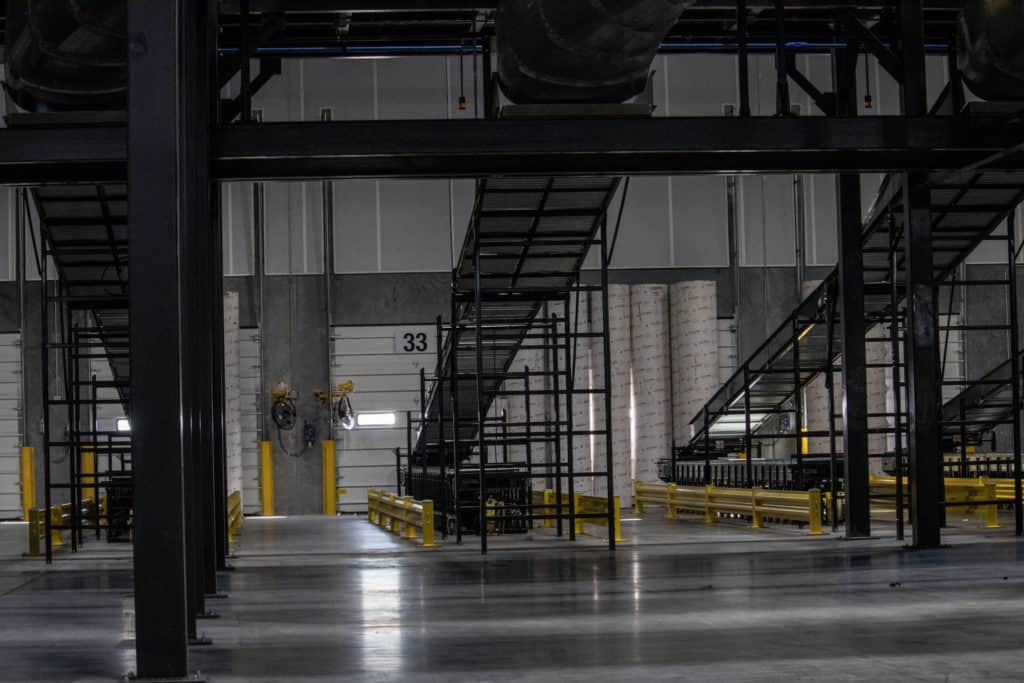
ASME B20.1: The Conveyor Safety Standard
ASME B20.1, Safety Standard for Conveyors and Related Equipment, is the consensus conveyor safety standard most conveyor systems in the United States are designed and installed to. It is published by the American Society of Mechanical Engineers and covers the design, construction, installation, maintenance, inspection, and operation of conveyors.
In broad terms, it addresses the topics in this article: guarding of hazardous points, emergency stopping, start-up warnings and controls, crossovers and passageways, and the responsibilities of owners and users to maintain safety devices and train people. It’s a paid standard, so we won’t quote it here. If you’re designing a new line, extending an existing one, or auditing an older system, ask your integrator which edition the work is being designed to. You can find the current edition on the ASME B20.1 page.
The Conveyor Equipment Manufacturers Association (CEMA) also publishes conveyor safety resources, including the safety labels you’ll find on most conveyor equipment. If labels on your system are faded or missing, replacing them is a cheap fix.
E-Stops and Pull Cords: How Conveyor Stop Devices Should Work
Emergency stops and pull cords are the conveyor safety devices people interact with most. They are only useful if they’re reachable, working, and understood.
Emergency stop buttons are red mushroom-head push buttons that stop the conveyor when pressed and stay latched until they’re deliberately reset. They belong at operator stations, at pack and pick stations, near transfers and merges, and at regular intervals along conveyor where people work.
Pull cord switches run a cable along the length of a conveyor so anyone working beside it can stop it from any point. They are common along long belt conveyors, takeaway lines, and areas where people work along the side of the line.
Start and stop push-button stations are separate from emergency stops. A normal stop button stops the line for routine reasons. Make sure people know the difference and that e-stops are clearly marked.
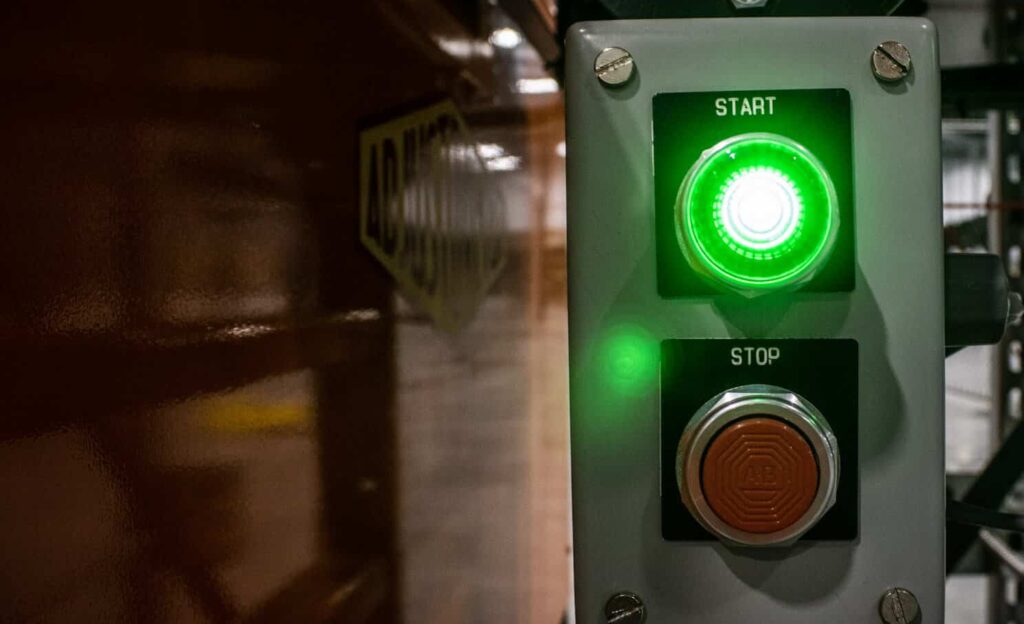
Conveyor safety rules for stop devices
- Reachable. People working along a conveyor should be able to reach a stop device without leaving their position or crossing the line. Don’t stage pallets, carts, or totes in front of e-stops.
- Latched and reset. After an e-stop or pull cord trips, the conveyor should not restart until the device is reset and a deliberate start is given. Resetting an e-stop alone should not restart the line.
- Tight cords. A slack pull cord may not trip the switch. Check tension and make sure the cable isn’t tied off, taped, or routed around obstructions.
- Zoned correctly. People need to know what each stop device stops. If an e-stop only stops one section, the upstream section may keep feeding product into it.
- Tested. Test stop devices on a schedule, and record the results. A pull cord that hasn’t been pulled in two years may not work.
An e-stop is not a lockout
This is the most important rule in this article. An e-stop stops the conveyor. It doesn’t isolate the energy, it can be reset by someone else, and on many systems a control fault or a reset at another station can bring the line back. Pressing an e-stop is the right first move in an emergency. It is not permission to reach into the conveyor. For that, you need lockout/tagout.
Lockout/Tagout on Conveyors
OSHA’s lockout/tagout standard, 29 CFR 1910.147, covers servicing and maintenance where unexpected start-up or stored energy could injure someone. For conveyor, that includes most maintenance and many jam-clearing tasks. Key requirements, in plain terms:
- A written program. Employers need an energy control program with written procedures, training, and periodic inspections of those procedures at least annually.
- Your lock, your key. Each authorized employee applies their own lock or tag to the energy isolating device, and each device is removed by the employee who applied it.
- Stored energy. Stored or residual energy must be relieved, disconnected, restrained, or otherwise made safe. On conveyor, that means bleeding air from pneumatic sections, blocking or unloading inclines, and accounting for take-up tension.
- Verify. Before work starts, verify the equipment is actually isolated. A common method is to try the normal start controls after lockout to confirm nothing moves, then return them to off.
Jam clearing and the minor servicing exception
Clearing jams is the moment most conveyor injuries happen, and it’s where lockout gets skipped. OSHA’s standard covers servicing during normal production when someone removes or bypasses a guard, or puts part of their body into the danger zone. There is a narrow exception for minor servicing that is routine, repetitive, and integral to production, but only when the work is done with alternative measures that give effective protection.
In practice, that means your facility should decide in advance, task by task, which jams can be cleared with a specific protected method (for example, from outside the guarding with a tool, after stopping the line) and which require full lockout. Write it down, train it, and make it easy to follow. If clearing a recurring jam requires reaching into the conveyor every shift, treat the jam itself as a conveyor safety problem and fix the cause. Century’s post on common conveyor issues and routine repairs covers several causes of constant jams at sections and transfers.
Low voltage still needs lockout
24V MDR conveyor uses low-voltage motorized rollers, and people sometimes assume that makes it safe to reach in. The voltage may be low, but the rollers still create pinch points, and the zones still start automatically. Lock out MDR conveyor the same way you’d lock out any other powered conveyor, at the power supply or disconnect your procedure names.
Conveyor Safety at Crossovers, Gates, and Walkways
People will take the shortest route. If the only way across a long conveyor line is a long walk around, someone will eventually step over it, duck under it, or ride it.
- Never ride, sit on, climb, or step over conveyor. Make this a hard rule.
- Provide crossovers (stairs and a platform over the line) where people need to cross regularly, and make sure they’re guarded and lit.
- Use gate sections (hinged or lift-up conveyor sections) where a walkway needs to pass through a line. A gate should stop the conveyor upstream when it’s open so product doesn’t pour off the end.
- Guard underpasses. Where people walk under conveyor, under-guards or netting keep falling product and parts away from them.
- Protect the structure. Floor bollards and guard rails keep forklifts and pallet jacks from hitting conveyor supports, which protects both people and tracking and alignment.
Conveyor Safety Checklist: Daily, Weekly, and Scheduled
A short conveyor safety checklist that operators and maintenance actually use beats a long one nobody fills out. Here’s a starting point. Adapt it to your equipment and your manufacturer’s instructions.
Before each shift (operators or leads)
- Guards are in place, including drive guards, nip guards, and side guards.
- E-stops are visible and not blocked.
- Pull cords are tight and not tied off or obstructed.
- Start-up warning (horn or light) works where the system has one.
- No loose product, debris, or tools on or under the conveyor.
- Walkways, crossovers, and gates are clear.
Weekly (maintenance)
- Test a rotation of e-stops and pull cords and record the results.
- Check that gate sections stop the upstream conveyor when opened.
- Look for missing or damaged guards, labels, and fasteners.
- Check for unusual noise, heat, or belt drift, which are often early signs of a mechanical problem.
Scheduled (maintenance or service provider)
- Test every stop device and verify which sections it stops.
- Review lockout procedures for each conveyor and confirm isolation points are labeled.
- Inspect drives, chains, and sprockets with guards removed under lockout, then reinstall guards.
- Review jam history and fix recurring jam points.
- Annual review of the energy control procedures, as 1910.147 requires.
Century’s conveyor unit maintenance checklist includes e-stop buttons and pull cord switches among the electrical items technicians check.
Training People to Work Around Conveyor
Conveyor safety guards and devices only work if people use them. Conveyor safety training should cover, at a minimum:
- Where the hazards are on your system, shown on the floor.
- Where every stop device is and what it stops.
- The difference between a normal stop, an e-stop, and lockout.
- Which jams operators may clear, and how, and which require maintenance and lockout.
- Dress rules: no loose sleeves, jewelry, or untied hair near running conveyor; gloves that won’t catch.
- Crossover and gate rules.
- How to report a missing guard or a stop device that doesn’t work, and the expectation that the line stops until it’s fixed.
Refresh conveyor safety training when the system changes. A new sorter, a new merge, or a re-sequenced MDR line changes where the hazards are and how the line behaves.
When an Older System Needs a Conveyor Safety Review
Older systems tend to drift away from their original safety design. Extensions get added without new pull cords. Control panels are modified by several different people over the years. Drawings stop matching the floor. If your system is more than a decade old, has been changed several times, or has never had a formal assessment, a conveyor safety review is worth scheduling along with a general condition audit.
Century’s post on what a 30-year-old conveyor system audit taught us describes what a formal audit covers: an equipment status review, a repair-vs.-upgrade assessment, and a documented baseline. Conveyor safety devices belong in that baseline. Century’s on-site service work includes diagnostic testing of emergency stop systems and push-button stations, and verification of finger guards and safety devices such as e-stops.
What are the most common conveyor hazards?
Ingoing nip points where belts wrap pulleys, pinch and shear points between rollers and at transfers, exposed drives and chains, entanglement in rotating parts, falling product from overhead or inclined conveyor, unexpected start-up on zoned conveyor, and stored energy in inclines, air systems, and take-ups.
What does OSHA require for conveyor guarding?
OSHA’s general machine guarding rule, 29 CFR 1910.212, requires guarding against hazards such as ingoing nip points and rotating parts. The power-transmission rule, 29 CFR 1910.219, requires chains, sprockets, belts, pulleys, and shafting within seven feet of the floor or working platform to be guarded.
What is ASME B20.1?
ASME B20.1 is the Safety Standard for Conveyors and Related Equipment published by the American Society of Mechanical Engineers. It covers conveyor design, installation, maintenance, inspection, and operation, including guarding, emergency stops, start-up warnings, and crossovers. It is a paid standard.
Is pressing an e-stop the same as lockout?
No. An e-stop stops the conveyor, but it doesn’t isolate energy and it can be reset by someone else. Before anyone reaches into a conveyor for maintenance or servicing, follow your lockout/tagout procedure under 29 CFR 1910.147.
How often should conveyor e-stops and pull cords be tested?
On a regular schedule set by your safety program and the equipment manufacturer, with results recorded. Many facilities check that devices are reachable every shift and test a rotation of them weekly, with full testing during scheduled maintenance.
Does a 24V MDR conveyor need to be locked out?
Yes. The voltage is low, but the motorized rollers still create pinch points and zones start automatically when product moves. Lock out MDR conveyor at the power supply or disconnect named in your procedure before reaching in.
Can workers cross over a conveyor?
Only on a crossover built for it, or through a gate section that stops the conveyor upstream when it’s open. Riding, climbing, or stepping over conveyor should never be allowed.
Who is responsible for conveyor safety in a warehouse?
The employer is responsible for guarding, energy control, and training under OSHA’s rules. Conveyor designers and integrators are responsible for the safety design of what they install, and everyone who works around the conveyor shares responsibility for following the rules and reporting problems.
Make Conveyor Safety Part of Maintenance
Conveyor safety belongs inside your maintenance program. Guards, stop devices, and lockout points wear, break, and get bypassed the same way belts and bearings do, and they need the same regular attention. The facilities that keep people safe around conveyor are the ones that check the devices, fix the jams that tempt people to reach in, and treat a missing guard as a reason to stop the line.
Century Conveyor has been installing and servicing conveyor systems since 1981. If you want your stop devices tested, your guarding checked, or an older system assessed, request on-site conveyor service, ask about a preventive maintenance program, or contact our team.