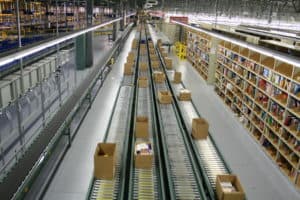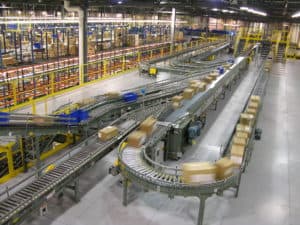
An incline conveyor is a powered conveyor, almost always a belt conveyor, set at an angle so it carries cartons, totes, or packages from one floor level up to another. A spiral conveyor does the same job by wrapping the climb into a tight helix, so product changes levels in a fraction of the floor space a straight incline needs.
Most distribution centers reach a point where the floor is full and the only room left is overhead. Mezzanines, multi-level pick modules, overhead transport lines, and sorters mounted above the dock all depend on getting product up and back down reliably. That move between levels is often the tightest constraint in a layout: it decides how much floor the conveyor takes, how fast product can flow, and what can and can’t ride on the line.
This guide covers how an incline conveyor works, when a spiral or a vertical lift makes more sense, how to size an incline, the transitions and controls that cause most of the problems, and the safety rules that apply when product and people are working above the floor.
At a glance
- An incline conveyor is a belt conveyor set at an angle. It’s simple, continuous, and handles a wide range of cartons and totes, but it needs a long run of floor.
- A spiral conveyor climbs in a helix. It saves floor space and keeps flow continuous, at a higher equipment cost.
- Vertical conveyors (continuous vertical conveyors and vertical reciprocating conveyors, or VRCs) lift straight up in the smallest footprint, usually at lower rates or with batch-style movement.
- The steepest angle you can run is set by your product and the belt surface, not by the space you have.
- Most incline conveyor problems happen at the transitions: the bottom feed, the top nose-over, and the merge into the next line.
Table of Contents
What Is an Incline Conveyor?
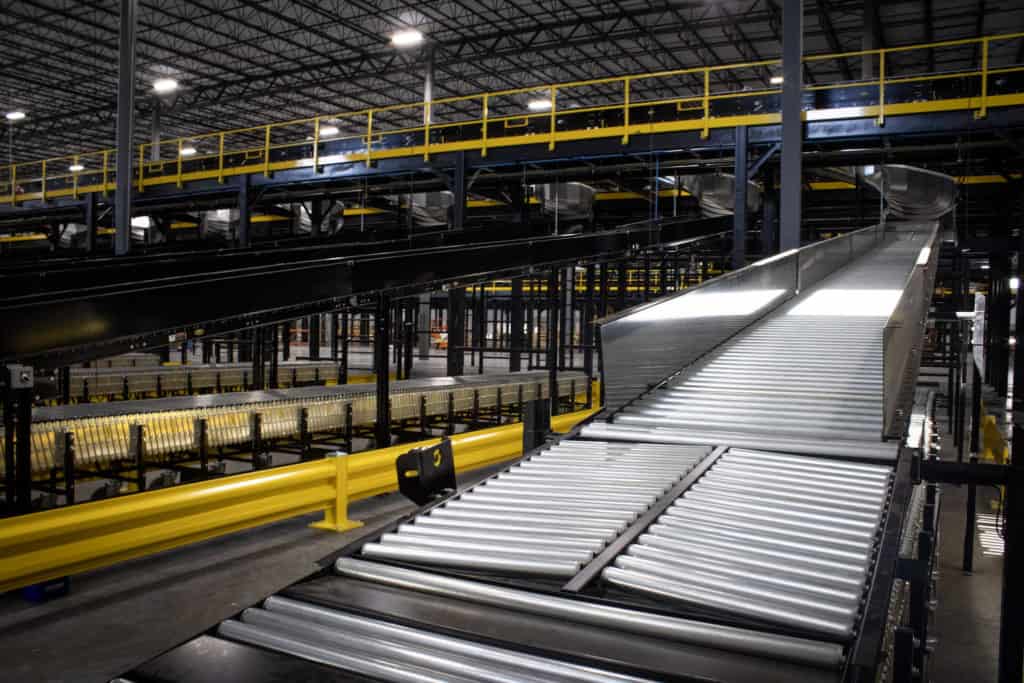
An incline conveyor is a conveyor section that rises at an angle between two elevations. The most common type in distribution is a belt conveyor: a continuous belt running over a slider bed or rollers, driven by a motor at one end or in the middle of the run. The belt grips the bottom of the carton or tote and carries it up the slope.
Belt is the default for an incline conveyor for a reason. Century’s conveyor and order fulfillment page puts it simply: inclines, declines, and gapping are where belt conveyors beat live roller, because the belt gives product a stable surface. A roller conveyor at the same angle lets product roll back or tumble. Belted inclines typically use a high-friction belt surface (often called rough-top) so cartons don’t slip on the climb.
A typical incline conveyor has:
- A bottom transition where product comes off a horizontal line and starts the climb.
- The inclined bed, with the belt, the slider bed or rollers under it, side guides, and the drive.
- A top transition, often a short powered section or nose-over, where product levels out onto the upper line.
- Controls, usually a photo eye at the top so the incline stops feeding when the upper line is full, plus e-stops and interlocks with the conveyors on each end.
The same equipment run the other way is a decline conveyor. Declines bring product down from a mezzanine to packing, shipping, or a sorter. Belt declines control the speed of product on the way down; roller declines, sometimes with brake rollers or speed control, are common on shorter, gentler drops.
Why Operations Move Product Between Levels
Every level change costs equipment, space, and controls. It’s worth doing when it frees up something more valuable:
- Mezzanine and pick module work. Multi-level pick modules put pickers on two or three levels. Totes need to get up to each level and back down to packing.
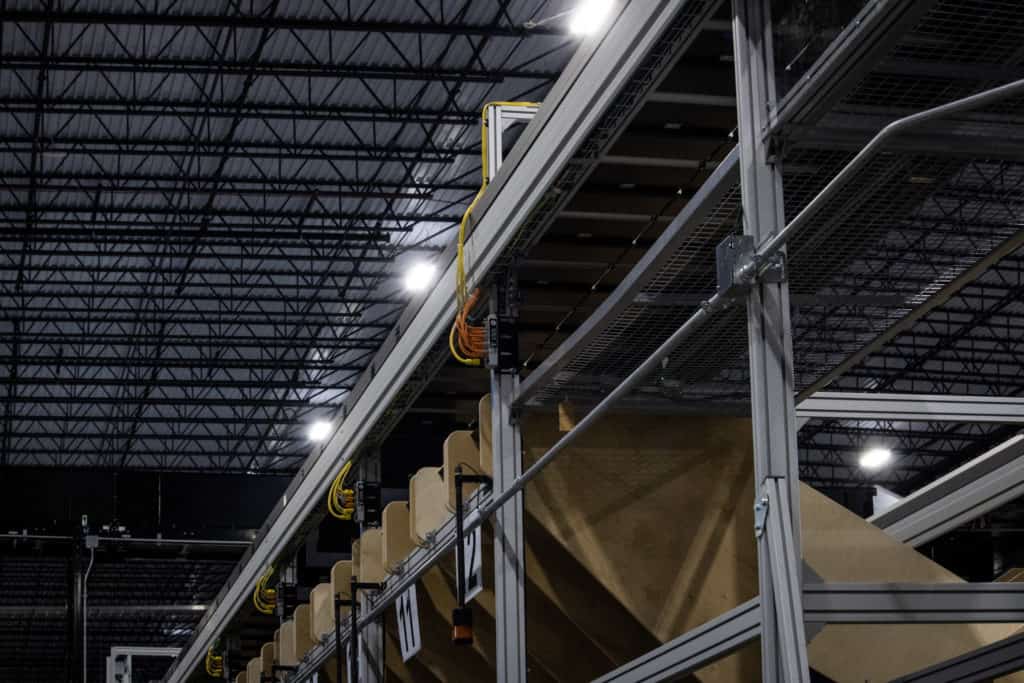
- Overhead transport. Running conveyor overhead keeps aisles, forklift paths, and work areas on the floor open. Century’s pick modules and storage page notes that a mezzanine can suspend an entire conveyor system overhead and leave the ground floor clear.
- Crossing aisles and doorways. An incline up, an overhead section, and a decline back down lets product cross a main aisle without blocking it.
- Feeding sorters and shipping. Sorters are often mounted at an elevation, so product climbs to the sorter and then rides decline lanes or chutes down to the doors.
- Adding capacity without adding building. When the footprint is fixed, height is the only direction left.
The 4 Ways to Move Cartons Between Levels
There are four common ways to change elevation on a carton and tote line. Each has a place.
| Option | How it moves product | Flow | Footprint | Best for |
|---|---|---|---|---|
| Incline or decline belt conveyor | Belt on an angle | Continuous | Long; grows with the height | Moderate rises with floor space available; a wide mix of cartons and totes |
| Spiral conveyor | Powered helix of slats or rollers | Continuous | Compact; mostly vertical | High rates and tight floor space |
| Continuous vertical conveyor (CVC) | Platforms or carriers that loop vertically | Continuous, carrier by carrier | Very small | Moderate rates with very little floor space |
| Vertical reciprocating conveyor (VRC) | A platform that travels up and down, like a freight lift | Batch, one load per trip | Very small | Pallets, carts, and heavy or awkward loads at lower rates |
Incline belt conveyor
A straight incline conveyor with a belt is the simplest and usually the least expensive way to change levels. It runs continuously, handles a wide range of product sizes, and uses components your maintenance team already knows. The trade-off is floor space. A gentle incline needs a long run, and that run plus its transitions has to fit somewhere in your layout without blocking aisles or doors.
Spiral conveyor
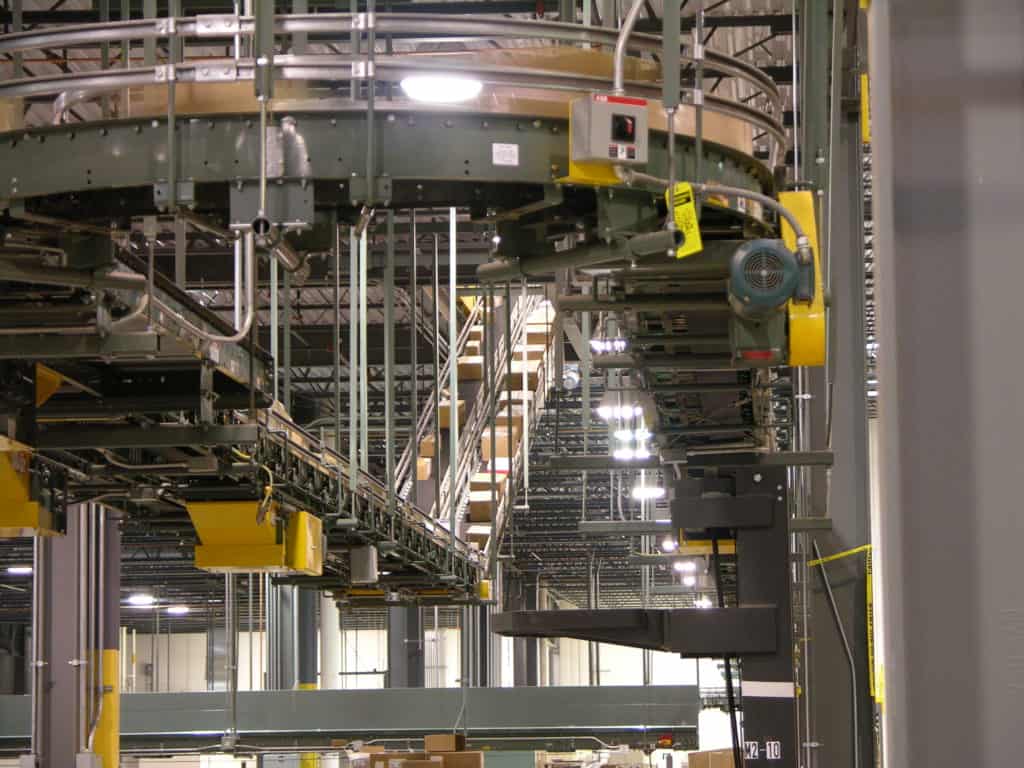
A spiral conveyor wraps the climb into a helix around a central column. Product rides a powered surface of slats or rollers that curves around and up. Because the path is a circle, a spiral climbs a mezzanine height in a small footprint and keeps product flowing continuously. Century’s order fulfillment page describes spirals as a compact way to reach additional levels with quicker processing than stackers or multiple inclines.
The trade-offs are equipment cost, a more specialized drive and slat or chain system to maintain, and limits on product size. Long, tall, or unstable items can be a problem on the curve. Spirals also come in gravity versions, which are used to lower product (for example, from a sorter to a lower level) rather than to lift it.
Continuous vertical conveyor
A continuous vertical conveyor uses carriers or platforms that travel a vertical loop, taking product on at one level and discharging it at another. It needs even less floor than a spiral and runs continuously, carrier by carrier. Rates are usually lower than a spiral, and the product range is set by the carrier size.
Vertical reciprocating conveyor (VRC)
A VRC is a platform that moves up and down between levels, carrying one load per trip. It’s used for pallets, carts, bulk loads, and items that can’t ride a belt. VRCs are classed as conveyors, not elevators, and they’re built to carry material only; people don’t ride them. Gates and interlocks at each level are part of the design.
The Johnson & Johnson distribution center Century worked on used several of these options together. Filled orders from the split-case pick area ride one of three TKF vertical lifts to an overhead zero-pressure accumulation line. Boxes that reach the end of the pick line take an incline up to the same overhead line. From there, boxes drop down to an 18-lane sorter, with scanners reading labels on the decline. Throughput went from about 900 to 1,000 boxes in an eight-hour period to about 1,350 to 1,400. Read the Johnson & Johnson story.
How to Size an Incline Conveyor
Sizing an incline conveyor comes down to three numbers: the height you need to climb, the steepest angle your product can handle, and the floor you have.
Start with the product, not the space
The steepest angle that works is set by what you’re conveying and the belt you’re using. Tall, narrow, or top-heavy cartons tip at angles that a flat tote handles easily. Round items, polybags, and product with slick bottoms slip sooner. Heavier loads put more demand on the drive. A grippier belt surface, cleats, or a gentler angle can each fix a problem product, at different costs.
Test with the worst product in your range: the tallest carton, the lightest polybag, the heaviest tote, and anything with a slick or uneven bottom.
Then do the geometry
Once you know the angle, the length is simple trigonometry. The conveyor length equals the rise divided by the sine of the angle, and the floor run equals the rise divided by the tangent of the angle. As an illustration, not a recommendation:
| Rise | Angle | Conveyor length (approx.) | Horizontal floor run (approx.) |
|---|---|---|---|
| 12 ft | 15° | 46 ft | 45 ft |
| 12 ft | 20° | 35 ft | 33 ft |
| 12 ft | 25° | 28 ft | 26 ft |
Add the bottom and top transitions on top of those numbers. Then ask whether that run fits without crossing an aisle, blocking a door, or landing in a spot where the upper line can’t continue. If it doesn’t fit, that’s when a spiral or a vertical conveyor earns its higher cost.
Check the rate and the gaps
An incline conveyor runs at a set speed, and product needs gaps between items so the transitions and photo eyes work cleanly. Make sure the speed and spacing deliver the rate you need at peak, not on an average day. If the upper line stops often, plan accumulation conveyor at the bottom so product can queue safely instead of backing up into the process feeding it.
Transitions and Controls: Where Most Incline Problems Start
The incline conveyor itself is rarely the problem. The ends usually are.
Bottom transition. Product moving from a horizontal roller line onto a climbing belt changes surface and angle at the same time. Short items can stall in the gap, and long items can bridge it awkwardly. A powered transfer or a belt section on the horizontal side helps.
Top transition. At the top, product tips forward onto the upper line. Tall cartons can tip over, and items can catch on the edge of the next conveyor. A properly sized nose-over and matched speeds on both sides keep the handoff smooth.
Stopping on the slope. When the upper line is full, the incline conveyor has to stop, and product sitting on a stopped incline belt needs to stay put. Plan where product waits. The best answer is usually to stop feeding the incline before it fills, using a photo eye at the top and accumulation at the bottom.
Merges at the top. If the incline conveyor feeds into a busy line, the merge logic decides whether product gets a window or sits on the slope. That’s a controls design question, and it should be answered before the steel goes up.
Declines. Coming down, the risk is speed. Product on a steep roller decline can accelerate and slam into whatever is waiting at the bottom. Belt declines, brake rollers, and controlled speed at the bottom prevent damage.
The F. Schumacher distribution center Century integrated shows the kind of control detail that matters. Showroom samples travel via an incline and zero-pressure accumulation to the shipping area, and on curves where product shouldn’t accumulate, a photo eye senses when the conveyor is full and shuts the unit down.
A Real Mezzanine Layout: Worldpac
The Worldpac distribution center in Edison, New Jersey, which Century designed and installed, is a clear example of how inclines and declines make a mezzanine work.
Worldpac distributes automotive parts for imported vehicles. The 123,000 square foot building handles 36,000 SKUs and about 1,000 orders a day. Picking starts in zones on the ground floor. Items are packed into totes, and the totes ride one of two incline conveyors up to picking stations on the mezzanine. A horizontal live roller line with zero-pressure accumulation carries totes through four picking zones, and pop-up transfers move them onto gravity conveyors at each station.
Completed orders move out on the takeaway conveyor, around a curve, and down the incline to shipment preparation. The system uses Hytrol live roller, gravity, and heavy-duty incline conveyor, and it was designed to handle different tote sizes, corrugated boxes, and oversized parts like tailpipes. A customer-direct order can be picked, checked, packaged, and manifested in as little as 20 minutes. Read the Worldpac story.
The lesson for your own layout: the inclines were placed where the order flow needed them, up to the mezzanine at the start of picking and back down at the end, so the floor below stayed free for ground-level picking and shipping.
How to Choose: 7 Questions to Answer First
- What’s the full product range? Smallest, largest, tallest, lightest, heaviest, and the bottom surface of each.
- How high is the climb, and how much floor do you have? Run the geometry for an incline conveyor before you rule it in or out.
- What rate do you need at peak? Continuous options (incline, spiral, CVC) handle steady flow; a VRC moves one load at a time.
- Does product need to go up, down, or both? Separate up and down paths, or one reversible path, change the equipment choice.
- What happens when the upper line stops? Plan where product waits.
- Are there pallets, carts, or non-conveyables? Those usually point to a VRC.
- Who will maintain it? A belt incline conveyor uses familiar parts. Spirals and vertical conveyors have specialized drives, chains, and slats that need trained technicians and spare parts on hand.
Safety at Inclines, Mezzanines, and Overhead Lines
Changing levels adds hazards that a floor-level line doesn’t have: people working at height, product that can fall, and equipment that stores energy on a slope.
- Fall protection at mezzanine edges. OSHA requires protection for employees on a walking-working surface with an unprotected side or edge 4 feet or more above a lower level, typically with guardrails. See 29 CFR 1910.28(b)(1), with guardrail criteria in 29 CFR 1910.29. Openings in a mezzanine edge where a conveyor or lift passes through need the same attention.
- Hoist areas. Where loads are transferred at a mezzanine edge, 1910.28(b)(2) covers protecting employees in hoist areas. VRC openings and their gates belong in that conversation.
- Falling objects. Overhead conveyors and incline conveyors carrying product above walkways need protection for people below. 1910.28(c) lists toeboards, screens, guardrails, canopy structures, and barricades as options.
- Guarding and lockout. Pinch points at drives, transitions, and nose-overs need guarding under 29 CFR 1910.212. Before reaching into an incline conveyor, lock out under 29 CFR 1910.147, and remember that product on a slope can roll back when the drive is released.
- Conveyor and VRC standards. ASME B20.1 is the safety standard for conveyors and related equipment, and it covers vertical reciprocating conveyors. CEMA, the Conveyor Equipment Manufacturers Association, publishes guidance and safety labels for conveyor equipment.
Our conveyor safety guide covers guarding, e-stops, pull cords, and lockout in more detail.
This section is general information, not engineering or legal advice. Have your mezzanine, conveyor, and lift design reviewed for your specific layout, loads, and local codes.
Maintaining Inclines, Declines, and Spirals
Incline conveyors work harder than flat conveyors. The drive carries the load up the slope, the belt surface wears where product grips it, and any tracking problem shows up faster.
- Belt tracking and wear. An incline conveyor belt that wanders rubs the frame and wears its edges. Check tracking and belt surface wear on a schedule. Our conveyor belt tracking guide explains why belts wander and how technicians correct them.
- Belt surface. A rough-top surface that wears smooth loses grip, and product starts slipping on the climb. Replace the belt before that happens.
- Drives and backstops. Check the motor, reducer, and any brake or anti-rollback device that holds product when the incline stops.
- Transitions. Check nose-overs, transfer plates, and photo eyes at both ends. Most jams start here.
- Spirals and vertical conveyors. Follow the manufacturer’s schedule for slats, chains, guides, and lubrication. These need trained technicians and spare parts on hand.
A preventive maintenance program with the same technicians visiting on a schedule is the most reliable way to catch these before they turn into downtime.
Replacing or Adding an Incline in a Running Building
Many operations already have inclines that are decades old. The frames often still have life in them, while belts, drives, controls, and transitions have worn or no longer fit today’s product mix. Common moves include replacing the belt and drive on an existing incline conveyor, re-engineering transitions for new carton sizes, adding accumulation and photo eye control at the top and bottom, or replacing a long incline with a spiral to free up floor space.
That kind of work usually has to happen around live operations, often in phases over nights and weekends. Century’s retrofit and modernization team handles projects from a few thousand dollars to a few million, including reusing existing equipment where it makes sense.
What is an incline conveyor used for?
An incline conveyor carries cartons, totes, and packages from one level to a higher one, such as up to a mezzanine, an overhead transport line, or a sorter. Run in the other direction, the same type of conveyor is a decline that brings product back down.
What is the difference between an incline conveyor and a spiral conveyor?
An incline conveyor climbs in a straight line, so it needs a long run of floor. A spiral conveyor climbs in a helix around a central column, so it reaches the same height in a much smaller footprint. Inclines usually cost less; spirals save floor space.
What is the maximum angle for an incline conveyor?
It depends on the product and the belt. Tall, top-heavy, round, or slick-bottomed items need gentler angles. Grippier belt surfaces or cleats allow steeper climbs. Test the worst product in your range and have the angle confirmed by your integrator.
Why are incline conveyors usually belt conveyors?
A belt grips the bottom of each carton or tote and keeps it stable on the slope. Product on a roller conveyor at the same angle can roll back or tumble, which is why roller is mostly used for gentle declines.
When should I use a VRC instead of a conveyor?
Use a vertical reciprocating conveyor when you’re moving pallets, carts, or heavy and awkward loads between levels, or when rates are low enough that one load per trip is enough. For continuous carton and tote flow, an incline, spiral, or continuous vertical conveyor usually fits better.
How much floor space does an incline conveyor need?
The floor run is the rise divided by the tangent of the angle, plus transitions at each end. For example, climbing 12 feet at 20 degrees takes roughly 33 feet of horizontal run before transitions. Gentler angles need more.
Do overhead conveyors need guarding underneath?
Where people work or walk below, protection from falling objects is required. OSHA’s walking-working surfaces rule lists toeboards, screens, guardrails, canopy structures, and barricades as ways to protect people from objects falling from a higher level.
Plan Your Incline Conveyor With an Integrator
Changing levels is where a layout either finds room to grow or runs out of it. The right incline conveyor, spiral, or lift depends on your product, your rate, your building, and what happens at both ends of the climb.
Century Conveyor has been designing, installing, and supporting conveyor systems since 1981, including mezzanine and multi-level layouts. If you’re planning a mezzanine, replacing an old incline conveyor, or trying to free up floor space, explore Century’s conveyor and order fulfillment systems or contact our team to talk through your layout.