

Table of Contents
In food and beverage distribution, the work is physical, the pace is relentless, and the margin for error is thin. Cases move constantly — from receiving docks to staging lanes to outbound pallets — and for most operations, a significant portion of that movement still depends on manual labor. Workers lift, stack, and repeat. Shift after shift. Year after year.
The result is predictable. Repetitive motion injuries accumulate. Good people get hurt. Some come back, some don’t. The ones who stay are grinding through shifts that take a real toll on their bodies — and the ones who leave take institutional knowledge and trained capacity with them. Turnover compounds the problem. New hires get placed into the same physically demanding roles, and the cycle continues.
This isn’t a story unique to one facility or one company. It’s a pattern that Century Conveyor’s team hears consistently from food and beverage distributors across the country. And while no one expects a distribution center to run without people, there’s a better way to think about where human effort should actually go — and where automation can step in to carry the load.
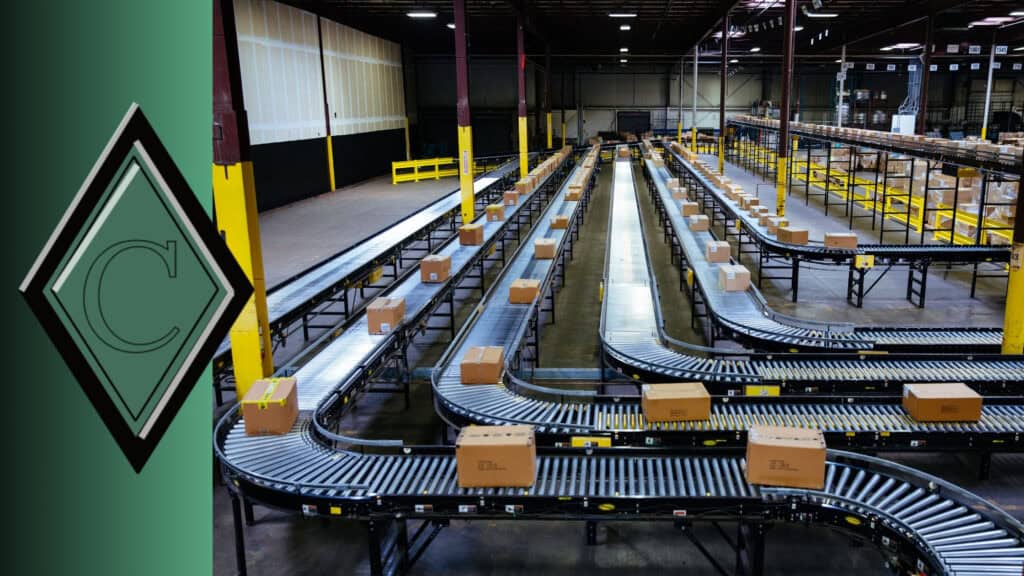
The Real Cost of Manual Palletizing: Reducing Injuries With Automation
When people talk about the cost of automation, the conversation usually starts with the price tag of the equipment. That’s a fair place to start, but it rarely tells the full story.
Consider what manual palletizing actually costs a food and beverage operation over time. Workers’ compensation claims. Modified duty assignments. Productivity losses during peak seasons when injured team members can’t perform at full capacity. The ongoing expense of recruiting and training replacement workers in a labor market that continues to tighten. The management time spent backfilling roles, navigating HR processes, and trying to maintain throughput during periods of reduced headcount.
These costs are real, they’re ongoing, and in many operations they’re so embedded in the normal cost of doing business that they’ve become invisible. The question worth asking isn’t whether automation is expensive. It’s whether the status quo is actually cheaper than it appears.
Two Solutions Designed for F&B Distribution
At Century Conveyor, the approach isn’t to sell a product catalog and find a customer to fit it. The work starts with understanding the specific operation — the floor layout, the product mix, the throughput demands, the pain points — and then engineering a system that actually solves the problem at hand. For food and beverage distributors dealing with injury risk and labor strain, there are two approaches that Century’s team has deployed repeatedly and effectively.
Robotic Palletizing
Robotic palletizing addresses one of the highest-risk tasks in any distribution center: the repetitive stacking of cases onto outbound pallets. It’s a task that requires precision, but it doesn’t require a person. Century’s robotic palletizing solutions — including palletizing and depalletizing arms and fully engineered robotic cells — are designed to handle this work continuously, without fatigue, without the injury risk that comes from repetitive motion, and without the throughput variability that comes with manual labor.
These systems don’t operate on a single template. Century designs each robotic palletizing installation around the realities of the specific facility — the SKU mix, the pallet configurations, the available floor space, the throughput requirements. The goal is a system that fits the operation, not one that forces the operation to adapt to it.
The downstream effects of removing manual palletizing from the equation go beyond injury reduction. When workers aren’t assigned to physically punishing end-of-line tasks, they’re available for roles that benefit from human judgment and flexibility. Throughput stabilizes. Injury claims decrease. Turnover in the most physically demanding positions drops. The operation becomes more predictable and more sustainable.
Pallet Handling Conveyor Systems
The risks in a food and beverage distribution center don’t begin and end at the palletizer. Loaded pallets moving through a facility — whether by hand, by forklift, or by a combination of both — represent a persistent source of bottlenecks, collisions, and manual handling exposure. Every time a loaded pallet changes hands or requires a fork truck to navigate a congested lane, there’s an opportunity for something to go wrong.
Century’s pallet handling conveyor solutions address this by automating the flow of product through the facility — from inbound receiving through staging and outbound shipping. By reducing the number of times a pallet needs to be touched or moved manually, these systems decrease the fork traffic that creates congestion and risk, improve overall flow efficiency, and reduce the manual handling exposure that contributes to injury.
Importantly, these systems are designed to integrate with existing facility layouts rather than require a complete operational overhaul. The goal is to improve what’s already working while removing the friction points that are creating problems — not to replace a functional operation wholesale with something unfamiliar.
What It Means to Work With a Full-Service Integrator
Automation projects fail when the equipment is right but the integration is wrong. A robotic palletizing cell that isn’t properly positioned within the flow of the line, or a pallet conveyor system that wasn’t designed to interface with the facility’s existing controls infrastructure, doesn’t deliver the value it’s capable of. The technology is only as effective as the engineering and execution behind it.
Century Conveyor is a full-service automation integrator, which means the team manages every phase of a project from initial concept through long-term support. That includes system design and engineering, controls engineering, control panel design and fabrication, mechanical and electrical installation, project management, and ongoing service and parts support after the system is live.
This matters for food and beverage distributors for a practical reason: you’re not coordinating between multiple vendors to get a project across the finish line. There’s one team accountable for the outcome from start to finish. When questions arise during installation — and they always do — there’s no finger-pointing between separate contractors. When the system needs support after go-live, the same team that built it is available to service it.
Century’s service capabilities include 24/7 support and a preventative maintenance program designed to keep systems running at peak performance over the long term. For operations that run around the clock, that kind of ongoing support infrastructure isn’t optional — it’s a requirement.
The Bigger Picture for F&B Distribution
The pressure on food and beverage distributors isn’t easing. Labor availability remains a challenge. The physical demands of distribution work haven’t decreased. And the expectation from customers for fast, accurate, consistent fulfillment has only grown.
Automation isn’t a solution to every challenge in a distribution center, and it’s not positioned that way. But for the specific, high-risk, highly repetitive tasks — end-of-line palletizing, pallet movement between zones, the manual handling work that wears people down over time — it’s a well-proven and increasingly accessible answer.
The facilities that are getting ahead of this challenge aren’t waiting for a crisis to force the conversation. They’re looking at the injury data, the turnover numbers, and the throughput constraints, and making a deliberate decision to invest in systems that protect their people and improve their operations at the same time. That decision tends to look better with every passing year.
See It in Person at MODEX 2026
Century Conveyor will be on the floor at MODEX 2026 in Atlanta — the nation’s premier supply chain and material handling trade show — April 13 through 16 at the Georgia World Congress Center. Find the team at Booth C14787.
For food and beverage distributors thinking seriously about automation, MODEX is an opportunity to see live systems, ask direct questions, and have a real conversation about what a project might look like for your specific operation. Availability for booth meetings fills up, so reaching out in advance to reserve time is recommended.
To learn more about Century Conveyor’s robotic palletizing and conveyor systems, or to start a conversation with an automation expert before the show, visit centuryconveyor.com or call (908) 205-0625.
Century Conveyor Systems is a full-service material handling automation integrator serving warehouses and distribution centers nationwide, with offices in New Jersey, California, and Kentucky.