Everybody promises easy returns. Very few operations can actually back that up.
Ask most warehouse and distribution leaders how they handle returns and you’ll hear some version of the same answer: “We deal with them as they come in.” That’s a process. It is not a system — and in reverse logistics, that distinction is where the money is won or lost.
Returns have quietly become one of the most consequential and least planned parts of modern warehousing and distribution. The expectations set by the largest players in e-commerce have created a world where customers assume returns are seamless. The reality on the warehouse floor is almost always more complicated. This article breaks down why reverse logistics is so hard, the three ways an undesigned returns process silently costs you, and what a real returns operation looks like when it’s built on purpose.
Returns Are Accelerating — and the Numbers Are Big
Returns are not going away. They are accelerating. A few figures put the scale in perspective:
- $743 billion in merchandise was returned to U.S. retailers in 2023, according to the National Retail Federation (NRF).
- On average, roughly 1 in 6 purchases is returned — and e-commerce return rates run about 3x higher than brick-and-mortar.
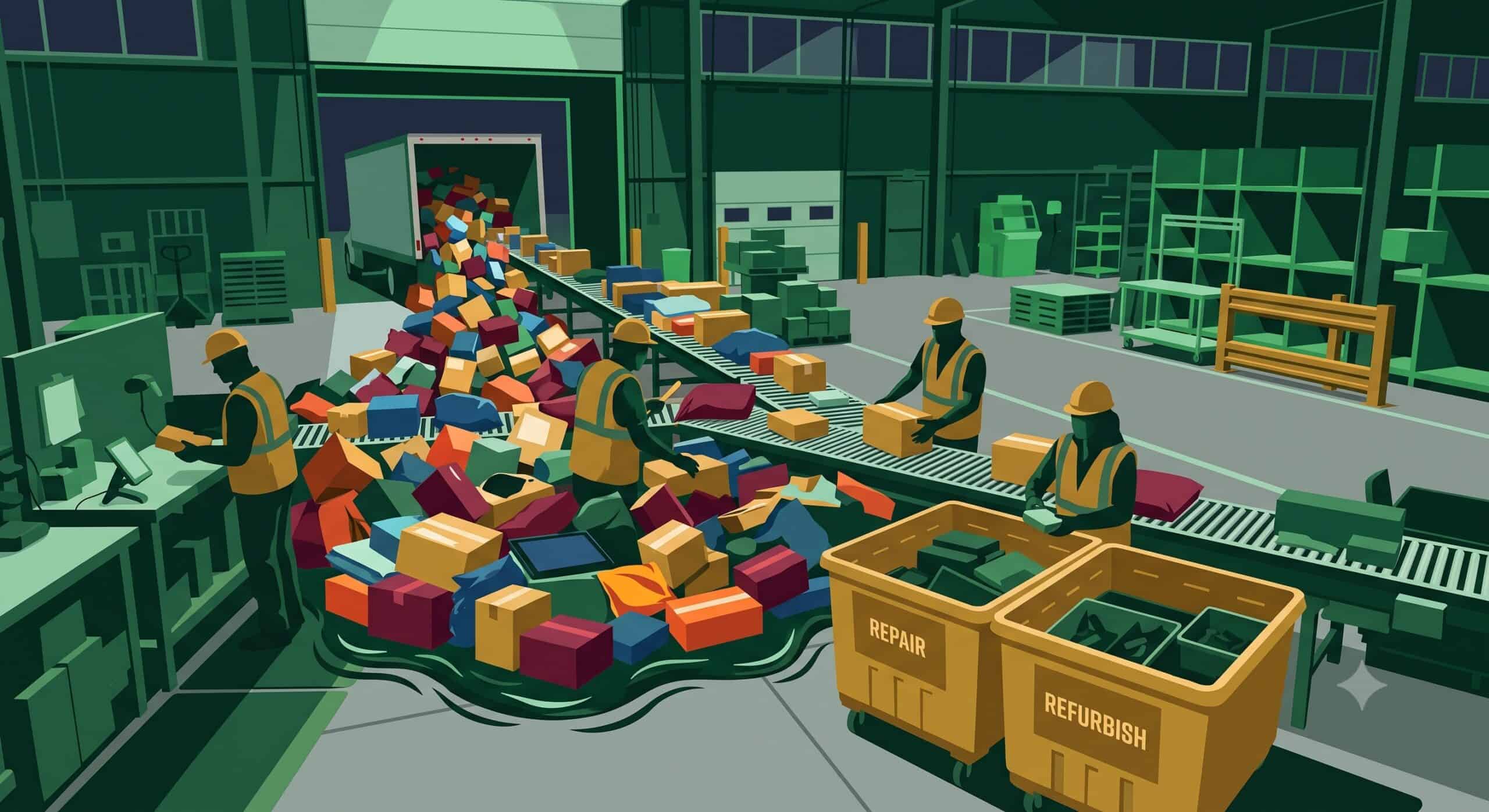
- A properly designed returns operation typically routes incoming product through at least three disposition zones to sort and route what comes back.
For any operation moving meaningful volume, returns are no longer a rounding error. They’re a category of work large enough to demand its own design.
Every Warehouse Has a Returns Process. Very Few Have a Returns System.
The expectations set by the biggest e-commerce brands have trained customers to assume returns are effortless. Behind the scenes, that seamlessness is expensive and hard to reproduce.
Consider how much variance a single returns dock absorbs. A mattress cannot be resold. A returned pair of jeans probably can. An electronics return might go to a certified reseller. Damaged goods need assessment before you even know what to do with them. Every category is different, every industry handles it differently, and most of the time nobody designed the process — it just accumulated.
If your team is figuring it out item by item, you are not behind. You are in the majority. But being in the majority doesn’t mean it isn’t costing you. It usually means the cost is simply invisible.
Three Ways an Undesigned Returns Process Costs You
When returns are handled by improvisation instead of design, the cost shows up in three predictable places.
1. No Clear Intake Process
Returns arrive and everyone improvises. Every item is handled the same way regardless of its condition, category, or disposition path. The result is inconsistency you cannot measure and therefore cannot fix. Without a defined intake step, there’s no reliable way to know what came back or what should happen to it next.
2. Inventory That Goes Dark
Product comes back into your facility and stops being tracked. You don’t know what is resellable, what needs repair, or what is sitting in a pile taking up floor space. Returned inventory becomes invisible inventory — and invisible inventory is expensive inventory. Every unit that can’t be found or assessed is working capital you’ve already paid for but can’t recover.
3. Space and Labor With No Defined Output
You’re dedicating floor space and team hours to returns, but there’s no defined workflow, no throughput metric, and no connection to your forward fulfillment operation. That’s not a returns operation. That’s a costly holding area wearing the label of one.
Why Reverse Logistics Is Harder Than Forward Fulfillment
The challenge that makes reverse logistics fundamentally different from forward fulfillment is inconsistency.
Standard warehouse automation is designed for uniform product moving in one predictable direction. Returns are the exact opposite. Every item comes back in a different condition, a different size, and with a different disposition path. The same system that excels at shipping identical SKUs outbound can choke on the unpredictable mix coming back in.
That’s why designing a returns operation isn’t just “forward fulfillment in reverse.” It requires workflows and technology built to expect variance rather than fight it.
Technology That Handles Variance
Newer approaches are built specifically for this problem. Tote-based robotic storage systems — such as the 3D robotic storage approach from Attabotics, a Century technology partner — handle returns without requiring standardized product dimensions or a uniform SKU footprint. You place items in a tote and the system handles the rest. The mix doesn’t matter. The size variance doesn’t matter. The tote accepts it, the system routes it, and your team always knows exactly where each item is and what stage it’s in.
Century partners with Attabotics to design returns workflows that work the way your product actually behaves — not the way an automation textbook says it should. As one operator described it: when all different types of things are coming back in random sizes and conditions, you put them in a tote and the system does the rest, regardless of what’s in it. The reported impact of designing returns this way is significant — meaningful space reduction, dramatically faster order fulfillment, and a large share of labor liberated for higher-value work.
What a Real Returns Operation Looks Like
For operations that have built a proper reverse logistics workflow, the difference isn’t just operational — it changes how the whole team thinks about the back end of the business. Returns go from being a cost center nobody wants to own to a measurable, manageable part of the operation.
The shift is cultural as much as mechanical. As one distribution-center operations manager put it, teams that once dreaded “returns day” reach a point where it’s just another part of the workflow: they know what’s coming in, they know where it goes, and they know what’s sitting in the returns area at any given time.
When You Build It Right, Returns Become a Resource
A designed returns system converts a liability into leverage in four ways.
Recovered inventory value. Returns that used to sit unassessed are identified, routed, and recovered — back to the shelf, to a reseller, or to a vendor credit. Product stops disappearing into a pile.
Faster throughput. Returns move through your building on a timeline you control, not a timeline dictated by accumulation. A system creates a cadence, and a cadence creates predictability.
Labor with a purpose. Your team processes returns in a defined workflow with clear steps and measurable output. Every hour spent on returns produces a tracked result, not a vague sense of progress on an undefined pile.
Visibility you can report on. You know what came back, why it came back, and what happened to it. That data shapes purchasing decisions, vendor relationships, and customer policy — none of which is possible when returns are invisible.
How to Start Designing Your Returns System
Moving from process to system doesn’t require solving everything at once. A practical sequence:
- Define a single intake step. Every return gets logged and assessed the same way before anything else happens.
- Establish disposition zones. Decide the routes — resell, repair/refurbish, recycle, vendor return — and sort against them consistently.
- Make returned inventory visible. Track it the moment it re-enters the building so it never goes dark.
- Set a throughput metric. Measure returns like any other operation, with a defined output per hour and per shift.
- Connect returns to forward fulfillment. Recovered product should flow back into sellable inventory quickly and predictably.
Frequently Asked Questions
What is reverse logistics? Reverse logistics is the set of processes for moving goods back from the customer through your facility — receiving returns, assessing condition, and routing each item to its best disposition (resale, repair, refurbishment, recycling, or vendor return). It’s the “backward” counterpart to forward fulfillment.
What’s the difference between a returns process and a returns system? A returns process handles items as they arrive, usually through improvisation. A returns system uses a defined intake, disposition zones, tracked inventory, and a throughput metric so results are consistent, measurable, and improvable.
Why are e-commerce return rates so high? Customer expectations for easy, free returns — set by the largest online retailers — encourage more frequent returns. E-commerce return rates run roughly three times higher than brick-and-mortar, which makes designed reverse logistics far more important for online and omnichannel operations.
Can warehouse automation handle returns? Traditional automation is built for uniform product moving one direction, so it struggles with returns. Systems designed for variance — such as tote-based robotic storage — handle mixed sizes and conditions without standardized dimensions, which makes them well suited to reverse logistics.
Turn Your Returns Into a Resource
Every reverse logistics challenge is different. If you want to talk through what your returns operation currently looks like — and what it could look like — that’s exactly the kind of conversation Century is built for. Returns don’t have to be the part of the business nobody wants to own. Designed well, they become a source of recovered value, predictable throughput, and real visibility.
Want more operations insights like this delivered to your inbox? Sign up for our email list at centuryconveyor.com/email/.
Century Conveyor Systems provides turnkey material handling automation and reverse logistics design for warehouse, distribution, and fulfillment operations. NJ | CA | KY.