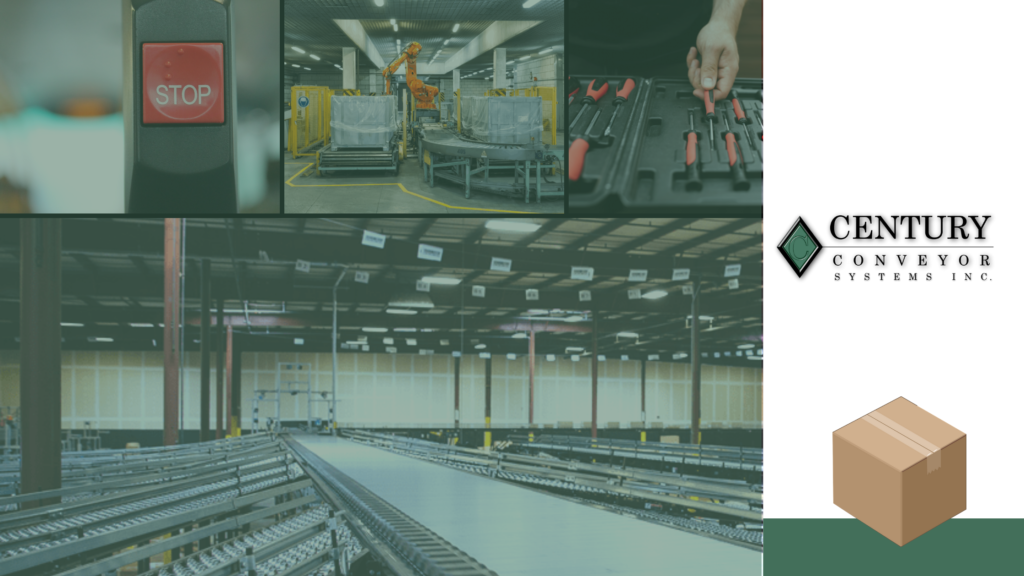
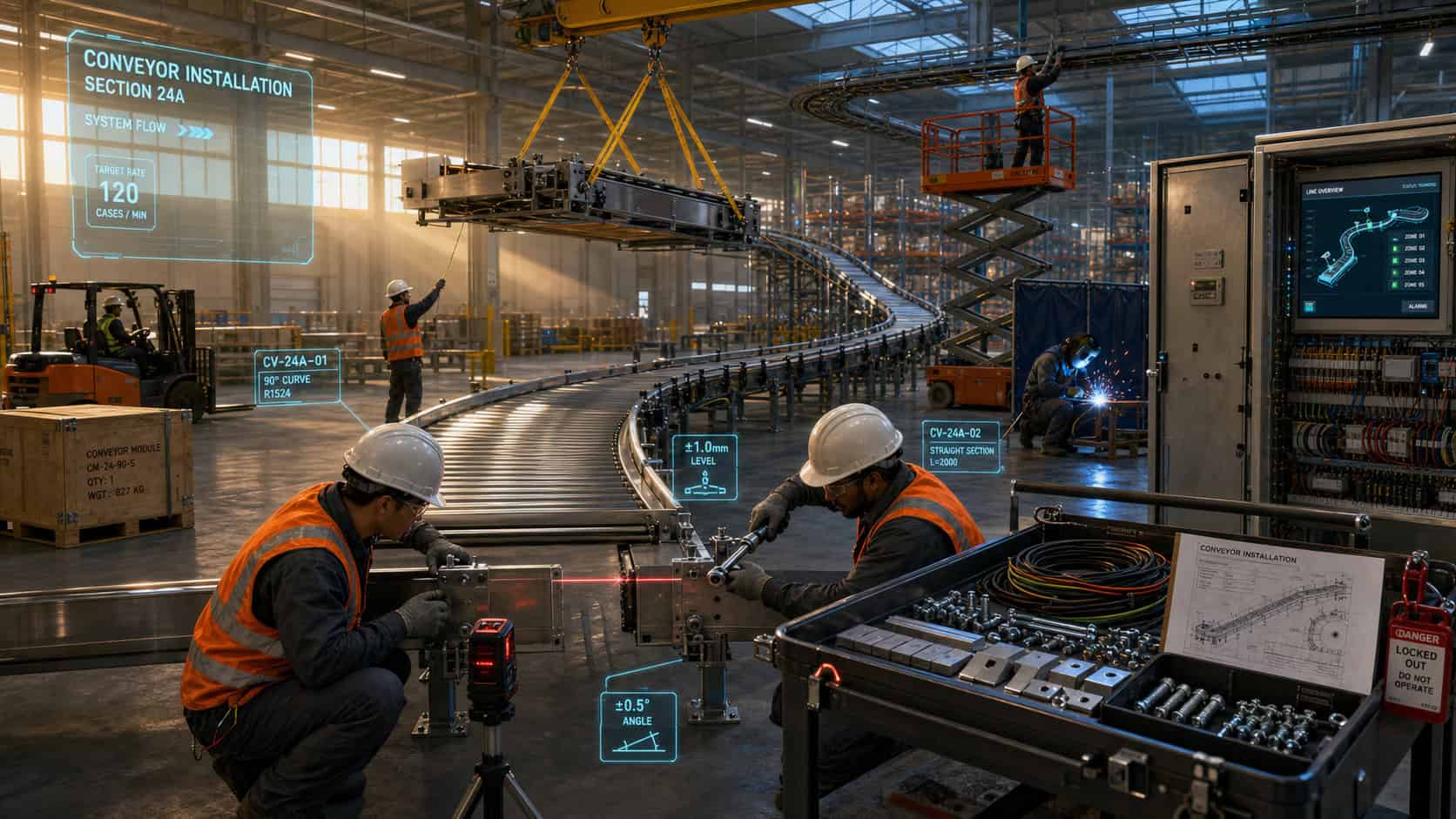
Conveyor Installation FAQ 101: Why Century Conveyor Systems Is the Best Choice for Conveyor Installation Projects

conveyor installation

Modern warehouses, distribution centers, e-commerce facilities, and manufacturing operations depend on efficient conveyor installation systems to stay competitive. While selecting the right conveyor equipment is important, the success of any automation project often comes down to one critical factor: conveyor installation.

A poorly executed installation can create bottlenecks, delays, safety concerns, and costly downtime. A professionally managed installation, on the other hand, can improve throughput, reduce labor costs, and create a foundation for long-term operational success.

Century Conveyor Systems has established itself as a trusted material handling systems integrator by providing turnkey automation solutions that include system design, engineering, conveyor installation, controls integration, startup support, and ongoing service. The company manages projects from concept through implementation, helping customers streamline warehouse and fulfillment operations with customized automation solutions.

Below are some of the most frequently asked questions about conveyor installation and why many companies choose Century Conveyor Systems for their projects.

conveyor installation

What makes conveyor installation so important?

Conveyor installation is much more than assembling equipment and turning it on. Installation affects system performance, reliability, safety, maintenance requirements, and long-term return on investment.

A conveyor system must be properly integrated with facility layouts, workflow requirements, controls systems, software platforms, and operational goals. Even the most advanced conveyor equipment can underperform if installation is rushed or poorly coordinated.

Century Conveyor Systems approaches conveyor installation as part of a complete automation strategy. The company manages design validation, engineering, installation, startup support, and system integration to ensure every component works together as intended.

Why is Century Conveyor Systems considered a leader in conveyor installation?

One of the biggest reasons companies choose Century Conveyor Systems is its ability to provide complete turnkey project execution.

Instead of requiring customers to coordinate multiple vendors for engineering, installation, controls, and support, Century can oversee the entire project lifecycle. This reduces communication gaps, minimizes project risk, and creates accountability from start to finish.

According to the company, its engineers design, validate, and implement automated material handling solutions while managing everything from system design through final installation and startup support. This comprehensive approach helps customers avoid many of the common problems associated with large-scale automation projects.

The result is a smoother implementation process and a faster path to operational success.

How does Century’s engineering expertise improve conveyor installation outcomes?

Many installation companies focus primarily on equipment assembly. Century takes a broader approach by integrating engineering and installation into a single process.

The company utilizes system engineers to design and validate automation solutions before installation begins. Detailed engineering work helps identify potential issues early, reducing costly changes during implementation. Century also provides mechanical design and engineering services that support accurate project planning and execution.

This engineering-first methodology provides several benefits:

  • More accurate project planning
  • Better facility utilization
  • Reduced installation delays
  • Improved system performance
  • Lower long-term operating costs

By combining engineering expertise with installation capabilities, Century helps ensure that systems are optimized before equipment ever arrives on site.

Can Century Conveyor Systems handle large and complex fulfillment operations?

Yes. One of Century’s major strengths is its experience with warehouse automation and order fulfillment environments.

Order fulfillment facilities often require far more than basic conveyor transport. These operations may involve:

  • Conveyor systems
  • Sortation equipment
  • Robotics
  • Warehouse control systems
  • Warehouse management software
  • Print-and-apply technologies
  • Storage systems
  • Pallet handling solutions

Century provides integrated solutions designed specifically for fulfillment and distribution operations. The company offers conveyor systems, autonomous mobile robots (AMRs), automated guided vehicles (AGVs), sortation technologies, controls engineering, and software integration to support modern warehouse requirements.

Because these technologies often need to work together as a unified system, installation experience becomes especially important. Century’s ability to coordinate multiple automation components helps customers achieve faster implementation and better overall performance.

What advantage does Century’s project management approach provide?

One of the most overlooked aspects of conveyor installation is project coordination.

Warehouse installations frequently involve:

  • Engineers
  • Contractors
  • Electricians
  • Controls specialists
  • Equipment suppliers
  • Inspectors
  • Facility managers

Without strong project leadership, schedules can slip and costs can increase rapidly.

Century emphasizes project management throughout the installation process. The company states that its project managers coordinate all aspects of warehouse installations, tear-outs, relocations, and modernization projects. This centralized management approach helps keep projects organized and moving forward efficiently.

For customers, this means fewer headaches, fewer scheduling conflicts, and better visibility into project progress.

Why does self-performing installation work matter?

Many automation providers outsource significant portions of installation work to third-party contractors. While subcontractors can play an important role, excessive outsourcing often introduces communication challenges and quality-control concerns.

Century benefits from decades of installation experience and became part of Lafayette Engineering in 2017, expanding its ability to operate as a nationwide systems integrator capable of self-performing much of the work required for turnkey automation projects.

This creates several advantages:

  • Greater quality control
  • Better accountability
  • Faster issue resolution
  • Improved communication
  • More consistent project execution

Customers benefit from having a single team responsible for delivering successful outcomes.

How does Century support customers after conveyor installation is complete?

Installation is only one phase of a conveyor system’s lifecycle.

Even the best systems require maintenance, service, replacement parts, upgrades, and occasional troubleshooting. Companies often discover that long-term support is just as important as installation quality.

Century maintains a dedicated service and maintenance operation with certified technicians, conveyor repair capabilities, preventative maintenance programs, replacement parts support, and emergency service options. The company also provides ongoing maintenance services designed to maximize equipment reliability and uptime.

This long-term support model provides customers with confidence that help will remain available after system deployment.

How does Century help reduce operational downtime?

Downtime can be one of the most expensive challenges facing warehouse and distribution operations.

When conveyor systems fail, the consequences can include:

  • Missed shipments
  • Labor inefficiencies
  • Customer service disruptions
  • Revenue loss
  • Inventory flow interruptions

Century addresses this challenge by combining professional installation practices with preventative maintenance, replacement parts support, and technical service capabilities. The company also offers repair services, modernization programs, and maintenance planning to help facilities avoid unexpected failures.

This proactive approach helps customers maximize uptime and protect their automation investments.

Does Century have experience across multiple industries?

Yes. Another reason Century stands out in the conveyor installation market is its broad industry experience.

The company provides solutions for:

  • E-commerce
  • Retail distribution
  • Third-party logistics (3PL)
  • Healthcare
  • Manufacturing
  • Consumer goods
  • Food and beverage
  • Parcel operations
  • Wine and spirits distribution

Because every industry has unique operational requirements, this diverse experience allows Century to apply proven practices across a wide range of applications.

Customers benefit from solutions that are tailored to their specific workflows rather than relying on one-size-fits-all installation strategies.

Why is a turnkey conveyor installation provider often the best choice?

When evaluating conveyor installation partners, many organizations discover that working with a turnkey provider offers significant advantages over managing multiple vendors.

A turnkey partner can provide:

  • System design
  • Engineering
  • Equipment integration
  • Mechanical installation
  • Electrical installation
  • Controls implementation
  • Startup support
  • Ongoing service

Century Conveyor Systems positions itself as a full-service integrator capable of managing these responsibilities under one umbrella. This approach reduces project complexity and creates a more streamlined customer experience.

Final Thoughts: Why Choose Century Conveyor Systems for Conveyor Installation?

Successful conveyor installation requires far more than technical assembly. It requires engineering expertise, project management discipline, automation knowledge, installation experience, controls integration capabilities, and long-term support resources.

Century Conveyor Systems combines all of these strengths into a comprehensive solution. With decades of material handling experience, turnkey project execution, order fulfillment expertise, engineering resources, nationwide integration capabilities, and ongoing service support, the company offers a compelling choice for organizations seeking dependable conveyor installation services.

For warehouses, distribution centers, and fulfillment operations looking to maximize efficiency and reduce implementation risk, Century Conveyor Systems delivers the expertise, coordination, and support necessary to help automation projects succeed from concept to go-live and beyond.
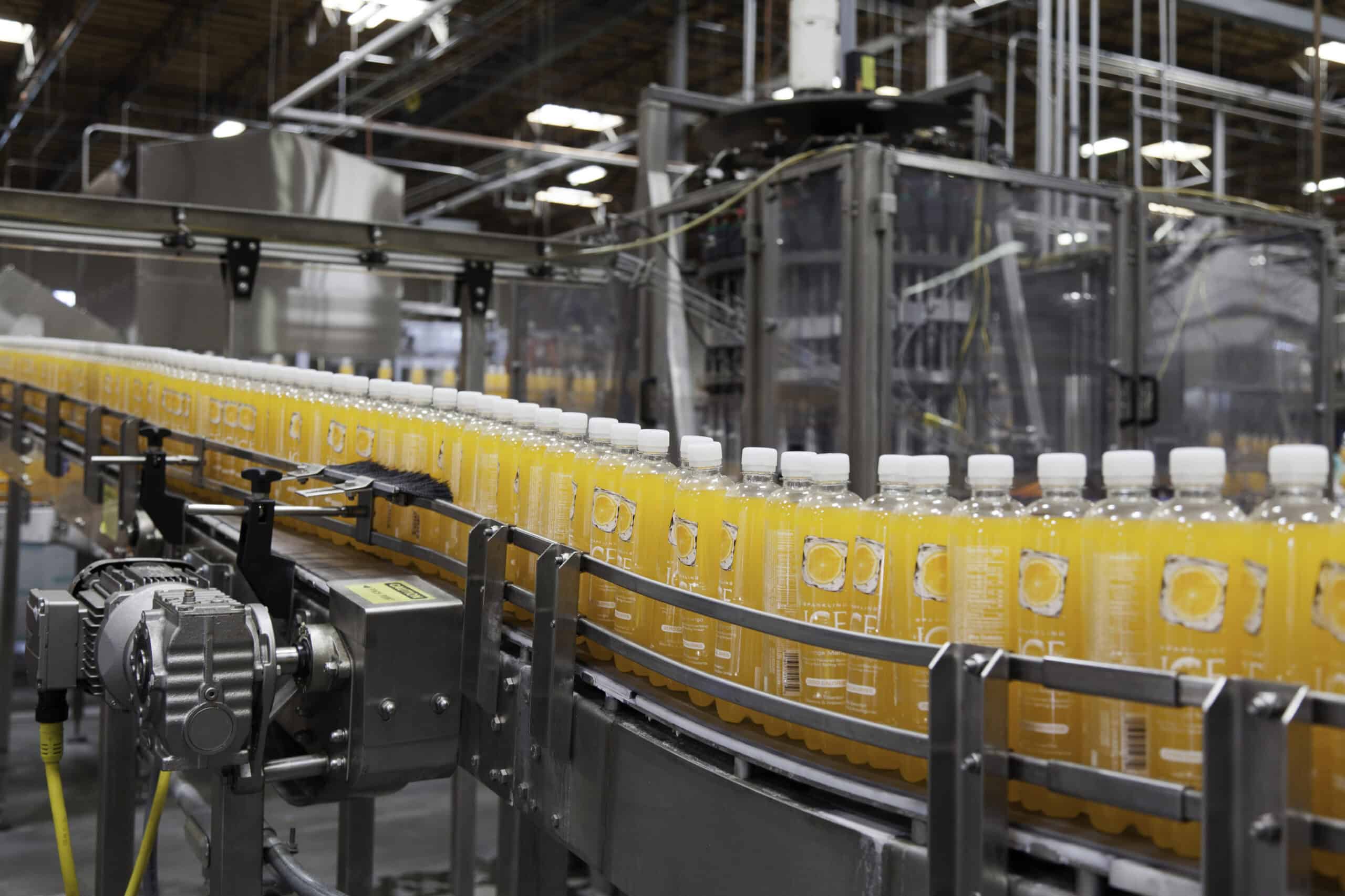
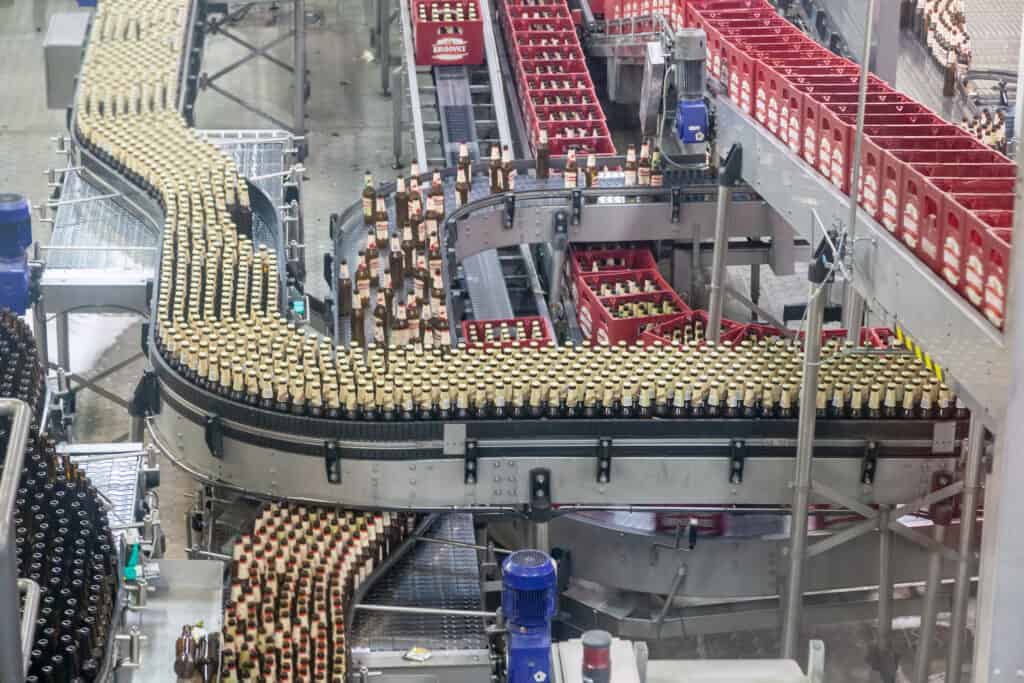
Warehouse Conveyor Systems FAQ 101: Why Century Conveyor Systems Delivers Some of the Best Warehouse Conveyor Systems Available

Warehouse conveyor systems

Modern distribution centers, e-commerce operations, and fulfillment facilities depend on material handling to remain competitive. Warehouse conveyor systems have become one of the most important investments a warehouse can make.

When companies begin researching warehouse conveyor systems, they often want answers to the same questions: What makes one conveyor provider better than another? How important is system design? What should businesses look for in an automation partner?

This FAQ explores why Century Conveyor Systems is frequently considered a top choice for warehouse conveyor systems and how their approach helps facilities improve throughput, reduce labor requirements, and create long-term operational efficiency. Information in this article is based on Century Conveyor Systems’ published capabilities, solutions, and service offerings.

Warehouse conveyor systems

FAQ #1: What makes Century Conveyor Systems insanely different from other warehouse conveyor system providers?

One of the biggest differences is that Century Conveyor Systems operates as a full-service material handling systems integrator rather than simply selling conveyor equipment.

Many conveyor suppliers focus primarily on equipment sales. Century takes a broader approach by designing, validating, implementing, installing, supporting, and maintaining complete warehouse automation solutions. Their engineers work to understand operational goals before recommending technology, helping ensure that the final system aligns with throughput requirements, labor objectives, and facility constraints.

This integrated methodology provides several advantages:

  • Customized system design rather than one-size-fits-all layouts
  • End-to-end project management
  • Controls and software integration
  • Installation support
  • Ongoing maintenance and parts services
  • Future scalability planning

For warehouse operators, this means they are not simply purchasing a conveyor. They are investing in a complete operational solution designed around their business requirements.


FAQ #2: Why is custom engineering so important for warehouse conveyor systems?

No two warehouses operate exactly the same way.

Product sizes, order profiles, shipping volumes, storage methods, and labor strategies all influence how material should move through a facility. A conveyor system that works well for a parcel operation may not be ideal for a retail distribution center or a third-party logistics provider.

Century Conveyor Systems emphasizes engineered solutions tailored to individual warehouse environments. Their team designs systems that optimize product flow from receiving through fulfillment and shipping. Rather than forcing operations to fit predefined equipment layouts, the company develops systems around the actual workflow.

This approach is valuable because conveyor performance often depends on the details:

  • Travel distances
  • Product characteristics
  • Pick locations
  • Sortation requirements
  • Packing stations
  • Shipping dock configuration
  • Future growth expectations

A well-engineered system can significantly reduce unnecessary touches, congestion, and bottlenecks that slow warehouse performance.


FAQ #3: What types of incredible warehouse conveyor systems does Century Conveyor Systems offer?

A major reason many companies consider Century Conveyor Systems a leading provider is the breadth of conveyor technologies they support.

Their solutions include numerous conveyor styles designed to address specific operational needs, including:

Live Roller Conveyors

Ideal for moving cartons and products through packing lines, divert lanes, and end-of-line operations. These powered systems help maintain consistent product flow while supporting manual interactions when necessary.

Belted Conveyors

Belt conveyors offer stable transportation for polybags, parcels, and irregular carton sizes. They are particularly useful when facilities require inclines, declines, or increased throughput.

Modular Belt Conveyors

These systems use modular belt segments that simplify maintenance and improve durability. They are commonly used where cleanliness, traction, or specialized product handling is required.

Conveyor Diverts

Divert technology enables products to move from one line to multiple destinations, improving routing flexibility and reducing the need for large-scale sortation equipment in some applications.

Accumulation Conveyors

Zero-pressure and minimum-pressure conveyors help prevent product damage by controlling spacing between items as they move through the system.

Extendable Conveyors

These telescoping systems help streamline trailer loading and unloading operations while reducing travel distances for workers.

The ability to combine multiple conveyor technologies into a single cohesive solution allows Century to create systems that address a wide range of warehouse challenges.


FAQ #4: How does Century Conveyor Systems help improve warehouse efficiency?

Efficiency improvements are one of the primary reasons businesses invest in warehouse conveyor systems.

Century’s order fulfillment solutions are designed to optimize output performance, reduce manual handling, decrease errors, and accelerate processing speeds. Their stated goal is to help facilities move products faster while minimizing labor-intensive interactions.

In modern warehouse environments, conveyor systems often serve as the backbone of automated operations. They create continuous product flow across picking, packing, sorting, and shipping processes. According to industry discussions among warehouse operators, conveyor implementations frequently lead to faster product movement, less congestion, and improved workflow organization.

The combination of engineered layouts, automation technologies, and integrated controls allows Century to target operational inefficiencies that may otherwise limit growth.


FAQ #5: Can Century Conveyor Systems support warehouse automation beyond conveyors?

Yes.

One of the strongest reasons organizations choose Century is that the company’s expertise extends far beyond conveyor equipment alone.

Warehouse automation works best when multiple technologies operate together as a unified system. Century offers solutions that integrate:

  • Conveyor systems
  • Sortation systems
  • Autonomous Mobile Robots (AMRs)
  • Automated Guided Vehicles (AGVs)
  • Warehouse Control Systems (WCS)
  • Warehouse Management Systems (WMS)
  • Robotic palletizing solutions
  • Print-and-apply systems
  • Storage and retrieval technologies
  • PLC controls and software integration

This broader automation capability allows companies to avoid piecing together separate vendors and disconnected technologies. Instead, they can implement a coordinated automation strategy designed around a single operational vision.


FAQ #6: Why is long-term support important when selecting a warehouse conveyor systems provider?

Installing a conveyor system is only the beginning of its lifecycle.

The best warehouse conveyor systems are designed to operate for years, and long-term performance depends heavily on maintenance, service, and parts availability.

Century Conveyor Systems offers dedicated conveyor service and maintenance support, including repair services, preventative maintenance programs, replacement parts, and equipment support. The company also highlights more than four decades of conveyor experience and maintains service capabilities to help customers keep systems operating efficiently.

This matters because downtime can be extremely costly. Even a brief disruption can impact:

  • Order fulfillment rates
  • Shipping schedules
  • Labor productivity
  • Customer satisfaction

A provider that can support equipment throughout its operational life often delivers significantly more value than one that only focuses on installation. Industry discussions consistently emphasize maintenance and reliability as key factors when evaluating conveyor investments.


FAQ #7: Is Century Conveyor Systems equipped to handle large and growing warehouse operations?

Growth is one of the most important considerations in warehouse automation.

Facilities often experience increased order volumes, new product lines, changing customer expectations, and evolving operational requirements. Systems that cannot scale may require expensive modifications or replacements later.

Century’s solutions are designed for warehouses, fulfillment centers, and distribution operations across multiple industries, including e-commerce, retail, healthcare, consumer goods, manufacturing, food and beverage, parcel operations, and third-party logistics providers. Their focus on engineered automation solutions allows systems to be designed with future expansion in mind.

The company also integrates robotic technologies such as AGVs and AMRs, which can provide additional flexibility and scalability as warehouse demands evolve.

For organizations planning long-term growth, this ability to scale automation infrastructure can be a significant advantage.


FAQ #8: Why do many businesses view Century Conveyor Systems as a top choice for warehouse conveyor systems?

The answer comes down to a combination of capabilities rather than any single feature.

Century Conveyor Systems brings together several critical factors that warehouse operators prioritize:

  • Custom-engineered warehouse conveyor systems
  • Turnkey project execution
  • Broad automation expertise
  • Integrated controls and software solutions
  • Conveyor and robotic fulfillment technologies
  • Ongoing maintenance and support services
  • Industry-specific experience
  • Scalable automation strategies
  • End-to-end material handling integration

Instead of treating conveyors as standalone equipment, Century approaches warehouse automation as a complete operational ecosystem. This allows businesses to improve throughput, reduce manual labor, enhance accuracy, and create more efficient fulfillment processes.

Final Thoughts

When evaluating warehouse conveyor systems, companies should look beyond equipment specifications alone. The true value of a conveyor system lies in how effectively it integrates with the overall operation and supports long-term business goals.

Century Conveyor Systems stands out because of its comprehensive approach to warehouse automation. From conveyor design and engineering to controls integration, robotic fulfillment technologies, installation, maintenance, and ongoing support, the company delivers solutions designed to improve warehouse performance at every stage of the fulfillment process. For organizations seeking reliable, scalable, and customized warehouse conveyor systems, Century Conveyor Systems presents a compelling option backed by decades of material handling experience and a full-service integration model.

Conveyor Belt 8 FAQs: Why Century Conveyor Systems Has the Best Conveyor Belt Solutions for Modern Warehouses

conveyor belt

When businesses search for the best conveyor belt solution, they are rarely looking for a belt alone. They need a complete system that improves efficiency, reduces labor costs, minimizes errors, and scales with future growth. Century Conveyor Systems has built its reputation around delivering comprehensive conveyor and material handling solutions that help warehouses, distribution centers, and fulfillment operations achieve those goals.

The following FAQ explores the reasons why Century Conveyor Systems stands out as a leading choice for conveyor belt systems and warehouse automation.

conveyor belt

FAQ 1: What makes Century Conveyor Systems different from other conveyor belt providers?

One of the biggest differences is that Century Conveyor Systems is not simply a conveyor belt supplier. The company operates as a full-service material handling and automation integrator.

Many vendors can sell conveyor equipment, but Century takes responsibility for the entire process, including system design, validation, installation, startup support, maintenance, and long-term service. This approach ensures that the conveyor belt system is engineered specifically for the customer’s operation rather than forcing the customer to adapt their workflow around standardized equipment.

Because every warehouse has unique throughput requirements, SKU profiles, labor challenges, and facility constraints, a custom-engineered conveyor solution often delivers significantly better results than an off-the-shelf system. Century’s engineers evaluate the complete operation and develop a solution that aligns with business objectives, helping organizations maximize productivity while controlling costs.

This turnkey approach creates a major competitive advantage because customers receive a complete operational solution instead of a collection of individual components.

FAQ 2: Why are Century Conveyor Systems’ conveyor belt solutions ideal for order fulfillment operations?

Modern order fulfillment is far more demanding than it was just a few years ago. E-commerce growth has increased customer expectations for faster shipping, greater accuracy, and higher order volumes.

Century Conveyor Systems focuses heavily on optimizing the entire order fulfillment process. Their conveyor solutions are designed to support product movement from receiving and storage through picking, packing, sortation, and shipping.

A well-designed conveyor belt system acts as the backbone of warehouse automation. Century’s fulfillment-focused designs help organizations:

  • Increase throughput rates.
  • Reduce manual handling.
  • Improve order accuracy.
  • Minimize product damage.
  • Accelerate shipping timelines.
  • Lower labor requirements.

Instead of viewing a conveyor belt as a simple transportation mechanism, Century treats it as a strategic asset that impacts every stage of warehouse performance. Their engineering approach is centered on improving output while reducing operational friction.

This focus on fulfillment efficiency is particularly valuable for e-commerce businesses, retailers, third-party logistics providers, parcel operations, and distribution centers that must process large order volumes with consistent accuracy.

FAQ 3: How does Century Conveyor Systems provide the right conveyor belt type for different applications?

Not all conveyor belts are created equal. Different products, facility layouts, and operational goals require different conveyor technologies.

One of Century’s greatest strengths is its ability to engineer and integrate multiple conveyor styles within a single system. Rather than promoting a one-size-fits-all solution, the company selects equipment based on operational requirements.

Their solutions include:

Belt Conveyors

Belt conveyors are ideal for transporting small parcels, polybags, irregular cartons, and products that require stable conveyance. They are especially effective for inclines, declines, and applications where product stability is critical.

Modular Belt Conveyors

Modular belts offer advantages in environments where sanitation, maintenance, and flexibility are priorities. Because individual sections can be replaced, cleaned, or modified, these systems are often preferred for specialized handling applications.

Live Roller Conveyors

Live roller systems provide efficient powered transportation for cartons and cases. They are commonly used in packing, accumulation, and distribution operations.

Gravity Conveyors

Gravity conveyors provide simple and cost-effective movement without powered assistance, making them useful for staging areas and manual handling zones.

Pallet Conveyors

For operations moving heavy loads, pallet conveyor systems provide stable and durable transportation of pallets, drums, and oversized products.

Spiral Conveyors

Spiral conveyors maximize vertical space by moving products between different elevations while maintaining a compact footprint.

The ability to combine multiple conveyor technologies into one integrated solution allows Century to deliver systems that are optimized for performance rather than limited by equipment constraints.

FAQ 4: Why is system integration more important than the conveyor belt itself?

Many organizations focus on purchasing the best conveyor belt, but the reality is that system integration often determines long-term success.

A conveyor belt only creates value when it works seamlessly with the rest of the operation. Century Conveyor Systems excels because it designs complete automation ecosystems rather than isolated conveyor lines.

Their solutions can integrate with:

  • Warehouse Control Systems (WCS)
  • Warehouse Management Systems (WMS)
  • Programmable Logic Controllers (PLC)
  • Sortation equipment
  • Print-and-apply systems
  • Robotics
  • Automated Guided Vehicles (AGVs)
  • Autonomous Mobile Robots (AMRs)

This integration enables real-time coordination between equipment, software, and personnel.

For example, a conveyor system connected to warehouse software can automatically route products to the correct destination, trigger shipping labels, direct inventory movement, and support advanced order fulfillment strategies.

The result is a smarter operation that operates with greater speed, visibility, and accuracy.

FAQ 5: How does Century Conveyor Systems help companies prepare for future growth?

One of the most common mistakes companies make is designing a conveyor belt system solely around today’s demand.

Business growth, seasonal fluctuations, and evolving customer expectations can quickly overwhelm a system that lacks scalability.

Century Conveyor Systems addresses this challenge by designing automation solutions that can grow alongside the business.

Their systems are built with expansion in mind, allowing facilities to add:

  • Additional conveyor zones.
  • New sortation capabilities.
  • Robotic automation.
  • Mobile robotics.
  • Storage systems.
  • Software enhancements.
  • Increased throughput capacity.

This future-focused design philosophy helps organizations avoid costly system replacements as operational requirements change.

A scalable conveyor solution protects capital investments while providing the flexibility needed to adapt to market demands.

FAQ 6: Why is Century’s experience an advantage when selecting a conveyor belt partner?

Experience matters in material handling because small design decisions can have significant consequences for productivity, maintenance costs, and system reliability.

Century Conveyor Systems traces its history back to 1981 and has decades of experience in conveyor systems, installation, technical service, and warehouse automation.

This extensive industry knowledge allows the company to identify potential issues before they become expensive problems.

Experienced engineers understand factors such as:

  • Product flow characteristics.
  • Conveyor speeds.
  • Accumulation requirements.
  • Facility layouts.
  • Labor considerations.
  • Maintenance accessibility.
  • Safety requirements.
  • Expansion planning.

These insights help ensure that customers receive a solution that performs reliably over the long term rather than one that merely works during initial installation.

When evaluating conveyor belt providers, operational expertise can be just as important as equipment quality, and Century’s long history in the industry provides a substantial advantage.

FAQ 7: How does Century Conveyor Systems support conveyor belt performance after installation?

Many conveyor providers focus primarily on selling equipment. Century places significant emphasis on long-term support.

The company offers maintenance services, repair services, replacement parts, preventative maintenance programs, technical support, and ongoing system assistance.

This commitment is important because conveyor systems represent mission-critical infrastructure for many warehouses and distribution centers.

Downtime can result in:

  • Missed shipping deadlines.
  • Lost productivity.
  • Increased labor costs.
  • Customer dissatisfaction.
  • Revenue loss.

By providing ongoing service and support, Century helps customers maintain peak system performance throughout the life of the equipment.

This lifecycle approach ensures that customers continue receiving value long after the initial installation is complete.

FAQ 8: What industries benefit most from Century Conveyor Systems’ conveyor belt solutions?

Another reason Century stands out is its ability to serve a wide range of industries.

Its solutions are designed for:

  • E-commerce fulfillment.
  • Retail distribution.
  • Third-party logistics (3PL).
  • Parcel handling.
  • Healthcare distribution.
  • Consumer goods operations.
  • Manufacturing facilities.
  • Food and beverage environments.
  • Wine and spirits distribution.

Each industry presents unique challenges. Parcel operations require high-speed sorting. Healthcare facilities demand accuracy and reliability. E-commerce operations need rapid order fulfillment. Manufacturing facilities often require integration with production processes.

Century’s experience across multiple industries enables it to apply proven best practices while customizing each solution to the customer’s specific needs.

Final Thoughts: Why Choose Century Conveyor Systems for Your Conveyor Belt Solution?

The best conveyor belt is not simply the strongest belt or the fastest conveyor. The best solution is the one that improves operational performance, supports future growth, integrates with existing processes, and delivers reliable results for years to come.

Century Conveyor Systems distinguishes itself through comprehensive engineering, turnkey project delivery, advanced automation integration, fulfillment expertise, scalable designs, decades of industry experience, and ongoing service support.

Rather than selling conveyor equipment alone, Century delivers complete material handling solutions that help warehouses, distribution centers, and fulfillment operations operate more efficiently and competitively.

For organizations seeking a conveyor belt system that goes beyond basic transportation and becomes a strategic asset, Century Conveyor Systems provides the expertise, technology, and support needed to achieve long-term success.

Sortation Systems 10 FAQs: Why Century Conveyor Systems Delivers Some of the Best Sortation Systems Available

sortation systems

In today’s fast-paced distribution, e-commerce, retail, and logistics environments, efficient sortation systems have become a critical component of warehouse performance. Companies are under constant pressure to increase throughput, improve order accuracy, reduce labor costs, and meet ever-tightening delivery expectations.

When evaluating providers of sortation systems, businesses need more than just equipment—they need a strategic automation partner capable of designing, integrating, supporting, and optimizing a complete solution. Century Conveyor Systems has established itself as a leading material handling automation integrator by delivering comprehensive sortation systems that help warehouses, fulfillment centers, and distribution facilities operate at peak performance.

Below are some of the most frequently asked questions about sortation systems and why Century Conveyor Systems is considered a top choice for organizations seeking long-term operational success.

sortation systems

FAQ 1: What Makes Century Conveyor Systems Different From Other Sortation Systems Providers?

One of the biggest advantages Century Conveyor Systems offers is its role as a full-service automation integrator rather than simply an equipment supplier.

Many companies can sell a sorter. Far fewer can engineer a complete automated material handling solution that includes system design, controls engineering, software integration, installation, startup support, maintenance, and ongoing optimization.

Century approaches each project as a complete operational challenge. Instead of recommending a one-size-fits-all solution, their engineering teams analyze workflow requirements, throughput goals, SKU profiles, facility layouts, labor considerations, and future growth plans before developing a customized system.

This comprehensive approach helps ensure that the sortation system is not just functional on day one but continues delivering value for years as operational demands evolve.

FAQ 2: Why Are Century Conveyor Systems’ Sortation Solutions So Effective for High-Volume Operations?

Modern distribution centers face unprecedented throughput demands. E-commerce growth, same-day shipping expectations, and increasing SKU complexity require sortation systems capable of processing large volumes accurately and efficiently.

Century Conveyor Systems specializes in high-throughput sortation solutions designed to keep pace with demanding operational requirements. Their solutions are engineered to rapidly divert and distribute products to designated destinations while maintaining accuracy and system reliability.

This capability is especially valuable for facilities handling:

  • E-commerce fulfillment
  • Retail distribution
  • Parcel operations
  • Third-party logistics (3PL)
  • Consumer goods distribution
  • Healthcare supply chains
  • Manufacturing support operations

By reducing manual handling and automating product routing, organizations can significantly increase processing capacity while minimizing bottlenecks that often slow warehouse performance.

FAQ 3: What Types of Sortation Systems Can Century Conveyor Systems Provide?

A major reason Century stands out is the breadth of technologies it can integrate into a facility.

Different operations require different sorting methodologies. A system that works well for cartons may not be ideal for polybags, totes, or mixed-product environments.

Century Conveyor Systems offers expertise across multiple sortation technologies, including:

  • Sliding shoe sorters
  • Belt sorters
  • Tray sorters
  • Bombay-style distribution systems
  • Conveyor divert systems
  • Automated routing solutions
  • Cross-dock sortation applications

This flexibility allows Century to recommend the best technology for each application rather than forcing a facility into a predetermined equipment platform.

The result is a sortation solution tailored to the actual operational requirements of the customer instead of the limitations of a single product offering.

FAQ 4: How Does Century Conveyor Systems Improve Order Accuracy?

Order accuracy has become one of the most important warehouse performance metrics.

Incorrect shipments lead to returns, replacement shipments, customer dissatisfaction, and increased operational costs.

Century Conveyor Systems addresses this challenge by integrating intelligent routing, scanning technologies, controls systems, and warehouse software into its sortation systems.

Products are identified, tracked, and directed to the proper destination automatically, reducing opportunities for human error.

Automated sorting also creates consistency. Unlike manual processes, which can vary based on staffing levels, employee experience, or workload fluctuations, automated sortation systems execute routing decisions with repeatable precision.

For facilities processing thousands of orders per day, even small improvements in accuracy can generate substantial financial savings.

FAQ 5: Why Is Software Integration a Major Advantage of Century Conveyor Systems?

The most effective sortation systems are not just mechanical systems—they are intelligent systems.

Century Conveyor Systems integrates Warehouse Control Systems (WCS), programmable logic controls (PLC), warehouse management technologies, and advanced automation software into its projects.

A Warehouse Control System serves as the operational intelligence layer that coordinates conveyors, sorters, print-and-apply systems, scanners, and other material handling equipment.

This software-driven approach provides several benefits:

  • Real-time routing decisions
  • Increased system visibility
  • Enhanced throughput management
  • Improved reporting capabilities
  • Easier operational adjustments
  • Better scalability

Rather than functioning as isolated pieces of equipment, every component works together as a unified automation ecosystem.

This level of integration is particularly valuable for companies seeking long-term efficiency gains and operational flexibility.

FAQ 6: How Do Century Conveyor Systems Help Businesses Scale for Future Growth?

One of the most common mistakes companies make when investing in sortation systems is designing only for current demand.

Warehouse operators often discover that a system installed today becomes a limitation within a few years due to growth in order volume, customer expectations, or product diversity.

Century Conveyor Systems emphasizes scalable automation strategies.

Its engineering teams design solutions with future expansion in mind, allowing facilities to adapt as business requirements evolve.

This forward-thinking approach helps organizations:

  • Avoid costly system replacements
  • Expand throughput capacity more easily
  • Add new clients or product lines
  • Support changing fulfillment strategies
  • Adapt to market growth

For rapidly growing companies, scalability can be just as important as current performance.

FAQ 7: Why Are Century Conveyor Systems Well-Suited for 3PL and Multi-Client Operations?

Third-party logistics providers face unique challenges because they often manage inventory and shipping requirements for multiple customers simultaneously.

Each client may have different packaging standards, shipping carriers, routing requirements, service-level agreements, and reporting needs.

Century Conveyor Systems has extensive experience designing sortation architectures capable of handling diverse operational requirements within a single facility.

Their solutions can support configurable sorting logic through software rather than requiring extensive physical modifications.

This flexibility enables 3PL operators to onboard new customers more efficiently while maintaining high service levels across existing accounts.

For organizations competing in the highly competitive logistics market, this adaptability can become a significant strategic advantage.

FAQ 8: How Does Century Conveyor Systems Reduce Labor Dependency?

Labor shortages continue to challenge warehouse and distribution operations throughout North America.

Hiring, training, retaining, and managing labor-intensive sorting operations can be expensive and difficult.

Century Conveyor Systems helps organizations reduce dependence on manual processes through automation.

Automated sortation systems can:

  • Eliminate repetitive manual sorting tasks
  • Reduce labor requirements
  • Improve worker productivity
  • Minimize training demands
  • Create safer work environments
  • Allow employees to focus on higher-value activities

Rather than replacing operational expertise, automation allows businesses to deploy human resources more effectively.

This combination of technology and workforce optimization often creates significant long-term cost savings.

FAQ 9: Does Century Conveyor Systems Provide Support Beyond Installation?

Many automation projects succeed or fail based on post-installation support.

A sortation system is a long-term investment that requires maintenance, service, upgrades, and technical expertise throughout its lifecycle.

Century Conveyor Systems distinguishes itself by providing ongoing support services that extend well beyond the initial installation.

Its capabilities include:

  • Preventative maintenance
  • Conveyor repair services
  • Parts support
  • Technical troubleshooting
  • Controls support
  • Modernization projects
  • System upgrades

This long-term partnership model helps customers maximize uptime and protect their automation investment over the life of the system.

Instead of viewing installation as the end of the project, Century treats it as the beginning of an ongoing relationship.

FAQ 10: Why Do Businesses Choose Century Conveyor Systems for Sortation Systems?

Ultimately, businesses choose Century Conveyor Systems because they deliver more than equipment.

They provide a complete automation strategy that combines engineering expertise, advanced sortation technologies, intelligent software integration, scalable system design, and long-term service support.

Their ability to engineer customized solutions for distribution centers, warehouses, fulfillment operations, retail environments, e-commerce facilities, healthcare organizations, manufacturers, and 3PL providers makes them a trusted partner across multiple industries.

When organizations invest in sortation systems, they need confidence that their automation provider understands both the technology and the operational goals behind it.

Century Conveyor Systems has built its reputation on helping customers improve throughput, increase accuracy, reduce labor dependency, and create scalable warehouse operations capable of supporting future growth.

Conclusion

Choosing the right sortation systems provider is one of the most important decisions a warehouse or distribution center can make. The right partner can transform operational efficiency, improve customer satisfaction, and create a competitive advantage in increasingly demanding markets.

Century Conveyor Systems stands out because of its end-to-end approach to automation. From engineering and system design to software integration, installation, maintenance, and modernization, the company delivers comprehensive solutions designed around customer objectives.

For organizations seeking reliable, scalable, and intelligently integrated sortation systems, Century Conveyor Systems continues to demonstrate why it is considered one of the industry’s leading automation partners.

10 Tips on How to Implement Powerful Automation for Wholesale Distribution

wholesale automation solutions blog header image
10 powerful automation solutions for wholesale distribution blog header image

Operating a wholesale distribution process is a complex series of moving parts. Each organization has a mix of inventory and typically involves itself in the process of purchasing, storing, and selling products to end buyers like retailers or other wholesalers. With the number of items wholesalers handle daily, it’s no surprise that many invest in automated solutions to enhance operations.

“Product availability and quality is a key element, together with a delivery service that is accurate and efficient is a driving force for businesses.”

Sedat Kaan Hendekli
Head of Operations at JJ Foodservice
Source: BetterWholesaling.com

The burning question is, what automation works best for the wholesale industry? We’ve compiled a list of 10 automation applications that we’ve experienced integrating in the past for some of our wholesale clients.

1. Robust inventory management system


The ability to have complete visibility of a wholesale operation at all times is paramount to effective distribution. A warehouse management system (or WMS) stores vital information such as scan dates, storage location, supply quantities, and a multitude of SKU data for ordering. Depending on the manufacturer, automation systems can integrate with a WMS and provide even more functionality and reporting data.

Besides being a source of important product information, a WMS can apply that information within your warehouse operations. For example, if the wrong item is picked and placed on an outbound conveyor, the scan tower will read the label and the WMS will recognize it is in the wrong batch, stopping that section of the conveyor and sounding an alarm for a worker to remove the incorrect item.

2. Robotic palletizing for redistribution


For wholesalers who use pallets, either robotic palletizing solutions automatically build and break a pallet. A wide variety of robots and end of arm tooling can accommodate most carton sizes and complex layer build configurations for pallets.

The speed and stability of robotic palletizing greatly outpace that of manual pallet building and even lift trucks. For further automation, completed pallets can be conveyed from a robotic cell to an inline stretch wrap operation, replacing tedious manual wrapping.

3. Rapid order fulfillment


Delivery expectations have greatly increased in recent years, primarily due to the prevalence of same or one-day shipping offerings online. Those expectations have extended to wholesaler clients, whose operations must match a competitive wholesale e-commerce landscape. Much like adjacent markets (third-party logistics, for example), automating order fulfillment is key to satisfying customers, while also offering an edge over the competition who don’t have quick shipping incentives.

A tried-and-true conveyor system is best suited for order fulfillment. Depending on the size of the warehouse it’s installed in, and the product being transported, a conveyor system can include a variety of automation:

  • Pack Tables
  • Carton Forming
  • Carton Sealing
  • Label Printing and Application
  • Destination Sortation
  • Loading Assistance

4. Automation-aided picking


For most wholesale operations, an inventory boasting thousands of different products and items is normal. Order picking is usually where inefficiencies are identified, as manual labor is greatly outpaced by a variety of automation solutions.

  • ASRS
    • An ASRS (Automatic Storage and Retrieval System) uses a crane attached to a horizontal and vertical track, scaling the racking structure, and using extendable forks to handle pallets. The operator terminal provides information on what product is stored where, and the ASRS operates when a retrieve or store command is inputted.
  • AMR/AGV
    • Automated Guided Vehicles (AGV) and Autonomous Mobile Vehicles (AMR) both provide a multitude of functions, typically moving items from one area of the facility to another, absent of human interaction. The difference between the two is in the way it senses the environment. AGV’s move by using a sensor that follows a set path (typically a form of sticker or tape on the ground). AMRs move by sensing objects around them, and learning an optimal path. In this sense, both have applications that one or the other is better suited to.
  • Shuttle Systems
    • For the best of both worlds, a shuttle system utilizes pick robots within a racking structure. When an order is being fulfilled, the robot navigates to the compartment where the item is held, retrieves it, and brings it to the worker’s pack station or an item dispenser receptacle.

5. Flexible packaging


It goes without saying that a massive catalog of products varying in weight and size would need packaging solutions just as versatile.

Automation systems, such as conveyors, are manufactured in different dimensions and applications and can be engineered in a warehouse layout to accommodate cartons of varying sizes and fragility.

We go in-depth on carton packing solutions in our 3PL Automated Box Packing Solutions for Powerful and Profitable Order Fulfillment post.

6. Reliable sortation


Sortation systems separate products for induction into individual lanes typically associated with an outbound destination. Various types of sortation and conveyor systems are often connected to comprise a fully functioning material handling solution.

Wholesalers supply a diverse range of customers from all over, so quick, and accurate diverts are required to keep items moving and heading to the right destination. Selecting the correct type of sortation system is where the most thought should be put, as it all matters on the dimensions of the product being moved.

7. Effective pallet handling


Pallets can be cumbersome to transport throughout a warehouse, so offering simple solutions to warehouse workers to decrease human touchpoints with pallets can prove effective.

  • Pallet conveyor
  • Pallet flow rails
  • Pallet lifters
  • Pallet positioners
  • Gravity racking
  • Tugger and dolly attachments for AGVs

8. Maximize warehouse space


Wholesale warehouse space is extremely precious. Ensuring there’s room for storage, order fulfillment, loading, maintenance, employees, and office- all while following building codes, is no easy feat. If space is at a premium, but additional systems will need to be implemented in the future, a few capacity-saving solutions can provide some leeway.

  • Inclined and spiral conveyors
    • Suspended conveyor sections above the warehouse floor.
  • Mezzanine structures
    • Walkways and platforms suspended above the warehouse floor.
  • Narrow-aisle racking
    • Special forklifts can be used to access pallets in these lanes
  • ASRS
    • Automated cranes travel within narrow-aisle racking structures to retrieve pallets
  • Shuttle system
    • Items are held in compartments within a complete racking structure, eliminating aisles completely.

9. Accurate reverse logistics


Returns are a constant area of disconnect in operations when it comes to order fulfillment. There needs to be a planned intake process to return the items to storage and re-fulfill the order with the correct products.

When returns enter back into a warehouse, they’re put in a separate staging area. Depending on the condition of the item, or whatever the nature of the return is, it may be returned to inventory, sent to another distributor who sells discount items or discarded.

Once a return item has been rescanned in the system, the customer’s order will either be marked as fulfilled (so they can receive their money back) or another order will be placed (in the event they were sent the wrong item, but they still need the correct item sent to them).

10. Forecast planning and optimization


Warehouse automation continues to improve as newer technologies are created and adapted. Artificial intelligence (AI), drones, machine vision, voice-to-robotic-pick, and warehouse data-driven learned actions are just a few examples of what’s on the horizon.

The wholesale industry is only going to grow, and understanding the current constraints of your warehouse, and the projected sales volume per quarter should be your guiding logic as to what automation can be implemented, and when.


Century Systems has had experience engineering systems for the wholesale industry (here’s a case study on a past client of ours), and we understand the importance of reliable and stable output rates. All of our projects are designed to be as efficient, turnkey, and results-driven as possible.

AGV and AMR vs. Conveyor Systems: Drive Efficiency With The Best Solution for your Warehouse.

agv and amr vs conveyor comparison blog post header image
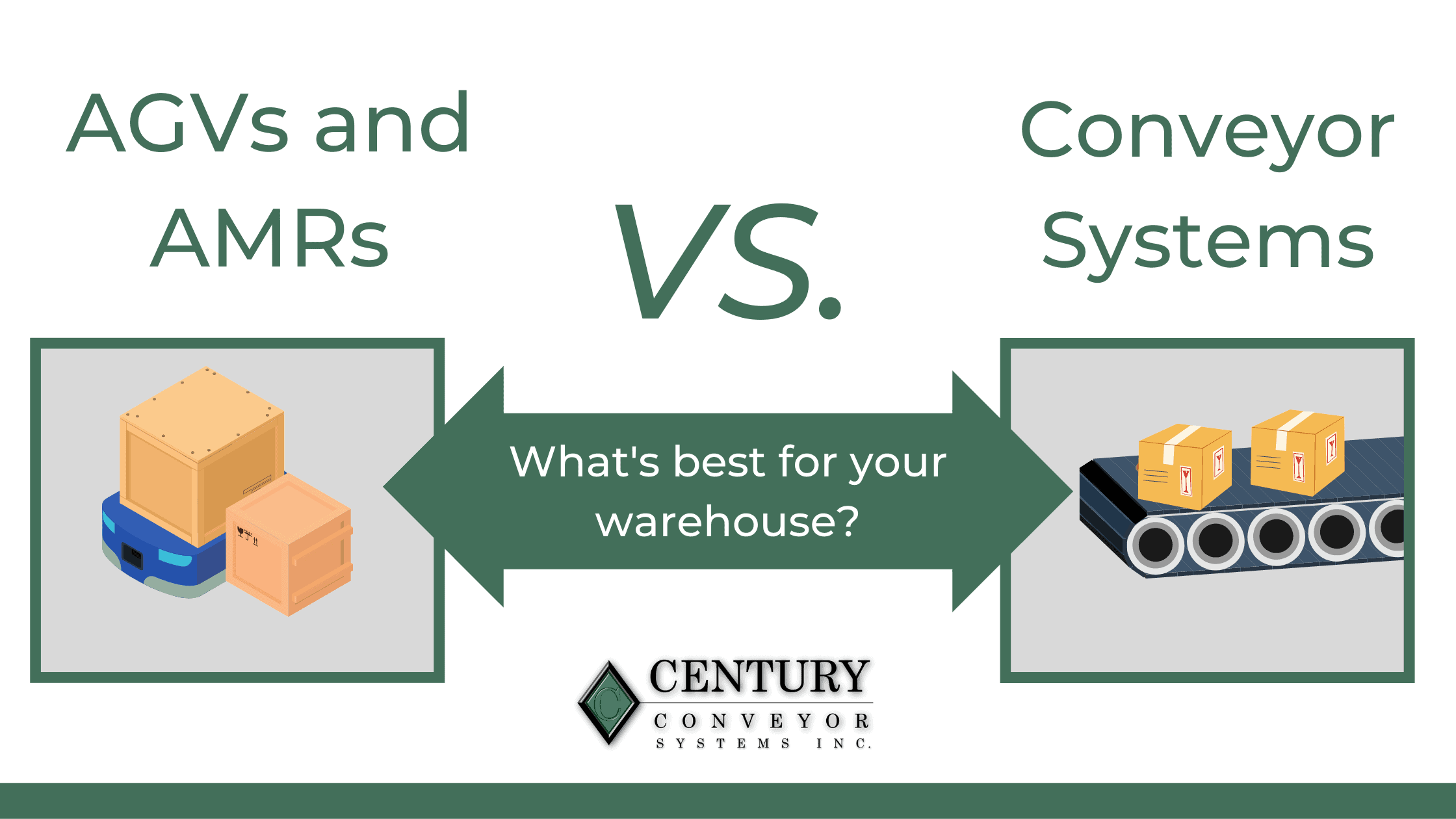
agv and amr vs conveyor system comparison blog post header image

Automatic Guided Vehicles (AGV) and Autonomous Mobile Robots (AMR) have existed for years now, offering robotic material handling operations for a multitude of warehouse operations. The industry is well aware of its pros and cons, and supply chain executives are content with placing them within their arsenal of automated warehouse solutions.

The much harder decision when automating is understanding which solution will provide the most benefit, as opposed to if it will at all. In the case of AGVs and AMRs, conveyor systems are tried and true forms of automation that continue to provide exceptional output and return-on-investment. While both solutions differ in engineering and functionality, both exist for the same goal- reliable, stable, and quick movement of items. How do AGVs/AMRs stack up against traditional conveyor systems? Where does one solution shine, while another does better in a different application?

Century has experience integrating both and understands where and how these systems outperform one over the other. We wanted to share some of our insights so you can evaluate what works best for your warehouse.


newsletter sign up element

AGV and AMR

AGVs and AMRs are often grouped together, mostly because the operations they perform overlap with each other. The single main difference between the two is its form of sensing and moving throughout the environment. AGVs move by using a sensor that follows a set path (typically a form of sticker or tape on the ground-hence the word “guided” in its name). AMRs move by sensing objects around them, and learning an optimal path (hence the word “autonomous” in its name).

This characteristic defines what operations are typically assigned to an AGV or an AMR. Essentially, AGVs work best at moving cartons and pallets across the facility with little to no variation in its traveling path. AMRs shine in picking operations, where it would not have a set path.

AGV


Effective in moving, tugging, and towing cartons or pallets from a single location to another.

  • Carts
  • Tuggers
  • Lift-Truck
  • Pallet Jack
  • Unit Load

AMR


Assistance in multi-variable operations that require diversion in movement paths.

  • Picking
  • Sortation
  • Inventory Control
  • Sanitization

AGVs and AMRs have seen expanded use over the course of the past year, and most new warehouses are built with the notion that automation will be implemented at some point. According to Research and Markets, United States, Germany, U.K., China and Japan are going to lead the market with an annual demand of more than 200,000 mobile robots (AGV & AMR) by 2026.

To put the cost-effectiveness of an AGV and AMR into perspective, Annual costs for a forklift operator can run up to $50,000. If a forklift has to be operated around the clock, then at least 3-4 drivers are needed. Adding the invest costs of $10,000 for a forklift truck to the personnel costs, the annual costs for one forklift come to over $200,000 (ResearchAndMarkets.com). Depending on the output of the warehouse, operating AGVs and AMRs can save thousands over traditional manually operated lift trucks.

Automated robotic solutions continue to improve as newer technologies are created and adapted. Artificial intelligence (AI), machine vision, voice-to-robotic-pick, and warehouse data-driven learned actions continue to provide added functionality and benefit to AGVs and AMRs (primarily the latter). This makes AGVs and AMRs a forward-facing implementation, as abilities are added to their repertoire of functionality through the advancement of warehouse technologies and software capabilities.

Conveyor

Conveyor systems are the typical solution of any automated operation, offering a continuously moving assembly line to quickly complete the processing and distribution of a package. Conveyors use belts or rollers to move cartons or pallets, powered by motors. Each warehouse that employs conveyors has a specially engineered layout, consisting of a variety of conveyor sections, depending on function.

Conveyor Section Types

  • Infeeding
  • Straight
  • Curved
  • Incline
  • Decline
  • Divert
  • Merge
  • Switch
  • Outfeeding

Conveyors produce the best results when implemented in fast-moving post-production operations such as order fulfillment, product distribution, sortation, and crossdocking. Conveyors are highly customizable, with the number of systems that can be added to the conveyor line spanning from carton forming to in-trailer loading, and everything in-between. Conveyors have proved the test of time as being the main system of reliable and quick movement in a warehouse. There’s a reason they’re still in use for over 100 years. The output rate is unmatched and its simplicity in design help it to easily integrate with other cutting-edge automation solutions.

The Most Important Factor: Your Warehouse

If you were to ask us what system we would use, we would ask “what’s your warehouse like?”. This is the number one question you should ask yourself as you’re exploring solutions. The effectiveness and benefit of these solutions are only relevant if integrated correctly in your distribution center, warehouse or facility.

To simply it even further- think on your answer to this question. Can your operations continue effectively if you install a “bolted-down” conveyor system. If the answer is a definite “NO”, then you’ll most likely benefit more from the use of AGVs and AMRs. A fully engineered conveyor system is not mobile, and if your warehouse has limited space, or needs open lanes for lift trucks to travel in, a conveyor system may not be ideal. That’s not to say it’s impossible to engineer, but an AGV or AMR would be a more realistic solution.

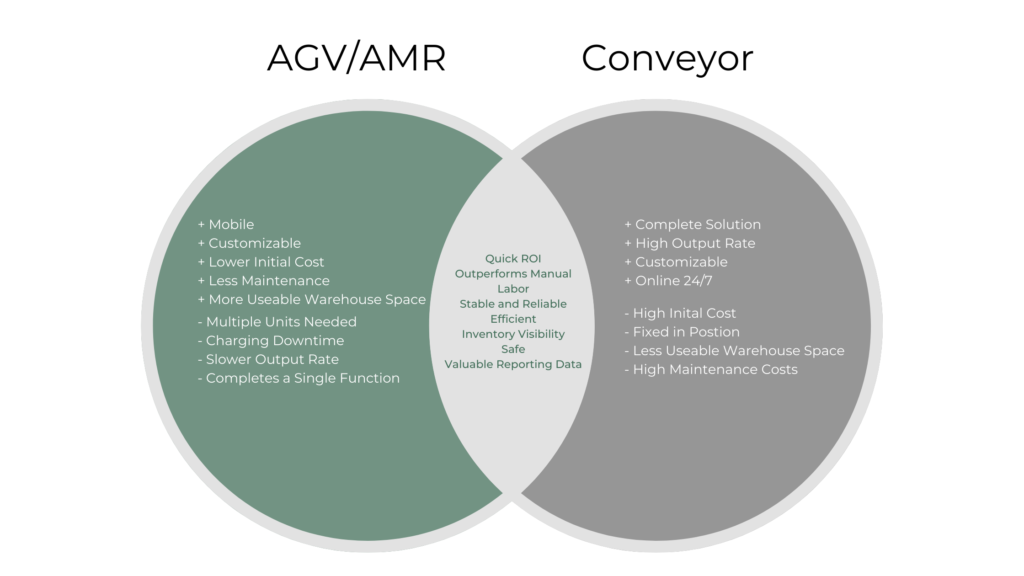
With that in mind, here’s our comparison between AGVs/AMRs and conveyor systems.

The Comparison

AGVs AMRs Vs Conveyor

Key Takeaway

Both systems will complete the task of transporting product across a warehouse, it’s that your operations and facility space will determine which one will work better.

AGVs/AMRs are ideal for warehouses that have:

  • Limited space and cannot install a conveyor system.
  • Extensive pick operations
  • Forklifts transporting the majority of items
  • A healthy output rate (5,000 to 20,000 cartons shipped per day)

Conveyor systems are ideal for warehouses that have:

  • Flexible space arrangements
  • A variety of package types
  • Extensive sortation operations
  • A high-output rate (20,000+ cartons shipped per day)

Both AGVs/AMRs and conveyors can benefit in more ways than one, and in many cases, are both implemented in a facility to maximize distribution operations.


century conveyor boilerplate element

7 Conveyance Solutions for Robust Handling of Various Product Types

ARB Solutions 2

Conveyor systems are versatile machines, working in tandem with a variety of material handling solutions, ensuring increase output and productivity. Besides the additions of machines in conjunction with a conveyance solution, there exists extended automation for the conveyor system itself.

Belting plays a critical role in how the product moves throughout the system, but typically, most operations use either a roller conveyor or a flat belt. What many do not realize is that belting can be upgraded to automatically position cartons in a way that simplifies various induction steps in the line.

ARB (Activated Roller Belt) technology revolutionizes the way a conveyor system functions by offering automatic aligning and positioning, precise gapping, high-speed sortation and diversion, uniform operator station package distribution, and more.

ARB equipment performs a variety of different functions on the product by utilizing free-spinning rollers that are embedded in plastic belt modules. The rollers can bi-directionally manipulate products in a variety of different angles and trajectories. The rollers can be bi-directional or omnidirectional depending on the usage of that specific belt space. The rollers reorientate themselves rapidly depending on the destination of the package.

ARB equipment can provide substantial throughput benefits while providing a quick return on investment by eliminating time-consuming manual labor and being flexible enough of a solution to apply to a variety of operations.

  • Sortation
  • Depalletizing
  • Singulators
  • Merges
  • Switching
  • Zone Picking
  • Infeeding and Outfeeding

1. Sortation Systems

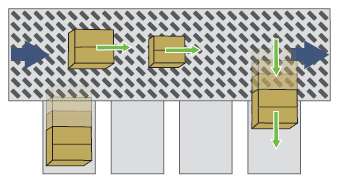
DARB S4500 Sorting Belt

90-degree sortation

Bi-directional right-angle sortation that activates the belt rollers when the carton reaches its divert destination. This form of sortation is high speed, with rates up to 250 packages a minute, in a compact footprint. If your facility distributes a variety of packages, this sortation method can accommodate polybags, crates, top-heavy items, and more, along with typical flat-bottomed cartons.

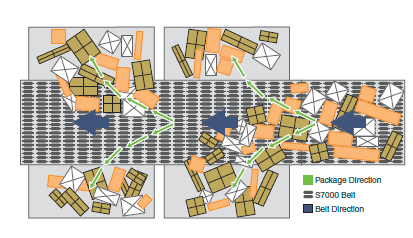
ARB Sorter S7000

Bulk sortation

In facilities where a continuous flow of a mix of bulk packages is present, ARB equipment can be employed to sort an even volume of packages for downstream processing (operator stations, for example). Due to the bulk nature of the continuous induction, sortation rates can achieve up to 360 packages per minute, automatically avoiding jams.

2. Depalletizing Systems

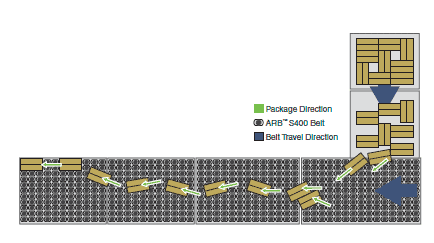
ARB Pallet Layer Descrambling S400

Depalletizing can be a laborious operation if done manually. With ARB equipment in use, omnidirectional track rollers can descramble up to 6 pallet layers per minute and place them in a uniform line, ideal for scanning or picking. By alternating packages left and right on the ARB conveyor, and using the side railing as a guide, packages line up neatly for downstream applications.

3. Singulators

ARB Singulating Belt

Singulating, in this context, means to place the items in a single, congruent line. Depending on induction rates, this could be a continuous line, or broken up into segments (for example, one segment having four packages). ARB equipment moves the undistributed packages from left to right to acquire a straight line, using the railing of the support to gently align the items. This eliminates the need for manual clearing of side-by-sides, recirculation due to miss-sorts, and enables workers to place items on without concern for positioning.

4. Merges

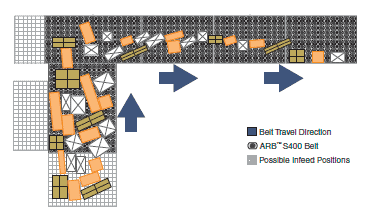
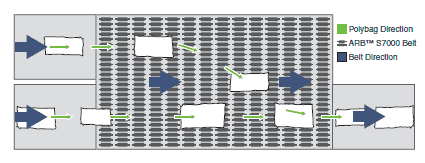
Polybag ARB Merging

Polybag merging

In a polybag-focused operation, reliable merging from multiple infeeds is paramount to downstream processes. ARB conveyor solutions merges infeed conveyors with a high-speed directional belt, while maintaining gapping, and alignment, for later scanning and sortation operations. All of this is completed in a relatively small footprint, as an ARB conveyor is designed to quickly merge the lanes.

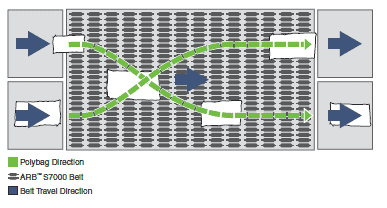
5. Switching

Polybag Switching and Aligning

Polybag destination switching

If lanes are not merging, but instead, crossing polybags over each other to their reach their destination lane, an ARB conveyor solution can achieve this efficiently. Much like the merging ARB conveyor, omnidirectional rollers quickly switch polybags into their respective destination outfeeds, while maintaining proper gapping and alignment.

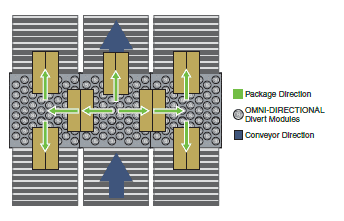
6. Zone Picking

Zone picking

Pick and pass order fulfillment zones can also benefit from ARB equipment inclusion. Manual picking stations can be added to a central conveyor merge, utilizing an omnidirectional sorter to easily pick packages from the main line to be processed, and then re-introduced back to that same conveyor. Order fulfillment can be completed at rates greater than 25 packages per minute, and only needs one 24-volt motor to drive the rollers.

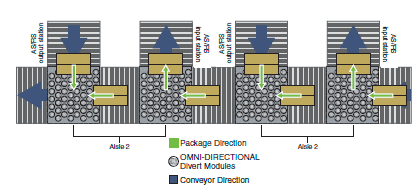
7. Infeeding and Outfeeding

Infeeding and Outfeeding ARB

Used in conjunction with an automatic storage and retrieval system (AS/RS), this ARB conveyor combines both infeeding and outfeeding operations. Packages can both be sent to storage, while simultaneously accepting packages coming from storage. This is achieved by utilizing omnidirectional sorters in conjunction with right angle diverters, with alternating flow directions that activate depending on the carton’s destination. Sortation can achieve excess of 30 packages per minute, while infeed/outfeed rates to an AS/RS can reach 1,800 cases or totes per hour.

Intralox equipment has been successfully implemented by retail, grocery, manufacturing, and direct-to-consumer e-commerce distribution centers. The technology brings value in many applications ranging from high-speed 90-degree sorting to AS/RS infeeding and outfeeding. From increased throughput to flexible package handling and efficiency, Intralox’s conveyance technologies pick up where traditional technologies end.


Century is a longtime partner and integrator of Intralox, utilizing its innovative ARB equipment technologies throughout a wide range of clients. Together, a truly efficient system can be designed, engineered, and installed to increase output, accuracy, and ROI.

Post-COVID Parcel Customer Expectations

parcel industry customer expectations blog post header

How automation solutions fulfill today’s parcel shipping demands

post covid parcel expectations automation solutions

Parcel delivery expectations have increased exponentially, exacerbated by the effects on consumers of the pandemic, and the movement of large E-commerce players offering 1-day or even same-day shipping. Consumers expect quick shipping in comparison to a decade ago when a speedy delivery was a premium option.

In a recent report by McKinsey & Co., online product categories have experienced a 15% to 40% increase in user growth during 2020. That increase of users means higher expectations for faster shipping speeds, and in turn, carriers and shippers will be expected to offer and fulfill such services.

To accommodate the demand, automation has been utilized to rapidly speed up processing and sortation operations. Forgoing manual labor opens the door to quick shipment offerings, a tantalizing benefit to any prospective client. Automated solutions typically depend on the conveyor and divert systems, which need to be versatile enough to handle small parcels like letters and polybags, to larger carton packages. Belt conveyors are used, versus roller, as smaller items could get stuck in between rollers if the weight is undistributed across incorrectly. Where automation differs, is in its sortation method:

Tilt-tray

Tilt-tray sortation uses order consolidation chutes to sort items in a batch-pick environment. Cartons are scanned before being inducted onto a tilt-tray carousel, where it will sit on a moving platform until it reaches its destination chute.  The tray will tilt either left or right depending on where it’s being sorted and slide down a chute onto a conveyor to be loaded.

Tilt-tray applications are effective for high-speed sortation.

Cross-belt

Functioning similar to the tilt-tray, cross-belt sortation differs by using bi-directional belts to divert items into destination chutes. Packages are inducted onto the cross-belt conveyor carousel and sorted accordingly. Each belt section can hold one package, but multiple belt sections can be combined and used in tandem to divert larger items.

Narrow-belt

A series of narrow belts, each with its own take-up, span the length of the conveyor. High friction divert wheels rise between the belts, diverting product to its destination.

Narrow belts are typically used for larger, heavier packages that need heavy-duty forms of sortation. Smaller packages would not be ideal for this application, as they would fall in-between the belting segments.

Shoe Sorter

High-speed sorter utilizing aluminum slats that have plastic shoes that slide across them to divert cartons either left or right (bi-directional) to required sort destinations.

The advantage this provides over the similar functions of the tilt-tray is that the shoe is incorporated as part of the central induction conveyor. This eliminates the need for a separate sortation application, like the aforementioned tilt-tray carousel.

Split-tray Sorter

Sometimes also referred to as a bomb-bay sorter, dual split tray sorters have the ability to sort two smaller items within the same tray, at higher throughput speeds.

Split-tray sections have a bottom platform that opens to drop items gently into chutes, totes, or cartons below. This method is space-saving, as the item discharge area drops below vs being conveyed.

Swivel Wheel Sorter

Swivel wheel sorters utilize a platform of omni-directional rollers to divert items quickly. When a product reaches the divert, the wheels orientate to direct the item to its destination. This sortation method works best for systems that have a conveyor junction, rather than a gradual merge or curve.

Push-tray Sorter

A high-speed sorter with tray segments utilizing a positive divert to gently push items or polybags off the tray and slide them into a sortation chute.

Depending on the dimensions of the parcel processed, each conveyor sortation method varies slightly, and one solution may work better than another one. It’s a function of careful engineering and planning to discover which one would work best. Regardless, any conveyor sorter will far exceed manual labor.

Parcel Customer Expectation

pullquote graphic parcel industy automation

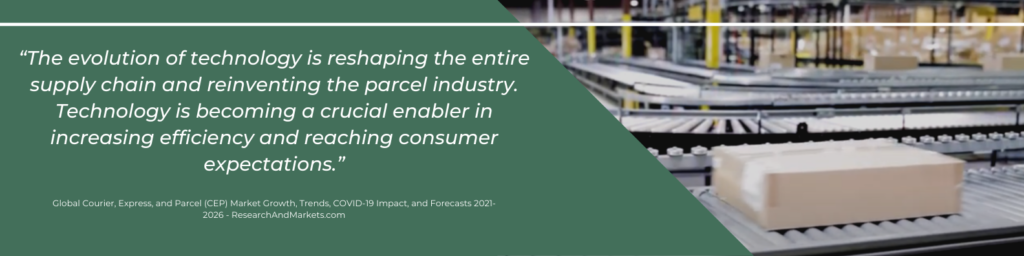
Mainly attributed to the increase in e-commerce usage, the courier, express, and parcel (CEP) market is expected to exhibit a CAGR of over 6% from 2021-2026 (source). To adjust to this substantial demand increase, automation and technology are taking center stage to provide future solutions. Parcel distributors have their work cut out for them, as operations need to accommodate for the increase, as well as deliver to customers within 1-2 days.

ShipStation’s report “Last Touch, Lasting Impact” highlighted insightful statistics in how consumers view various topics concerning shipping. A few pertaining to parcel shipping expectations include:

  • 86% say a poor shipping experience negatively impacts their perception of the retailer.
  • 87% say that shipping and delivery experience directly impacts their decision to shop with the merchant again.
  • 47% of customers are more likely to pay for express shipping now than they were pre-COVID.
parcel industry customer shipping expectation stats

Clients strive to uphold the best delivery experience for their customers, and that expectation extends to their parcel handling partner. Recurring slow shipping speeds and errors in sortation can spur negative consumer sentiment or increase returns, something clients work very hard to avoid.

The parcel industry is a constantly evolving sector, as automation technology continues to provide solutions for quick handling and delivery of packages. The post-COVID explosion of online shopping has led many forward-thinking parcel shippers to evaluate their current operations and develop an integration plan.


Century Systems understands how critical effective parcel operations are to maintain customer delivery satisfaction. Our primary focus is to engineer an automated solution that provides a profitable output and is curated specifically to your warehouse layout.

5 Economical Ways to Avoid Conveyor System Downtime

blog header for conveyor service and repair
system downtime blog graphic

Conveyor system downtime is a constant threat to a continuously profitable operation. The importance of proper maintenance and ongoing support is paramount to keeping orders shipped on time and clients satisfied. Unplanned downtime can cost companies up to $250,000 per hour, with 82% of businesses experiencing at least one system outage over the past three years (source).

system downtime costs quote

How do you avoid those monumental losses? Here are a few options your business can take to proactively prepare against downtime.

  • Preventative Maintenance Service Plans
  • Hotline Support Agreements
  • On-site Repair Services
  • Spare Parts Inventory Management Programs
  • System Retrofits & Modernizations

1. Preventative Maintenance Service Plan

Some systems run 24/7 and are vital to keeping your operations effective. With hundreds of moving parts and sometimes a complex controls network, it is inevitable something will need to be replaced or repaired, often at the worst possible time.

Avoid the costs and frustrations of downtime and schedule a system audit followed by a comprehensive quarterly, or bi-yearly preventive maintenance program.

A team of experienced certified technicians will walk through your system validating each unit/component, age and condition, available working hours, and more during the initial audit. An optimized Preventative Maintenance plan and associated cost will then be developed for review and implementation.

2. Hotline Live Support (24/7)

Certain integrators may offer live digital support, to guide your designated controls engineer to a solution. This can be achieved by using a VPN to remotely control your system, allowing the support agent to view all error codes, make corrections, and guide your team accordingly.

For example, if an emergency stop cord is pulled, it is a relatively easy fix via the control system, but only if your controller can identify the issue. Instead of sending out a maintenance team, a support agent can remotely clear the codes and restore the system quickly.

When contracting with an integrator, ensure that they have this service as part of the proposal. Century Conveyor Systems includes a year of hotline support with every solution purchase, as well as multi-tiered options depending on the complexity.

3. On-call Emergency Repair

System downtime can occur due to factors often outside the control of normal operations. Life cycle wear, operator errors, power fluctuations, etc. cannot be predicted from an occurrence perspective. Even with an internal maintenance team, a specialist may be needed to address and remedy the situation.

Century can dispatch a team of certified technicians to your location in 24-48 hours and when layered with a Hotline Support Agreement, may even be able to resolve the problem within hours.

Our emergency repair service is within a call away as a safety net in the event of a system failure.

4. Spare Parts Optimization Programs

Downtime is typically the issue of a single component failing, bringing operations to a stop. Like a chain, if one link is broken, nothing works. Now you are scrambling to order a new part from the manufacturer, and then need to get it installed. Unfortunately, depending on the part, you could be waiting weeks or even months.

The solution? Allocate some space in your warehouse (ideally a small section of shelving) towards spare parts. Proactively order components and replenish anything that is used. This can span from common cables and photo eyes to large motors and compressors.

The upfront cost of a spare part is negligible compared to the monetary loss of a system shutdown until the part is received and installed.

If you’re looking to stock up on spare conveyor parts, we may be able to help out.

5. System Retrofits and Modernization

The business drivers of a facility operation are constantly changing with things like labor shortages, SKU proliferation, and the shift to e-commerce fulfillment changing order profiles and product handling requirements. This often requires adjustments to existing systems to accommodate these changes.

Technology is always advancing very rapidly in the material handling industry. Automation is constantly being upgraded to something faster, more efficient & accurate providing improved throughput and functionality.

As demand for distribution efficiency increases due to many influencing factors, now may be the time to evaluate your system. Adjustments can be made piecemeal to keep overall system costs lower, but still benefit the functionality and efficiency of your system.


Don’t find your operations stalled and unable to produce the scheduled output. Build a maintenance plan, explore support and emergency options, keep a spare parts supply stock, and retrofit older systems. Century Conveyor Systems is dedicated to the integrity of your operations. We offer all these services and more as a full-service automation integrator. Bring us your problems and we will work towards an innovative solution, together.