Ahead of the Trend: The Rise of eCommerce in the Wine and Spirits Industry

rise of ecommerce in wine and spirits industry blog header image
rise of ecommerce in the wine and spirits industry blog header image

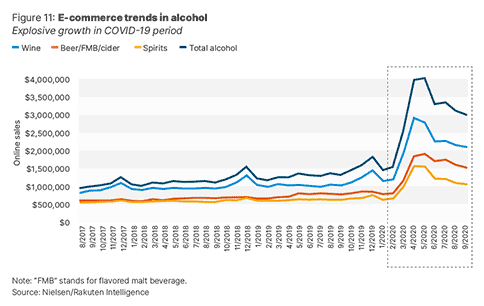
Online sales directly to the consumer in the wine and spirits industry used to be a tiny niche, compared to typical distribution methods, but the newest trend, fueled by COVID, is anything but.

In 2020, bars and restaurants shut their doors, leading consumers to make the decision to shop online. U.S. E-commerce sales of alcohol increased more than 80% in value during the pandemic (IWSR). A year later, the sales have plateaued, but are still 15% to 20% higher than pre-pandemic levels. Consumers turned to online shopping because of an external factor, and a surprising number have stuck around after that factor has been eased.

Online liquor stores have seen increases in sales, spurring investor interest. Last February, Uber purchased Drizly for $1.1 billion (Barrons). Consumer interest is certain to increase in eCommerce purchasing as users adopt the buying behavior, and experience the benefits over traditional liquor store visits. Along with Drizly, a few other online liquor stores run in the races, including:

Uptown Spirits

ReserveBar

Thrive Market

Wine.com

Bright Cellars

Nestor Liquor

Minibar

Flaviar

Wine.com

How does this affect the wine and spirits industry? Supply chains will have to accommodate for order fulfillment, that is having the necessary material handling solutions in place to ensure an order gets packed, labeled, and sorted to its end destination. This is quite different from what is typically processed in a wine and liquor distribution operation.

Cartons (usually packed within 6 bottles) are sent to be palletized or loaded in a truck, which makes deliveries to liquor stores, bars, and restaurants. With an online order, each package is customized and can contain a variety of items (kitting).

Wine and liquor warehouses will have to store individual items, accurately pick and pack them, apply a shipping label, and send them to the customer’s doorstep safely and within a few days’ time.

Integrating order fulfillment is a carefully planned and engineered project, but the long-term growth and profits will dwarf the initial investment once implemented fully.

Order fulfillment is one of Century’s specialties. We’ve had experience in the past engineering systems specifically for eCommerce operations, and we’d like to pass along our recommendations on the solutions that are used.

1. Storage and Pick Modules

Managing a fully stocked wine and spirits warehouse can get complicated when a large variety of products are offered. This creates a need for both short-term and long-term pallet storage. Automation in the form of an ASRS (automatic storage and retrieval system) can rapidly retrieve pallets that need to be distributed or store long-term inventory in the most optimal spot within a racking system.

An ASRS uses a crane attached to a horizontal and vertical track, scaling the racking structure, and using extendable forks to handle pallets. The operator terminal provides information on what product is stored where, and the ASRS operates when a retrieve or store command is inputted.

2. Conveyor System

A tried-and-true conveyor system will be the most accurate, simple, and efficient solution for a wine and spirits warehouse. Conveyors are dynamic in the sense that there are hundreds of additional solutions that can be integrated in the layout. Being highly customizable, each conveyor system is engineered according to the layout of the wine and spirits operation.

In the wine and spirits industry, the key to stable operations is ensuring cartons avoid damage. A zero-pressure accumulation conveyor (like this conveyor, manufactured by Hytrol) does not allow cartons to touch, by properly maintaining space between each and stopping the rollers when the accumulation zone is full. This is especially important when fulfilling specific customer orders that may include unevenly sized items.

3. Pack Tables

In order fulfillment, stations are positioned at infeeding operations so that orders can be packaged and sent to a label application. A worker or autonomous robot picks the products and brings it to a pack table. The worker checks to ensure that the order is correct in places in any invoicing documents, and places the items in the package with void-fill.

Pack tables are simple to integrate, and sit aside a main conveyor, so that workers can simply push orders from their tables onto the conveying surface.

4. Print and Apply Stations

Affixing identifiable tags on packages is crucial to ensuring their deliverability. Scanners and sensors across the line depend on a readable tag for it to make it to its destination. Print and apply systems do exactly that. However, there are multiple systems depending on the identification process use and where the box must be marked. Applications can roll-on, wipe over, corner wrap, air blow, and stamp labels.

The direction the box must be scanned also plays a role in a solution selection, but it will outpace manual operations regardless.

5. Sortation

Sortation systems separate products for induction into individual lanes typically associated with an outbound destination. Various types of sortation and conveyor systems are often connected to comprise a fully functioning material handling solution.

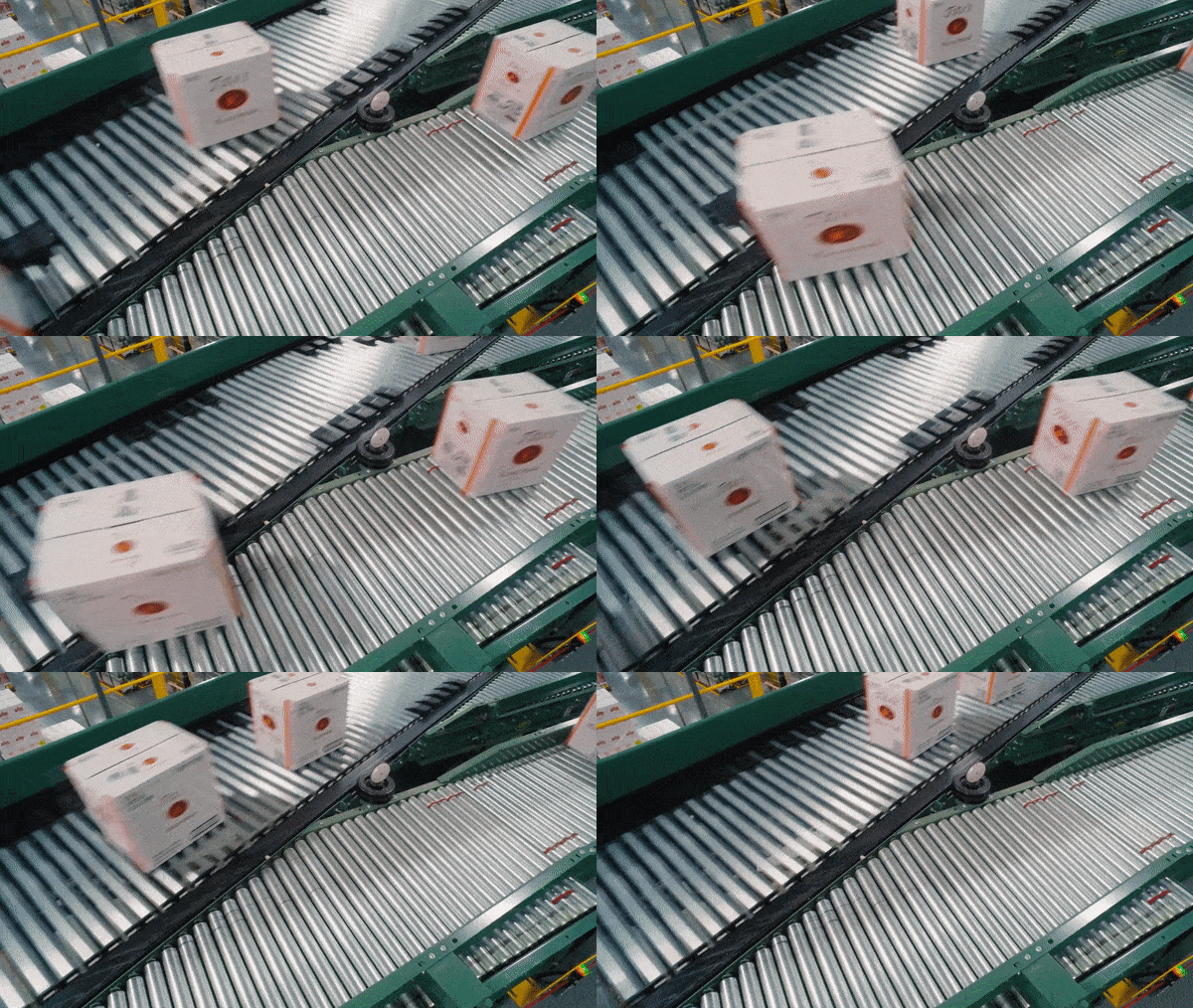
The type of sortation integrates highly depends on what product is being moved. For a fragile wine and spirits operation, care must be taken in selecting a stable method of diverting the packages. Sliding Shoe and Narrow Belt sorters are best suited for safely, yet quickly, sending items to where they need to be.

narrow belt sortation
Narrow belt utilizes thin belts so that rising directional skate wheels activate when a package is to be diverted down a destination lane.

sliding shoe conveyor sortation
Sliding shoe uses segmented plastic slats that gently divert cartons to an outfeeding conveyor.

6. Warehouse Management System

The ability to have complete visibility of your warehouse inventory at all times is paramount to operating effectively. A warehouse management system (or WMS) stores vital information such as alcohol percentage, storage location, best-by dates for rotation, and a multitude of SKU data for ordering. A WMS can even offer a best shipping rate selector and presents data with correct state alcohol regulations applied.

Besides being a source of important product information, a WMS can apply that information within your warehouse operations. For example, if the wrong item is picked and placed on an outbound conveyor, the scan tower will read the label and the WMS will recognize it is in the wrong batch, stopping that section of conveyor and sounding an alarm for a worker to remove the incorrect item.

7. Reverse Logistics

Returns are a constant area of disconnect in operations when it comes to order fulfillment. There needs to be a planned intake process to return the items to storage and re-fulfill the order with the correct products.

When returns enter back into a warehouse, they’re put in a separate staging area. Depending on the condition of the item, or whatever the nature of the return is, it may be returned to inventory, sent to another distributor who sells discount items or discarded.

Once a return item has been rescanned in the system, the customer’s order will either be marked as fulfilled (so they can receive their money back) or another order will be placed (in the event they were sent the wrong item, but they still need the correct item sent to them).


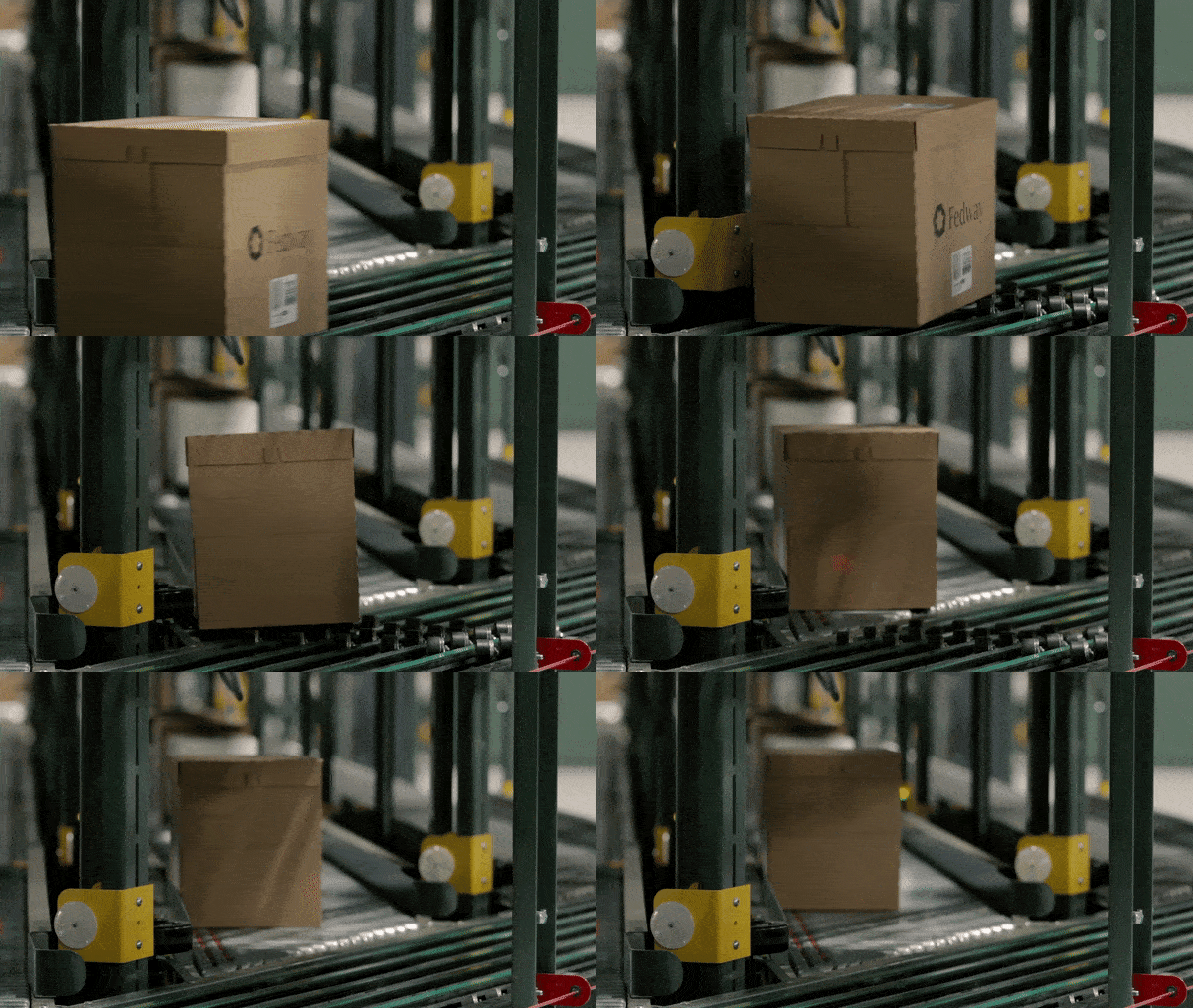
Century Systems has extensive experience in integrating warehouse automation systems in the wine and spirits material handling industry. View the video below on a system we engineered and integrated with Fedway Associates.

7 Efficient Automation Solutions for Wine and Spirits Distribution

wine and spirits warehouse solutions for distribution blog post

Distributing wine and spirits is a delicate and demanding operation. Warehouses are expected to process, store, and fulfill a massive catalog of products to a wide portfolio of clients, all with their own special requests. An operations employee in a distribution warehouse has their work cut out for them, as the constant supply and demand fluctuates depending on a multitude of factors like seasonality, geography, product timing, and more.

Investing in an automated wine and spirits warehouse solution can absolutely support operations in more ways than one, moving product safely, quickly, and where it needs to be. Evaluating current warehouse operations is certainly a smart move, especially considering the status of the wine and spirits industry now, and in the near future.

figure 11 new 484x306 2

“We believe there is a permanent consumer shift to more online purchases of wine, which will expand with the coming of age of millennial consumers.”

SVB: State of the Wine Industry Report 2021

To help in your evaluation, here are 7 cost-saving and effective warehouse solutions that’ll support your wine and spirits distribution operations.

1. Labeling and shipping costs

Correct labeling of alcoholic beverages is not only important for delivery operations but needed for state alcohol regulations and the associated shipping costs. Recurring mislabeling can incur hefty fees and make distribution a headache. Automated print and apply systems can streamline these processes and lower error rates and are relatively easy to add to a warehouse operation. Labeling machines produce the correct shipping information and apply the label by stamping it as the carton passes by, without the need to pick up or stop the product.

2. Warehouse Management System (WMS)

The ability to have complete visibility of your warehouse inventory at all times is paramount to operating effectively. A warehouse management system (or WMS) stores vital information such as alcohol percentage, storage location, best-by dates for rotation, and a multitude of SKU data for ordering. A WMS can even offer a best shipping rate selector and presents data with correct state alcohol regulations applied.

Besides being a source of important product information, a WMS can apply that information within your warehouse operations. For example, if the wrong item is picked and placed on an outbound conveyor, the scan tower will read the label and the WMS will recognize it is in the wrong batch, stopping that section of conveyor and sounding an alarm for a worker to remove the incorrect item.

3. Direct to consumer wine and spirits shipping

The prevalence of direct-to-consumer (D2C) wine and spirits services continue to grow, with wine clubs, subscription boxes, alcoholic beverage delivery, and other flexible solutions becoming more common with consumers. If you are looking to expand your consumer base, investing in a D2C approach early can prove proliferous in the near future. Order fulfillment automation solutions are versatile enough to fit within any step of your operation, ranging from automatic item picking to shipping label application. The importance of effective packing operations to avoid breakage should also be considered. Careful selection of package erecting, sealing, and void-filling machines are all a part of integrating a wine or liquor order fulfillment warehouse process.

4. Gapping and breakage reduction

An unfortunate truth of the wine and spirits distribution industry is that product breakage can and will happen. All you can do in your warehouse is minimize it. An effective method of doing so is using a zero-pressure accumulation conveyor. These gravity conveyors do no allow products to touch each other, using an array of sensors to properly gap infeeding operations, and stopping when the accumulation zone is full.

To increase product safety, a herringbone (canted rollers) design can be used to avoid product from making contact with side railing and guards. For even more stability, a cascade release function can be implemented, which staggers conveyor zones as product begins to move. This provides a small gap between each product when operations start and stop.

5. Storage solutions for reserves and limited run beverages

Managing a fully stocked wine and spirit storage can get complicated when limited run products and desirables vintages are concerned. This creates a need for both short-term and long-term pallet storage. Automation in the form of an ASRS (automatic storage and retrieval system) can rapidly retrieve pallets that need to be distributed or store long-term inventory in the most optimal spot within a racking system. An ASRS uses a crane attached to a horizontal and vertical track, scaling the racking structure, and using extendable forks to handle pallets. The operator terminal provides information on what product is stored where, and the ASRS operates when a retrieve or store command is inputted.

6. Cross-docking for quick sortation and delivery of non-stored items

Cross-docking is a warehouse operation that processes items, sorts them to the correct location, and sends them right back out for transportation. Packages are introduced and sent to their destination route quickly and efficiently without storing or spending more than 24 hours in a cross-docking operation.

For high-volume wine and spirit warehouses, this method provides extremely effective in getting product to stores or delivering to customers.

7. Flexibility in handling a variety of packaging types

Wine and spirit companies are innovating in specialty packaging types to attract customers in a constantly competitive product environment. Coupled with the growing sales of cannabis, companies are investing a significant amount in resources to ensure their product stands out.

Wine and spirits warehouse distribution operations must be dynamic enough to maintain current clients and attract new ones who have packaging designs that call for special handling. Automation systems, such as conveyors, are manufactured in different dimensions and applications and can be engineered in a warehouse layout to accommodate cartons of varying sizes and fragility.


Century Systems has extensive experience in integrating warehouse automation systems in the wine and spirits material handling industry. View the video below on a system we engineered and integrated with Fedway Associates.

7 Conveyance Solutions for Robust Handling of Various Product Types

ARB Solutions 2

Conveyor systems are versatile machines, working in tandem with a variety of material handling solutions, ensuring increase output and productivity. Besides the additions of machines in conjunction with a conveyance solution, there exists extended automation for the conveyor system itself.

Belting plays a critical role in how the product moves throughout the system, but typically, most operations use either a roller conveyor or a flat belt. What many do not realize is that belting can be upgraded to automatically position cartons in a way that simplifies various induction steps in the line.

ARB (Activated Roller Belt) technology revolutionizes the way a conveyor system functions by offering automatic aligning and positioning, precise gapping, high-speed sortation and diversion, uniform operator station package distribution, and more.

ARB equipment performs a variety of different functions on the product by utilizing free-spinning rollers that are embedded in plastic belt modules. The rollers can bi-directionally manipulate products in a variety of different angles and trajectories. The rollers can be bi-directional or omnidirectional depending on the usage of that specific belt space. The rollers reorientate themselves rapidly depending on the destination of the package.

ARB equipment can provide substantial throughput benefits while providing a quick return on investment by eliminating time-consuming manual labor and being flexible enough of a solution to apply to a variety of operations.

  • Sortation
  • Depalletizing
  • Singulators
  • Merges
  • Switching
  • Zone Picking
  • Infeeding and Outfeeding

1. Sortation Systems

DARB S4500 Sorting Belt

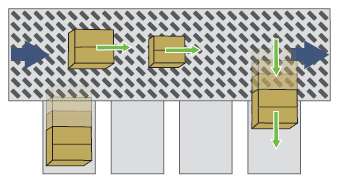
90-degree sortation

Bi-directional right-angle sortation that activates the belt rollers when the carton reaches its divert destination. This form of sortation is high speed, with rates up to 250 packages a minute, in a compact footprint. If your facility distributes a variety of packages, this sortation method can accommodate polybags, crates, top-heavy items, and more, along with typical flat-bottomed cartons.

ARB Sorter S7000

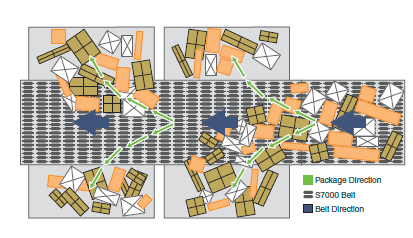
Bulk sortation

In facilities where a continuous flow of a mix of bulk packages is present, ARB equipment can be employed to sort an even volume of packages for downstream processing (operator stations, for example). Due to the bulk nature of the continuous induction, sortation rates can achieve up to 360 packages per minute, automatically avoiding jams.

2. Depalletizing Systems

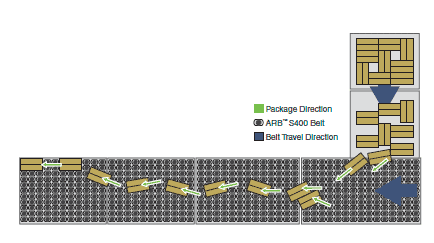
ARB Pallet Layer Descrambling S400

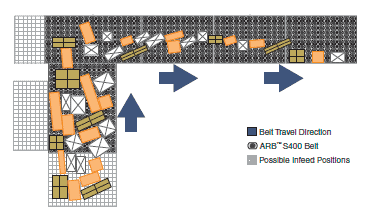
Depalletizing can be a laborious operation if done manually. With ARB equipment in use, omnidirectional track rollers can descramble up to 6 pallet layers per minute and place them in a uniform line, ideal for scanning or picking. By alternating packages left and right on the ARB conveyor, and using the side railing as a guide, packages line up neatly for downstream applications.

3. Singulators

ARB Singulating Belt

Singulating, in this context, means to place the items in a single, congruent line. Depending on induction rates, this could be a continuous line, or broken up into segments (for example, one segment having four packages). ARB equipment moves the undistributed packages from left to right to acquire a straight line, using the railing of the support to gently align the items. This eliminates the need for manual clearing of side-by-sides, recirculation due to miss-sorts, and enables workers to place items on without concern for positioning.

4. Merges

Polybag ARB Merging

Polybag merging

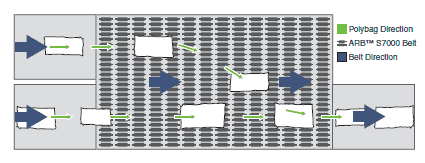
In a polybag-focused operation, reliable merging from multiple infeeds is paramount to downstream processes. ARB conveyor solutions merges infeed conveyors with a high-speed directional belt, while maintaining gapping, and alignment, for later scanning and sortation operations. All of this is completed in a relatively small footprint, as an ARB conveyor is designed to quickly merge the lanes.

5. Switching

Polybag Switching and Aligning

Polybag destination switching

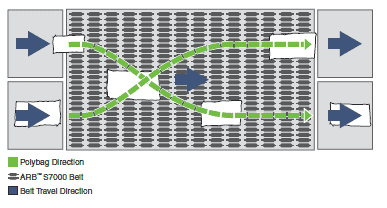
If lanes are not merging, but instead, crossing polybags over each other to their reach their destination lane, an ARB conveyor solution can achieve this efficiently. Much like the merging ARB conveyor, omnidirectional rollers quickly switch polybags into their respective destination outfeeds, while maintaining proper gapping and alignment.

6. Zone Picking

Zone picking

Pick and pass order fulfillment zones can also benefit from ARB equipment inclusion. Manual picking stations can be added to a central conveyor merge, utilizing an omnidirectional sorter to easily pick packages from the main line to be processed, and then re-introduced back to that same conveyor. Order fulfillment can be completed at rates greater than 25 packages per minute, and only needs one 24-volt motor to drive the rollers.

7. Infeeding and Outfeeding

Infeeding and Outfeeding ARB

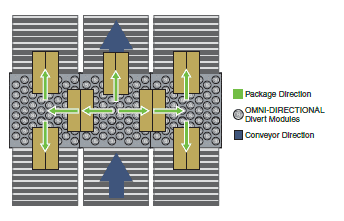
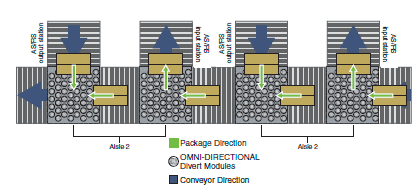
Used in conjunction with an automatic storage and retrieval system (AS/RS), this ARB conveyor combines both infeeding and outfeeding operations. Packages can both be sent to storage, while simultaneously accepting packages coming from storage. This is achieved by utilizing omnidirectional sorters in conjunction with right angle diverters, with alternating flow directions that activate depending on the carton’s destination. Sortation can achieve excess of 30 packages per minute, while infeed/outfeed rates to an AS/RS can reach 1,800 cases or totes per hour.

Intralox equipment has been successfully implemented by retail, grocery, manufacturing, and direct-to-consumer e-commerce distribution centers. The technology brings value in many applications ranging from high-speed 90-degree sorting to AS/RS infeeding and outfeeding. From increased throughput to flexible package handling and efficiency, Intralox’s conveyance technologies pick up where traditional technologies end.


Century is a longtime partner and integrator of Intralox, utilizing its innovative ARB equipment technologies throughout a wide range of clients. Together, a truly efficient system can be designed, engineered, and installed to increase output, accuracy, and ROI.